7639667
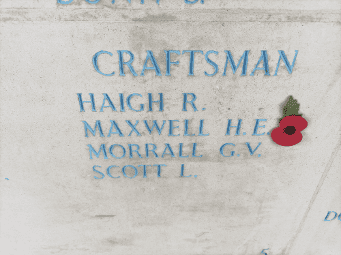
Horace Edgar Maxwell died of wounds on 14th June 1943 aged 23 while he was a prisoner of war in Thailand. He had served with the Royal Electrical Mechanical Engineers. His ashes are buried at Kanchanaburi War Cemetery.
Horace Edgar Maxwell, named after his maternal step uncle, Edgar Horace Reeve Toone, was born on 30th April 1920 at 28 Queen Street, Leamington Spa, son of David Henry and Alice née Chamberlain. Horace had one older brother Arthur Henry who was born in in 1913.
In 1927 when Horace was only 7 years old his mother died and he then lived with Arthur, his grandparents, Henry & Sarah and his father at 28 Queen Street. Upon leaving the Central School in Leamington Horace became a turner at Norman Engineering Co. Warwick.
On 25th July 1940 he enlisted into the Royal Army Ordnance Corps Territorial Army as a Private and attested at No 5 Training Battalion in Chepstow. He was described as 5’ 7½” tall, weighing 143 lbs with brown eyes and auburn hair. His girth was 37” with a 2½“range of expansion. His religion was Church of England and his medical grade B1.
Horace saw service at home until he was posted overseas to Malaya, embarking on 3rd January 1941. Sadly his father David also died very young aged 53 in June the same year. Horace’s brother Arthur went to live with their aunt and uncle Flo and Bill Pears at 1 Cliff Row, New Cubbington, Leamington Spa.
The Malayan Campaign to which Horace was sent was fought by Allied and Axis forces in Malaya from 8th December 1941 until 31st January 1942. It was dominated by land battles between British Commonwealth army units, and the Imperial Japanese Army with minor skirmishes at the beginning of the campaign between British Commonwealth and Royal Thai Armed Forces. For the British, Indian, Australian and Malayan forces defending the colony, the campaign was a total disaster.
Following bitter fighting, the last organised Allied forces left Malaya on 31st January 1942 and engineers blew a 70 ft wide hole in the causeway that linked Johore and Singapore. Japanese raiders and infiltrators, often disguised as Singaporean civilians, began to cross the Straits of Johor in inflatable boats soon afterwards.
In less than two months, the Battle for Malaya ended in comprehensive defeat for the Commonwealth forces and their retreat from the Malay Peninsula to the fortress of Singapore. Nearly 50,000 Commonwealth troops were captured or killed during the battle. The Japanese Army invaded the island of Singapore on 7th February and completed their conquest of the island on 15th, capturing 80,000 more prisoners, including Horace who was reported as ‘missing in Malaya’ the same day. The final battle before the surrender was with the Royal Malay Regiment at Bukit Candu on the 14th February 1942.
Horace was taken prisoner and forced to work on the notorious Burma Railway in Thailand close to the River Kwai. He was transferred into the Royal Electrical Mechanical Engineers as a Craftsman on 1st October 1942 and died of wounds on 14th June 1943 aged 23. The cause of death was given as cholera and his body together with those of 300 comrades was cremated and his ashes buried at Kanchanaburi War Cemetery, close to Special Memorial 9 M.4.
Horace was awarded the 1939-45 Star, Pacific Star, Defence Medal and War Medal 1939-45 for his services. He left £197 4s 4d to his brother Arthur in his will.
Horace’s step uncle Edgar Horace Reeve Toone, who was killed in World War I, is also commemorated on the Leamington war memorial.