
Leamington’s war memorial was designed by Birmingham sculptor Albert Toft, who was present at the unveiling ceremony with his wife. He had previously been the sculptor of the statue of Queen Victoria near the Town Hall.
Consisting of a 7-foot bronze statue of a British soldier, with reversed arms and erected on a 10-foot Cornish granite monument, it is a constant reminder to all who pass by of the sacrifice of the 546 men from the Royal Spa who died for King & Country.
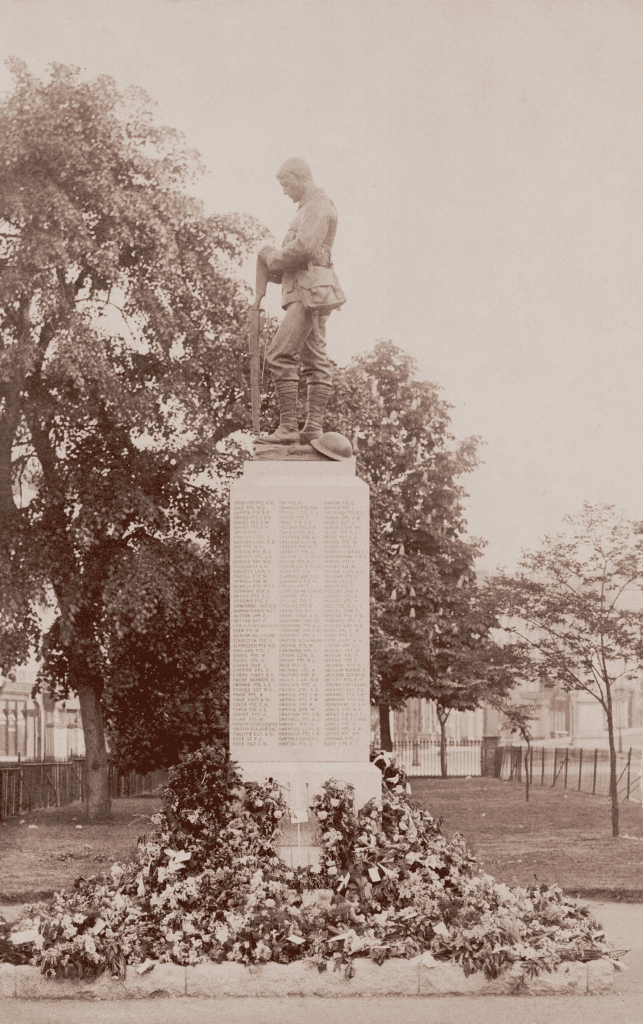
The Memorial was unveiled at Euston Place Gardens at 3.00pm on Saturday afternoon 27th May 1922 by Lieut-General Sir Aylmet Hunter-Weston, K.C.B, D.S.O, M.P. in the presence of 10,000 people.
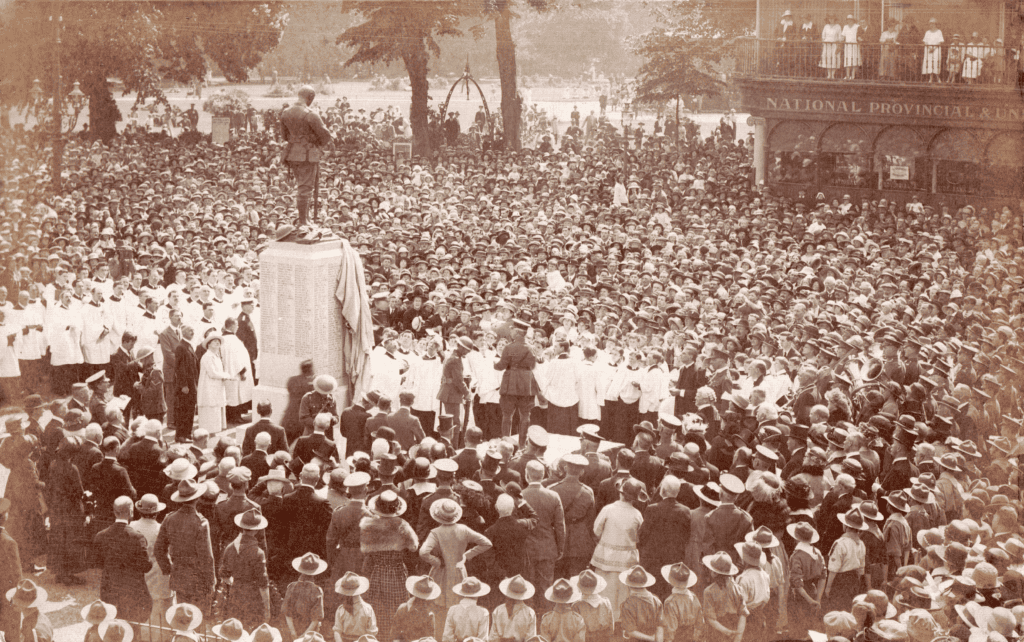
It is said that the town was like a deserted village as all the trades people suspended business following a request by the Chamber of Trade. Flags flew at half-mast on public buildings.
Relatives of the Fallen were accommodated in a special enclosure, together with ex-servicemen and another enclosure contained the subscribers to the memorial.
Four soldiers with reversed arms took up position at the four corners of the memorial.
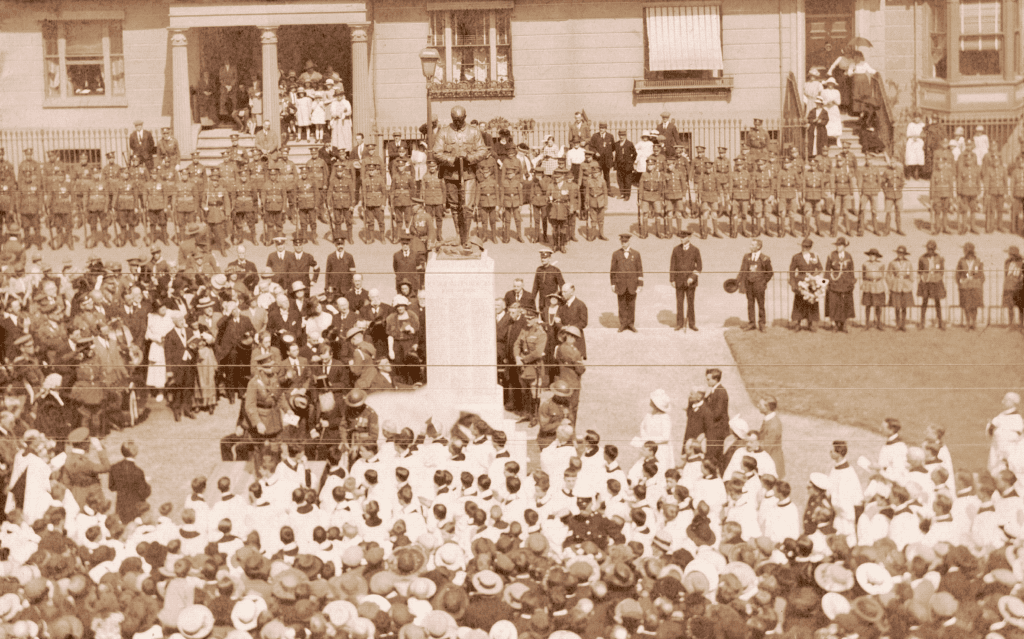
Lieut-General Hunter-Weston pulled the cord to release the Union Jack and unveil the memorial. As he did so, he said, “I unveil this Memorial in thankful remembrance of the men of the Borough of Royal Leamington Spa who gave their lives for King and Country in the Great War.”
This was followed by the order to the military to ‘Present Arms’. The General Salute was given and the buglers sounded the ‘Last Post’.
Lt. General Sir John Keir, Chairman of the War Memorial Committee said that there has been a certain amount of comment with regard to the statue which represented a soldier without head-dress.
He said, “We have not attempted to depict a soldier on parade, but one who is standing in an attitude of devotion to fallen comrades, and many will have seen soldiers so standing.”
The Mayor of Leamington, Councillor Kelynge England, on behalf of the Town Council, undertook the safe custody of the memorial.
He said, “The Council will regard it as a sacred duty to see that the memorial, containing as it does, the names of 546 Leamington men, is preserved intact for all time in the hope that it will serve the useful purpose of reminding us and those who come after us of the great sacrifices made by those noble fellows whose names are inscribed thereon, in order that we may live in peace and to inspire future generations with a spirit of true patriotism and a strong sense of duty to their King and Empire. It is a very easy matter to forget the past, and although the war is very vivid in our memory, this will not be the case a generation or two hence, so the memorial will be a constant reminder of the most awful conflict the world has ever known.”
In 1951 an additional area of the memorial was unveiled recording the names of servicemen who died during in 1939-1945. Subsequently names were added recording deaths relating to conflicts in Malaya, Korea, the Falklands and Northern Ireland. A separate plaque records the names of those killed during bombing of the town.
Allan Jennings