
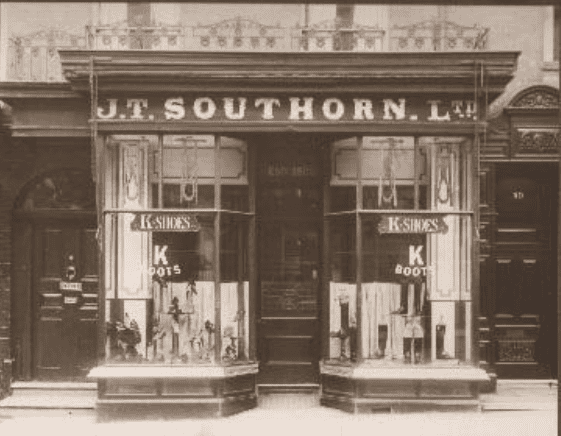
It was unthinkable at one time to buy shoes from anywhere other than shops just selling shoes. Every need was catered for from a selection of styles, sizes and colours for ladies, gentlemen and children. Service was a priority and assistants frequently climbed ladders to find the customer’s choice.
From Smiths in Clemens Street, along Bath Street and up the Parade there were shoe shops in abundance. Freeman Hardy and Willis had three, with one in Bath Street, one on the Parade and another along Regent Street. This was the shop that everyone knew with prices and quality to suit all pockets. Close behind in popularity was Stead & Simpsons with a branch in Bath Street and another opposite the Town Hall. Pughs was a small family business in Bath Street which closed in the 1960s.
Melvilles, in Victoria Terrace sold Clarkes shoes which were considered the best footwear for children. They had a special department and was the only shop in town that measured the child’s foot.
Progressing up the Parade we had Agers and Barratts and John Plant. A few doors away was Randalls which I remember as a child, with its tantalising window display of ballet and dancing shoes. Close together were Lotus, Englands and Southorns. The latter had been in the town centre since Victorian times, the makers of bespoke footwear for the gentry of a bygone era.
The early sixties saw the arrival on the Parade of Lilley and Skinner, Manfield and K Shoes, and next door to Woolworths was Collins. These stores were very popular with the youngsters who were looking for quality as well as the latest in fashion. I spent a lot of money in these stores and regretted their loss to the town.
Along Regent Street was Wyles, a family shoe shop. This shop took the Provident Cheque which was a boon for families with children. The same also applied to Aftons, a small shop along Regent Grove.
Slowly the smaller family owned shops faced closure with the import of cheaper styles from abroad. Chain stores started selling shoes, mostly on a self- selection basis, giving up the one to one customer service. Now it is commonplace to put a pair of shoes in the shopping trolley amongst the weekly groceries! With more affordable prices and changing fashions, repairs went by the wayside and we lost the Shoe Hospital under the Bridges and the smaller family-run cobblers around the town.
Now, if we want to buy shoes in town it is difficult to find the choice that we were familiar with half a century ago.
Tessa Whitehouse.
This article is reproduced from an LHG Newsletter