
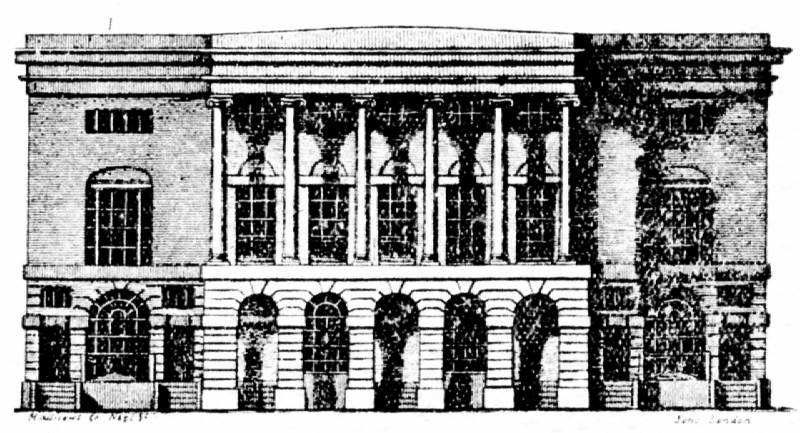
 As the village of Leamington Priors rapidly developed into a fashionable spa, the increasing number of visitors and residents required distractions other than simply taking the waters. Bath Street was at the hub of the initial development since most of the springs and the bath houses built around them were in that vicinity. By 1813 there were two bath houses in Bath Street, the New Inn provided hotel accommodation, and in 1814 a theatre was opened opposite Abbotts’ Baths by Mr John Sims. Two years later, Robert William Elliston a well-known experienced actor-manager, took over the lease. Not afraid of spending money, and seeing that more diversions were needed in the town, Elliston was soon planning another establishment. In 1821 he opened the building which he called the Parthenon, designed by Samuel Beazley, a prolific designer, writer and dramatist, known to Elliston from his Drury Lane days. The Parthenon stood roughly half way along Bath Street on the west side. It consisted of a central block with a smaller wing either side. It housed Elliston’s Library, also known as the County Library, and the Assembly Rooms, later known as the Lower Assembly Rooms, the Upper Assembly Rooms having been open since 1814 in the new town on the north side of the river.
Moncrieff’s ‘New Visitors’ Guide to the Spa of Leamington Priors and its Vicinity’, published in 1824 by Elliston, offered this description: “The façade of the building is at once chaste and imposing. A handsome and lofty arcade and colonnade of the Ionic order projects from the central division of the building and extends across the pavement to a width of 13 feet, while in length it comprises 42 feet. The arcade consists of 6 rusticated piers, arched and groined, over which is the same number of Ionic columns supporting a handsome cornice, frieze, etc. The whole has a remarkably classical and commanding appearance.”
On the ground floor was a suite of rooms about 100 feet in length, the entrance to which was through the central door. The first room was the Repository offering for sale stationery, drawing and writing materials, together with a well chosen selection of music. It also held a selection of fancy goods, both English and foreign, such as ivory articles, cutlery, perfumery, ladies’ work boxes, writing desks, toys, etc. There were also pianofortes for hire. From the Repository the visitor passed through an arched vestibule into the Library, which was decorated in classical style with drapery, busts, candelabra, sarcophagi, etc. It housed 12,000 volumes of all descriptions, and new works hot off the press were continually being added. Moncrieff extravagantly declared that its contents comprised works that “are not to be found in any other circulating library in the kingdom”.
From the Library a pair of folding doors led to a spacious Reading Room whose a stained glass French window lead out to a promenade and garden. The Reading Room contained works of reference on every subject, maps, newspapers and periodicals, and much else, collected regardless of expense. Below the ground floor a “commodious arched apartment” housed a bookbinding establishment and printing offices. Elliston printed and published works by local writers, and members of the public could also have articles printed and bound.
The entrance to the Assembly Rooms on the first floor was by a door beneath the south side of the arcade. Large folding doors opened on to an oak staircase leading to the ballroom, 83 feet in length, 31 feet 6 inches wide and 30 feet high. Decorated in the Grecian style, with panelled walls, a niche in each corner held a figure depicting one of the four muses of comedy, tragedy, music and dance. There were also copies of the basso relievo frieze from the Parthenon in Athens depicting sacrificial and festive processions, which gave the building its name, and the room was lit by ten huge ormolu chandeliers holding 38 burners powered by gas. At one end of the ballroom, there was the orchestra, and a very grand and powerful organ. Beyond the sliding doors was the Tea Room and to the right of this the Card Room.
For Moncrieff, everything about the Parthenon was elegant, chaste, noble, tasteful, luxurious, spacious and well proportioned. The contents of the library and the reading room and the proportions, convenience and decoration of the assembly rooms surpassed anything to be found in the kingdom: no expense had been spared. The whole enterprise cost Elliston in excess of £25,000, an enormous sum equating to over £1.5 million today.It occasionally played host to some of the famous actors of the time, one of whom was the celebrated comedic actor, Robert William Elliston. In 1816, Elliston took over from Sims as manager of the theatre and brought many well-known actors to perform there. He had been manager or lessee of other theatres around the country and was then director at the Theatre Royal Drury Lane in London, but Leamington was one of his favourite places. Not afraid of spending money, and seeing that more diversions were needed in the town, Elliston was soon planning another establishment. In 1821 he opened the building which he called the Parthenon, designed by Samuel Beazley (insert link to ‘Beazley bio’). Elliston and Beazley were well known to each other. As well as designing and altering several theatres, including Drury Lane, Beazley was also a prolific writer and dramatist. The Parthenon housed Elliston’s Library, also known as the County Library, and the Assembly Rooms. These soon became known as the Lower Assembly Rooms, the Upper Assembly Rooms having been open since 1814 in the new town on the north side of the river. The fortunes of the Parthenon would mirror the ups and downs in the fortunes of its owners and of the town itself.
The Parthenon stood roughly half way along Bath Street on the west side. It consisted of a central block with a smaller wing either side. At the top of the central building was inscribed its name, Parthenon. Moncrieff’s New Visitors’ Guide to the Spa of Leamington Priors and its Vicinity, published in 1824 by Elliston, describes the outside. “The façade of the building is at once chaste and imposing. A handsome and lofty arcade and colonnade of the Ionic order projects from the central division of the building and extends across the pavement to a width of 13 feet, while in length it comprises 42 feet. The arcade consists of 6 rusticated piers, arched and groined, over which is the same number of Ionic columns supporting a handsome cornice, frieze, etc. The whole has a remarkably classical and commanding appearance.”
The guide refers to the building consisting of three dwelling houses. On the ground floor was a suite of rooms about 100 feet in length, the entrance to which was through the central door. The first room was the Repository offering for sale stationery, drawing and writing materials, together with a well chosen selection of music. It also held a selection of fancy items, both English and foreign, such as ivory articles, cutlery, perfumery, ladies’ work boxes, writing desks, toys, etc. There were also pianofortes for hire.
From the repository you passed through an arched vestibule into the Library, which was decorated in classical style with drapery, busts, candelabra, sarcophagi, etc. It housed 12,000 volumes of all descriptions, and new works hot off the press were continually being added to it. Moncrieff extravagantly declares of the library’s contents that they comprised works that “are not to be found in any other circulating library in the kingdom”.
To continue the tour of the ground floor, from the library a pair of folding doors led to the Reading Room, a handsome and spacious room. At the further end was a bow with a stained glass French window leading out to a promenade and garden. The Reading Room contained works of reference on every subject, maps, newspapers and periodicals, and much else, collected regardless of expense.
Below the ground floor was a “commodious arched apartment” which housed a bookbinding establishment and printing offices. Elliston printed and published works by local writers, and members of the public could also have articles printed and bound.
The entrance to the Assembly Rooms on the first floor was by a door beneath the south side of the arcade. From large folding doors an oak staircase led up to the ball room, 83 feet in length, 31 feet 6 inches wide and 30 feet high. It was decorated in the Grecian style, consisting of paneled walls, in each corner of which was a niche containing a figure depicting one of the four muses of comedy, tragedy, music and dance. In the upper compartments were some imitations of the basso relievo frieze from the Parthenon in Athens depicting sacrificial and festive processions, which gave the building its name. Sited to the sides of the room were ten massive ormolu chandeliers holding 38 burners lit by gas. At one end was situated the orchestra, and there was also a very grand and powerful organ. Passing under this you entered the Tea Room with large sliding doors and to the right of this the Card Room.
Moncrieff writes of the Parthenon, as of everything in Leamington, in very glowing terms. Everything about the Parthenon was elegant, chaste, noble, tasteful, luxurious, spacious and well proportioned. The contents of the library and the reading room and the proportions, convenience and decoration of the assembly rooms surpassed anything to be found in the kingdom. He tells the reader that no expense was spared and this was certainly true, as the whole enterprise cost Elliston in excess of £25,000, an enormous sum of money equating to about a million pounds today.
The Royal Assembly Rooms
The Parthenon was one of many establishments in Leamington offering assemblies, concerts and balls for entertainment, and reading material and fine art for improving the mind. All of these were in fact more popular than the theatre on the whole. The plays of Shakespeare for example did not appeal to most people.
The Upper Assembly Rooms were well established, but Elliston on his many acting/managing visits from London, clearly thought that there was room for another such establishment in town which would also earn him some money. Mrs Elliston had been a successful teacher of dance in Bath and London before visiting Leamington each season from 1818. She too spotted a gap in the market, and set up her own school of dance. In 1820 Mrs and the two Misses Elliston gave the first spring ball at the Upper Assembly Rooms, and following this, balls were often given for the pupils of Elliston’s Dancing Academy. Elliston may even have conceived the idea of The Royal Assembly Room to accommodate his wife’s numerous pupils. After her death in 1821, two of her daughters continued the Academy, having both become teachers of dance.
The Royal Assembly Rooms became a popular venue for concerts and other music festivals. Its spacious proportions and vaulted ceiling produced an excellent acoustic which attracted some of the most prestigious performers of the day.
The Tea Room
The Tea room provided tea or coffee and other refreshment. Admission to balls cost 5s 6d including tea and coffee for one event, or a subscription cost 15 shillings a season for ladies and one guinea for gentlemen plus one shilling per event for tea and coffee. For a time summer balls took place weekly in both the Upper and Lower Assembly Rooms on Tuesdays and Thursdays. During the winter of 1826 – 7 there were nine balls in the Upper and ten in the Lower Assembly Rooms. This was not sustainable, however, and the competition bankrupted both proprietors, Elliston declaring himself bankrupt in December 1826.
During the season the public library, repository, reading rooms and gardens were thrown open for musical promenades, etc on certain evenings and were well attended by “all the rank and fashion of the place.” Upwards of 300 people could assemble there without feeling uncomfortably crowded. Books could be borrowed from the library and newspapers delivered or perused in the reading room on taking out one of three classes of subscription and for various periods, – a year, a week or a fortnight. The most expensive was a first class subscription at £3.13s.6d for a year or 14s per fortnight, and third class, the cheapest, £1.5s.0d per year or 3s per week, – all far from accessible by ordinary Leamington residents.
Changing fortunes: Henry Twistleton Elliston
Following Elliston’s bankruptcy, the Parthenon passed through several different hands, including at various times, Elliston’s son, Henry Twistleton Elliston, who was also the organist at the parish church. The assembly rooms continued to provide entertainment and dancing lessons. As well as the Elliston daughters, Mr Samuel Lee ran a ‘Select Academy’ for teaching the latest dances including ‘Mazurkas, Royal Gallopades, Waltzing, etc’ and later also the very popular ‘correct ballroom polka’.
Henry Elliston sold the Parthenon in about 1833 and also closed the theatre in Bath Street. However, in 1835 he took on the Parthenon again. Despite local opposition, he removed the top portion of the portico on the grounds that it obstructed the light inside the building and was used by undesirable people who lowered the tone of the building. Following the closure of the theatre, there were occasional dramatic performances in The Parthenon from 1835 onwards, mostly by the Leamington Amateur Dramatic Club, later known as The Garrick Amateur Dramatic Club. Under Henry Elliston the Parthenon became the Royal Music Hall in about 1838. The ground floor library, repository and reading room continued as before but under various librarians, including Henry T Elliston, Mr Ebers, Mr Shorthose and Mr William Enoch. When the Royal Assembly Rooms became the Royal Music Hall, the library became a separate business, passing through several hands including back to the Elliston family.
Like his father before him Henry T was very much involved in providing various diversions for the town. As well as managing the Royal Assembly Rooms, from 1830 Henry T Elliston leased the Upper Assembly Rooms. Business had been bad for years and when Mr Francis Stenton, the MC, died in 1829 he left his family penniless. A benefit ball was given in aid of his widow and eight children. Henry T Elliston had the Upper Assembly Rooms redecorated and refurnished and in 1831 there was a very successful programme of concerts, balls and dramatic performances. So successful was this that a complimentary dinner was given for him in November of that year. However, the venue was at a disadvantage in not having a saline well and attendance once more declined. By 1835, balls were no longer given at the Upper Assembly Rooms, Elliston preferring the Royal Pump Rooms, but with no greater success. The Upper Assembly Rooms became a theatre and concert hall, but continued to run at a loss. By 1845 many of the fixtures and fittings had been sold. Meanwhile, dances continued to be held at the Royal Assembly Rooms throughout the Winter season and again in the Summer, – but only if enough people subscribed in advance, as can be seen from the Leamington Courier of November and December 1833: “Immediately a sufficient number shall have entered their names, a committee will be formed and the ulterior measures for conducting the series announced. Subscribers’ named will be received at the County Library.” This procedure was obviously successful as Subscription Balls were regularly advertised in the paper.
Further Attractions
The Parthenon was an excellent musical venue with spacious rooms, orchestra and powerful organ, and saw the birth of several societies and clubs. Pigot & Co’s Directory of 1841 states “Within the finely proportioned and beautiful music hall in Bath Street, called the ‘Parthenon’, the lovers of music can enjoy an exquisite treat, the concerts being of a very superior character”. In 1826, in the time of Robert W Elliston, a meeting of professional and amateur musicians held at Elliston’s Rooms led to the formation of the Leamington and Warwick Philharmonic Society, with Henry T Elliston amongst its first members.
The Leamington Choral Society held their meetings there and attracted large numbers of members under the tutelage of Mr Frederick Marshall. The object was to improve the practice of sacred music and some members became professionally qualified. Monthly performances were given to subscribers and the public and the funds generated helped to extend the Parthenon library’s selection of sacred music.
A popular attraction of the time was the Travelling Panorama, which depicted historical events and geographical scenes painted on canvas and displayed in a huge circle surrounding the viewer as if they were part of the scene. An advertisement dated 1833 for a Grand Historical Panorama noted the dimensions: the Panorama covered over 15,000 sq ft of canvas.
Over the years, the Royal Music Hall continued to provide all kinds of entertainment, concerts, amateur dramatics and shows. Famous writers such as Charles Dickens who came in about 1838 gave talks and readings. In 1857 an attraction entitled ‘Patchwork’, consisting of a selection of poetry, tableaux and songs given by various artistes came to the Music Hall. The advertisement asserts that “wherever ‘Patchwork’ has been given it has been patronized by the Clergy and great numbers of Ladies. It does not contain one word or expression that could be objected to by the most scrupulous parent”. In September, the Dolby sisters, backed by the Vocal Union and supported by Monsieur Sainton on violin entertained with ‘Favourite English Glees and Madrigals’. Later that month,the Leamington Advertiser heralded the visit of General Tom Thumb the following week, listing some of his characters and acts. The announcement ends: “The Little General leaves the Hall of Exhibition daily in his Miniature Carriage drawn by the Smallest Ponies in the World attended by his Elfin Coachman and Footman in Livery.” Undoubtedly, people would have flocked to see this famous little man give his three performances a day. He was born Charles Sherwood Stratton in 1838 in Connecticut. Although a normal-sized baby, he ceased to grow after six months, only beginning to grow very slowly again from 18 years onwards. He eventually attained a height of 3.35 feet and weighed 71 pounds. Phineas T Barnum, the Circus proprietor and a distant relative, taught Charles to sing, dance, mime and impersonate famous people, and gave him the name General Tom Thumb. Barnum took him on a tour of America at the age of five, with other midgets and performers, to great acclaim. The following year they toured Europe and he became an international celebrity, appearing before Queen Victoria and other royals several times. People loved him, not just for his diminutive size but for his performances. His act consisted of comic patter with a ‘straight’ man and songs. He performed a series of comic scenes, disappearing off stage for a change of costume between each one. Some of the characters he portrayed were Napoleon, Frederick the Great, a Scottish Highlander, a sailor and Cupid. He also appeared dressed only in a body stocking posing in a series of tableaux of Greek statues.
For six days in November 1859 the Music Hall hosted Batchelder’s Monster Panorama of Africa and India. The Royal Leamington Spa Courier of 12 November 1859 carried a report of the exhibition, describing it as highly interesting, and noting the good attendances. The paper advises anyone interested in missionary work in Africa and in the activities of Dr Livingstone to visit the exhibition at the Music Hall. It consisted of scenes painted on canvas and “judiciously selected so as to gratify almost every variety of taste”. The singing of Mr Batchelder’s young daughter, who possessed a very pleasing voice, was much praised. In March 1860 Mr Henry gave his “Extensive Demonstrations of the Heavens and Earth with Music selected from the Grand Oratorio of Haydn’s Creation”.
Changes Afoot
While the Royal Music Hall flourished in the first floor Assembly Rooms, the use of the ground floor changed over the years. In the New Guide of 1839 the listings include insurance offices for N L Torre, Eliza Elliston’s husband, agent at the Parthenon for Family Endowment, Freemasons’ and National Loan Fund. Mr Torre is also listed as a classical private tutor, formerly scholar of Winchester and fellow of New College Oxford. By 1846, William Enoch’s repository, library and reading room occupied number 16, one of the side wings of the building, still claiming to offer several thousand volumes of the best works in every department of literature, prints, guides, Bibles, prayer books and stationery. The central part, number 17, was leased to John Dowler, decorator, upholsterer, paper hanger, cabinet maker, appraiser and house agent, carpet and floor cloth warehouseman.
By this time, Leamington had a public library which moved in 1858 to the corner of Church Walk and Bath Street. Henry T Elliston was appointed librarian in 1863. By 1864 the library had outgrown these premises so part of the Parthenon was leased to accommodate the overflow. The census return for 1861 shows numbers 17 and 18 as uninhabited and being used as a furniture warehouse by Mr Wackrill. In 1875 Bath Street was renumbered. Numbers 16, 17 and 18, the Parthenon, became 50, 52 and 54. On 28 April 1892, The Assembly Rooms with the two houses and shops adjoining, being nos. 50 and 54 Bath Street occupied by Mr J Jones, Trunk Maker, came up for auction.
Well into the 1890s and early 1900s the upper floor of the Parthenon continued to be known as the Royal Music Hall, with a theatrical licence for stage plays, managed by a Mr A White. On the ground floor of number 52 in 1896 were Blackburn & Co, Clothiers, while J. Jones, Trunk Manufacturer, continued to occupy numbers 50 and 54, expanding later into umbrella making and perambulator storage.
The coming of the Cinema
In the late 1890s the filmshow became popular. It developed from the magic lantern show in which painted slides and pictures could be projected onto a screen. Many of the images were of a religious nature but the most popular were humorous ones and the travel ones depicting foreign countries with their different customs and animals. With the advances in photography it became possible to give slide shows of real views. These still used a lantern with light, a series of lenses and a holder for the slides. By 1896 a projector, or Bioscope, for showing moving films had been developed.
At first the opportunity for viewing films was provided by travelling showmen who set up in a hall in town for one or two nights. Fairground showmen also began to set up variety shows advertising a Bioscope, with a tent behind and an elaborately decorated and lit front with organ to attract an audience. It was standing room only for the five minute clips of moving film, but audiences in a hall were seated, and the entertainment included variety acts between clips of film. Variety theatres were quick to latch on to the advantage of a Bioscope and the Royal Assembly Rooms became one of the first so-called ‘fixed’ cinemas, providing regular film shows from about 1909.
The weekly magazine, The Bioscope in its issue of 15 July 1909 lists a show at the Royal Assembly Rooms by President Pictures. The films included “The Tale the Ticket Told”, “The Gallant French Guardsman” and “Saved by a Dream” among others, with variety by Tom Dalton and Elliot Ware. Mr W Burchett was the first rate operator and Miss Marie Beresford the brilliant picture pianist. This was the first of regular cinema shows held in a permanent building in Leamington.
Apart from being known as the Royal Assembly Rooms, the cinema operated under various names over the years including Whites Electric Theatre, the Electric and the Spa Cinema. In October 1910 Mr Will White, a noted comedian, appeared between films presented by New Century Pictures. Kelly’s Directory of 1914 informs us that the Spa Cinema seated 500 and showed feature length films. For the period 1916 to about 1923, seats cost from 5d to 1s.3d. The cinema closed before the advent of the ‘talkies’ and by 1924 it was once again known as the Royal Assembly Rooms and Spa Café, (later the Blue Café), advertising vaudeville and music hall acts, and by November 1930, cabaret.
Auction
Meanwhile, on 29 April 1936 the Parthenon buildings were put up for sale by auction at the Bath Hotel. This included numbers 50, 52 and 54 and the Blue Café Assembly Rooms. All were let on a lease expiring on 25 March 1945. The sale particulars describe the Blue Cafe as an extensive suite of Assembly Rooms with two double entrances from Bath Street and comprising a well proportioned ballroom 65 feet by 32 feet 6 inches with stage; café or dining room 39 feet by 18 feet; lounge; office; kitchen, cloak rooms, dressing rooms and store rooms. The premises were let to Mrs M M Fowler OBE, at a rent of £260 per annum.
According to the sale particulars the ground floor of 52 Bath Street was a double fronted lock-up shop let on lease to Messrs Wm Blackburn & Co Ltd, Multiple Outfitters, who had been there for several decades. Number 54 was a lock-up shop with living accommodation over let to Messrs Home & Colonial Stores Ltd, Multiple Grocers. Number 50, with vacant possession, was a double fronted shop with deep arcade windows. On the ground floor was a well lighted showroom, while the first, second and third floors, approached from the shop, had two large rooms which could be used as showrooms, stock rooms or living accommodation. To the rear were a further four large rooms with access from Bath Place.
The Parthenon’s fortunes continued to fluctuate. The Assembly Rooms continued into the 1960s with different uses but gradually deteriorated, despite the building having been listed Grade II in November 1953. The three ground floor apartments housed various shops over the years and finally became a market hall.
Alan Griffin
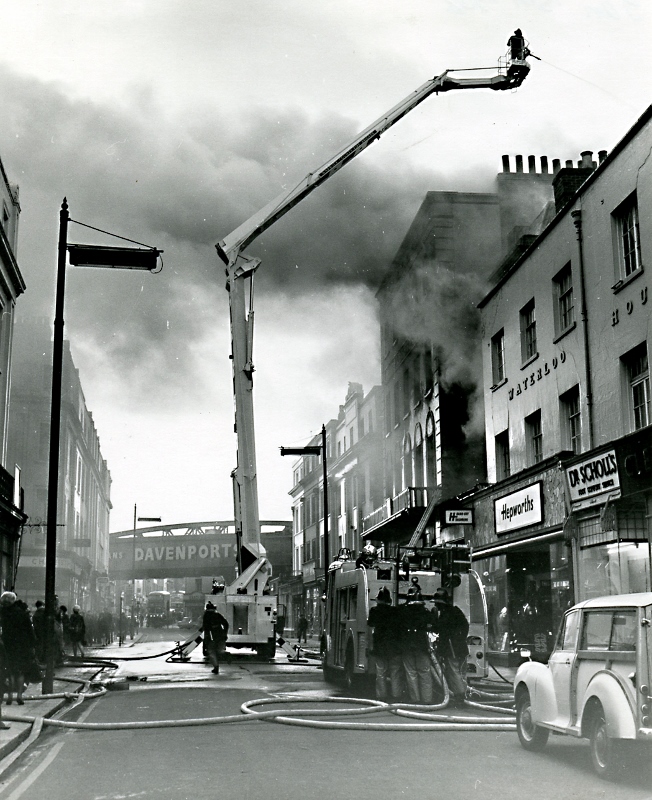
On 15 January 1968 the Parthenon was partially destroyed by fire. The Leamington Spa Courier of 19 January 1968 reported the fire but did not name the building focusing instead on the traffic jam caused when Bath Street had to be closed, and the degeneration of the area.
Until the fire, the building had survived more or less intact above ground floor level although it had become partly derelict at the rear. In 1970, the building was demolished and the front rebuilt in the style of the original but without the columns, retaining the name Parthenon over the top. The rear was rebuilt in modern style. Later in the 1970s, a London developer, Mr Norman Sims, submitted a proposal for a ‘magnificent’ indoor market. He proposed introducing a wide variety of shops into a new arcade in the Parthenon. This came at a time when there was concern about the deterioration of the town south of the river and what could be done to revive the fortunes of Bath Street in particular. Sims’s plan was intended to contribute to this revival. It required planning permission to alter the ground floor frontage of this ‘listed’ building. Warwick District Council approved the market plan in late 1975, but in February 1976 it was shelved amid fears that it would be overshadowed by a new shopping development in Upper Parade, and strong competition from a development in Clemens Street.
Meanwhile by 1975 Bejam Stores occupied the ground floor, and continued there until at least 1988, selling freezer, frozen foods, and Leamington’s first microwave ovens. The Parthenon is now occupied by Iceland. Only the façade of the building above ground floor level bears any resemblance to the original, the street-level frontage being a modern glass shop front.
Although the original building has not survived, the name Parthenon on the restored frontage is a reminder of a building which once housed a considerable library, played host to some of the most famous actors, musicians and speakers of their time, as well as a great variety of novelty acts, educational lectures and presentations, all conceived for the entertainment and education of both visitors and residents of Leamington. The Parthenon saw the birth of the cinema and later became a very popular dance venue, helping to boost morale during the Second World War. Who would guess from the present building that it once rang with laughter, music and applause, or brought to a curious public information and knowledge about the wider world, or simply provided a really good night out?
M Bailes