
1581033
We are indebted to Derek’s brother David, a long-time member of Leamington History Group for providing the information, photographs and images used in this story.
RAF Sergeant Charles Derek Brown died on 3rd January 1944 aged 21 while serving with 101 Squadron. He is buried in the Berlin (1939-1945) War Cemetery, He is also commemorated on the All Saints’ Parish Church War Memorial, the Leamington College for Boys War Memorial and the Lockheed Brakes Sports and Social Club War Memorial (where his name is recorded as C. D. Browne). He was awarded the 1939-45 War Medal and Europe Star.
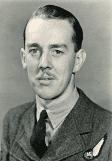
Having been born at Cay Block, Warneford Hospital, Leamington Spa, Derek, as he was known, grew up at 3 Maple Road. His mother and father, Agatha and Charles had 2 other children, Eileen and Gavin, who is known as David, with Derek being the eldest.
Derek went to Shrubland Street Primary School before attending Leamington College for Boys. He was a choir boy at All Saints Parish Church.
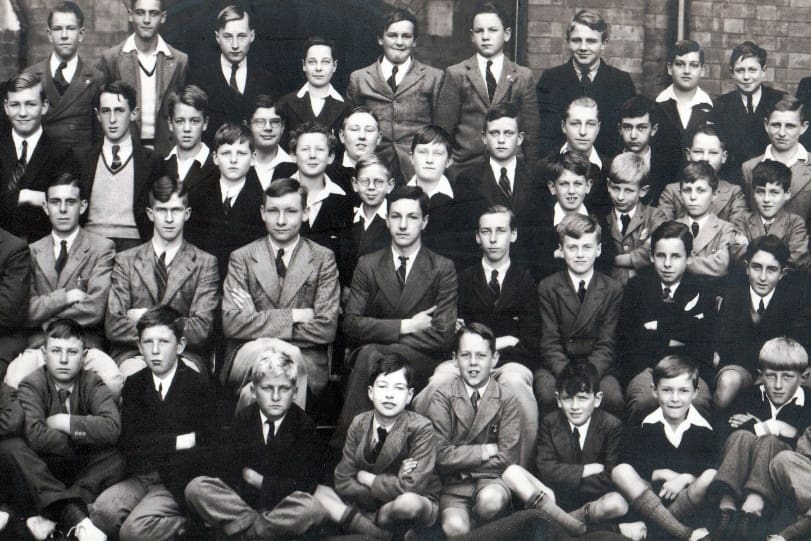
Some of Leamington College students in 1934. Derek is 5th from the left on the front row.
On leaving school, he worked in the offices at Lockheed Hydraulic Brake Company [Automotive Products] on Tachbrook Road for 18 months. Having tired of office work, he applied for a job in the Experimental Section making undercarriages for Spitfires, Air Speed Oxford’s, Anson’s etc. During this time, he joined the Home Guard and soon became a Sergeant.
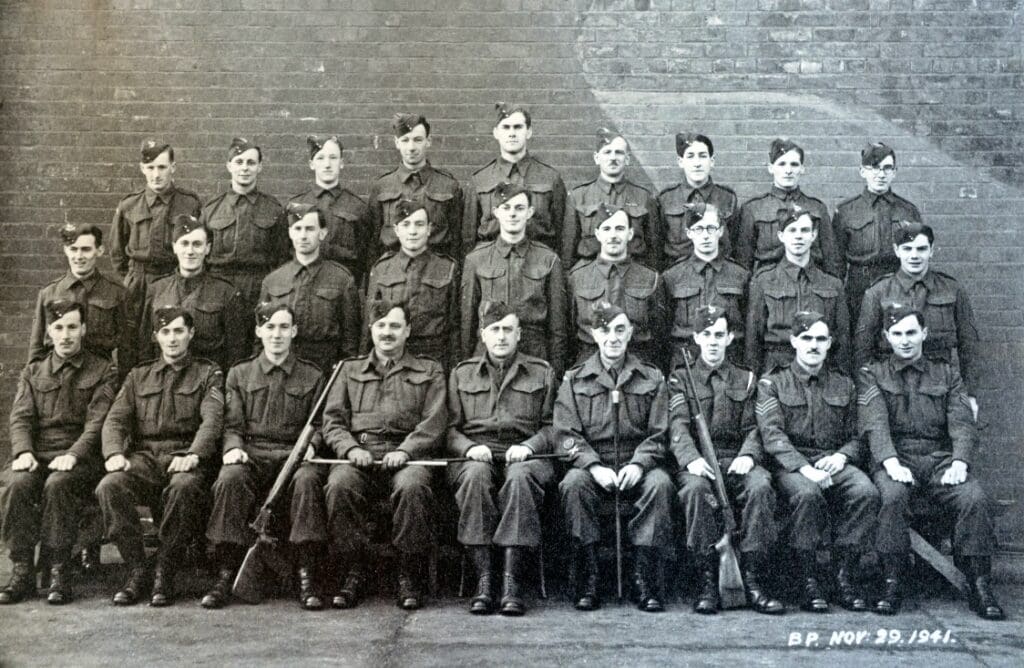
Lockheed Home Guard on 29th November 1941. Derek is 3rd from the right on the front row.
His job was classed as a reserved occupation meaning that he would not be called up for military service. Derek wanted to do more for the war effort, and in June 1942 he travelled to Birmingham and volunteered for the Royal Air Force as a wireless operator / air gunner.
During his training a notice was posted on the notice board asking for volunteers who spoke German or who had other skills that would be useful for special operations. Derek had studied German at Leamington College and volunteered. He joined 101 squadron, a special unit based at Ludford Magna in Lincolnshire which was controlled by Bomber Command.
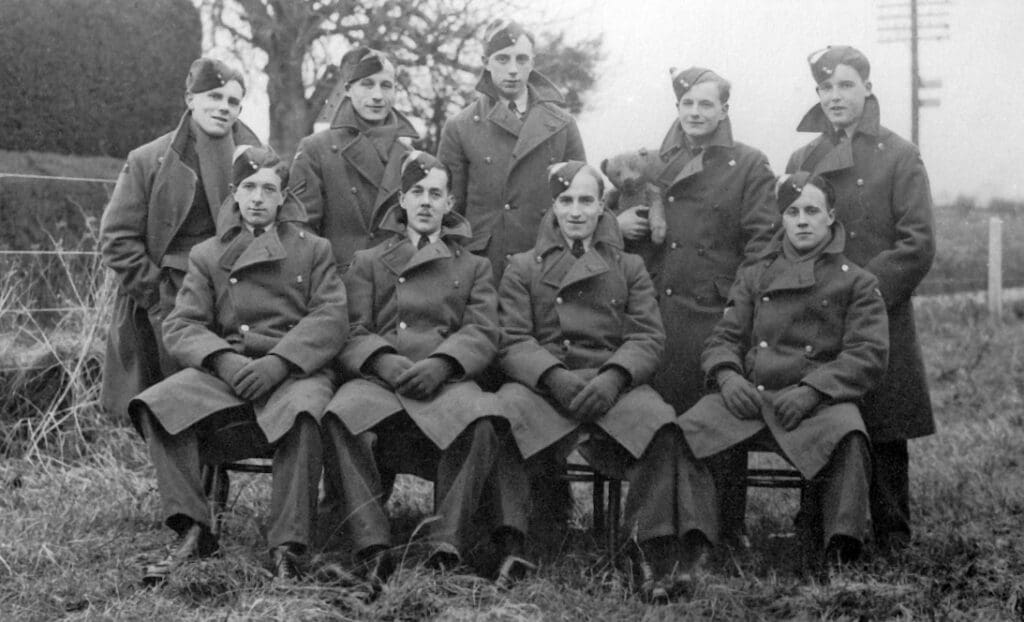
Derek is 2nd from the left on the front row.
Normally, Lancaster Bombers flew with 7 crew, but Derek flew with them as an extra man, which meant reducing weight elsewhere on the aeroplane. He was promoted to Sergeant. His job was to listen in to the German broadcasts to find information about where their night fighters were heading. Having obtained information, he passed this on to the pilot who would pass it on to other allied fighters. Then he would ‘blot out’ their radio broadcast forcing them to find another frequency to broadcast on and the whole process would start again.
The RAF actively discouraged Bomber Command crews from marrying due to the very high risk of deaths. As Derek was known as ‘a bit of a rebel’, he did marry, but he didn’t tell the RAF. He had met Doris Walsby of Moorgate, London whilst on leave, at the Palais de Dance in Spencer Street. Doris was lodging at the Bath Hotel in Bath Street.
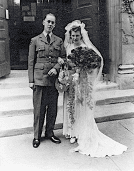
They married on 17th October 1942 at St. Botolph Parish Church in Bishopsgate London and Derek added an ‘E’ to his surname, making it Browne in order to confuse anyone that came across the marriage.
On 16th December 1943 Derek and the rest of the crew of the DV283 Avro Lancaster MKIII heavy bomber were struggling back home after a bombing raid. The pilot told the crew to parachute out as it reached Ludford Magna. The aeroplane then crash-landed. Fortunately, there were no injuries.
Just before midnight on 2nd January 1944 Derek again headed to Germany, this time to Berlin with F/L. A. Lazenby, Sgt. C. Lindsay, F/O. Craig, Sgt. A. Walton, Sgt. D. Stephens and two Canadian airmen, F/O. J. McClure and Sgt. G. Becket. This was only his 3rd flight. On the way home they were shot down near Michendorf in Germany. Four crew died and four survived, those being Lindsay, McClure, Craig and Walton, and they became prisoners of war. The dead were buried locally.
Although it is not certain if this 101 squadron Lancaster fell victim to a night fighter or flak, its end came quickly. “Aircraft hit twice, shortly after leaving the target,” reported Flying Officer McClure RCAF, their Canadian air bomber. “Lazenby [Flight Lieutenant Lazenby, the pilot] gave order immediately abandon although at the time aircraft was flying straight and level, but was filled with smoke. I immediately jettisoned the hatch and left the aircraft.” The third man out was the flight engineer, Sergeant Craig, who writes, “Lazenby was alive and he stated over the intercom that he was wounded in the leg. Nothing heard from Sergeants Brown, Becket or Stephens at any time during the action, nor anymore from the pilot.”
Even though Doris was living at Bath Buildings, Smith Street [part of the Bath Hotel] at the time of his death, they never actually lived together as a married couple. Doris continued working at Leamington until the end of the war when she returned to London.
In 1949 Derek’s family were notified that the military war dead that had been buried in various places around Germany were being moved to a purpose-built forces cemetery in Berlin. Permanent headstones would be erected by the Imperial War Graves Commission.
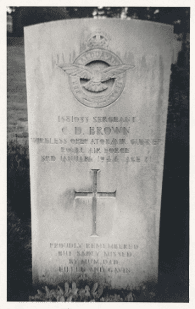
A memorial service was held at All Saints Parish Church on 11th November 1951 for those who fell during the Second World War and Derek was one of 8 named.