Soans is an unusual name, is spelled in various ways, sounds a bit foreign, but probably comes from the English word Son, which has evolved into Sons, then Soans. It may be Scandinavian, implying that my ancestors came to this country in long boats, intent on pillage & plunder. Many people might think that an appropriate background for a life in the Motor Trade!
What is indisputable is that our family can be traced back to 1655, based largely in Kent/north Surrey. Recent generations settled around Bromley in Kent. Soans’ Business history in engineering & motor vehicles spans 120 years, 85 of them in association with Ford.
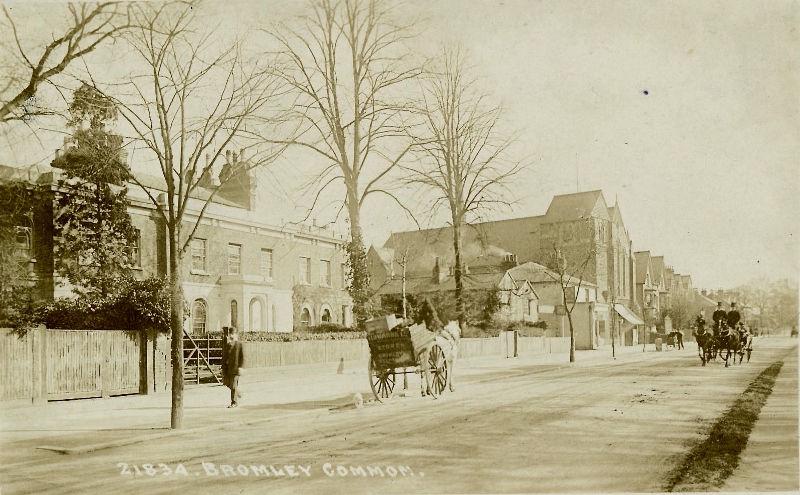
The story starts in Bromley, close to the Commonaround 120 years ago. The Common still exists, but looks a bit different nowadays. Note: there is not a single motor vehicle to be seen.
The Soans family does not come from a privileged background, far from it. My Great-Great- Great-Grandfather, was a wheelwright. James his son was a tailor who in 1884 was committed to the Bromley Union Workhouse. Three years later he absconded and never returned. Alfred, his son, was born in Bromley in 1841, and at the age of 29 he married 24 year old Elizabeth Line at Bromley Parish Church. Alfred & Elizabeth had five sons & two daughters. Two sons, Percy (my Great Uncle) and his younger brother Charles (my Grandad) provide the family link for the title of this article – A Family Business.
![Shed [Slide 4] Soans Presentation (800x624)](http://www.leamingtonhistory.co.uk/wp-content/uploads/2014/11/Shed-Slide-4-Soans-Presentation-800x624.jpg) Percy and Charles were quite entrepreneurial. In 1895, they built a shed at their parent’s home, 5,Holmsdale Road, Bromley, and started repairing and selling bicycles. This was the heyday of the bicycle industry, with the “Safety” having replaced the earlier “Boneshaker” and “Penny Farthing”. They formed a Partnership, ‘Soans Brothers’, and even began production of their own bicycle, the Mikado.
Percy and Charles were quite entrepreneurial. In 1895, they built a shed at their parent’s home, 5,Holmsdale Road, Bromley, and started repairing and selling bicycles. This was the heyday of the bicycle industry, with the “Safety” having replaced the earlier “Boneshaker” and “Penny Farthing”. They formed a Partnership, ‘Soans Brothers’, and even began production of their own bicycle, the Mikado.
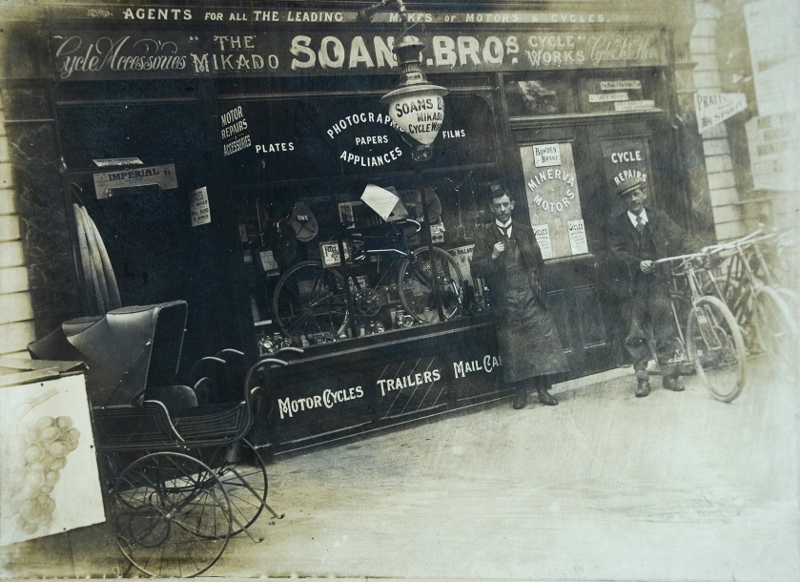
Outgrowing the original shed, they moved into a shop at 149 Masons Hill, Bromley, where they offered a wide range of services as a cycle and hardware shop. The photo from the very early 1900’s shows the shop front, proclaiming Soans Brothers “Agents for all the leading Makes of Motors & Cycles”, as well as having Motor Cycles listed there. The door also bears the name of Minerva Motors. Minerva were a Belgian company that began making bicycles about the same time as the Soans brothers, but then developed a clip-on engine for bicycles, before branching out into making motor cars. The UK became their largest export market and their single cylinder Minervette was the cheapest car that you could buy here. One of their leading dealers was Charles Rolls – soon to become better known as the first half of Rolls Royce.
In 1905, in addition to the shop, the brothers leased a “house & premises” nearby at 40 Napier Road in Bromley. The house was probably used for an office & store, but “the premises” were developed to become a very well equipped Engineering Machine shop. These were still the relatively early days of motoring but Soans Brothers’ work already embraced motorbikes & cars, as well as bicycles. The supply of spare parts was very different from today – often if something broke, you simply had to make a new one.
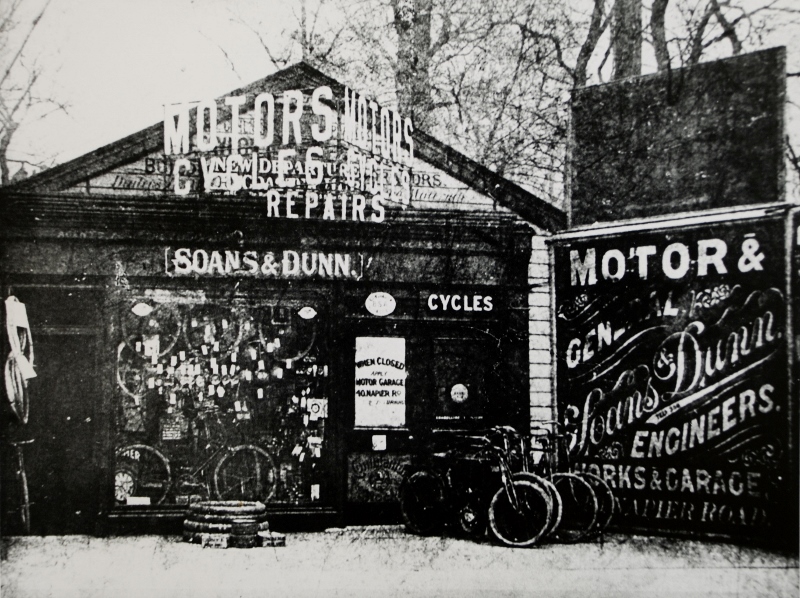
In 1906, with William McHarry, who had married their sister Frances, the brothers took out a Patent together for a new design of road wheel that “facilitated tyre repair or changing”. No further development of this invention has been traced however. Business clearly grew and in 1908 they linked up with another Bromley Cycle & Motor engineer, Edward Dunn, to form a new Partnership, Soans Bros. & Dunn. . Meanwhile the Napier Road premises were being further developed and by this time were advertising their Engineering capabilities. Further expansion occurred three years later when they linked up with another local engineer, E. Haines Jones, who had premises in Farnborough, a village a few miles east of Bromley. The new business was called Soans, Dunn & Jones and this name continued until 1919, when the name reverted to Soans & Dunn, with Mr. Jones having either retired or left. This new partnership enabled the brothers to move to new premises – down the road to 93 Masons Hill, Bromley, where a new garage was established on a site that had previously been a “rustic works”, -the production of gates, fencing and seats. Earlier records show the site had originally been a pond, accessible from one end to enable horses to be watered and carriers to plim the wheels of their wagons. “Plim” is a term for soaking wooden wheels in water to swell the spokes and rims in hot weather to counter the shrinkage of the wood. It must originally have been a sizeable pond since a local history book of the time describes it as extending “ into the neighbouring field where it was overgrown with reeds & sedges, within which dwelt newts, croaking bull-frogs, fish of various sorts including carp, and other interesting creatures”.
By that time the brothers had become agents for Brasier cars and Hallford trucks. Brasier were a well-regarded French company manufacturing rather nice cars, and the trucks were made by J & E Halls, a company started in 1785 in nearby Dartford that still exists today as specialist refrigeration engineers. Their trucks were used extensively in the First World War.
The year 1911 marked a turning point: the business became Ford agents, beginning an association that was to last some 85 years. The increase in business with Ford soon led to further expansion. The outbreak of War three years later brought great changes, as the Machine Shop was turned over to machining gun shell cases for nearby Woolwich Arsenal. At that time many such cases were machined from solid billets of steel – quite a big job. I still have a 3” one – fortunately empty and used as a door stop. The garage side of the business meanwhile was reconditioning vehicles returned from the front line, many of them the ubiquitous Ford Model T, which served as ambulances, trucks and staff cars. ![Leaflet [Page 2] Soans Presentation (600x800)](http://www.leamingtonhistory.co.uk/wp-content/uploads/2014/11/Leaflet-Page-2-Soans-Presentation-600x800.jpg) Vehicle sales to the public did continue throughout the War, but as the sales leaflet comparing the costs of running a van to a horse & cart shows, there was still much to do to convert customers to consider the internal combustion engine. When the war ended the company bought batches of Model T’s from the War Office straight from the French battlefields, unseen, & rebuilt them for civilian sale.
Vehicle sales to the public did continue throughout the War, but as the sales leaflet comparing the costs of running a van to a horse & cart shows, there was still much to do to convert customers to consider the internal combustion engine. When the war ended the company bought batches of Model T’s from the War Office straight from the French battlefields, unseen, & rebuilt them for civilian sale.
Post-war, business arrangements became much more formalised. Ford Motor Company drew up new contracts appointing exclusive Main Dealers around the UK, each with a designated area of responsibility, within which they could appoint sub-dealers to provide a full geographic coverage, a system that continued right into the 1990’s. Soans & Dunn were among the first to sign up to Ford’s exclusive new terms, in 1919.
1924 marked another development: Charles’s son Fred (my dad) then joined the firm, literally straight from school aged 15. He came home for lunch from school one morning to be told he wasn’t going back – it was time to earn his keep! That afternoon Grandad took him to buy some overalls and work boots, next morning he started work at 5/- (25p per week in today’s money) sweeping floors and serving petrol from cans – this was before the advent of pumps.
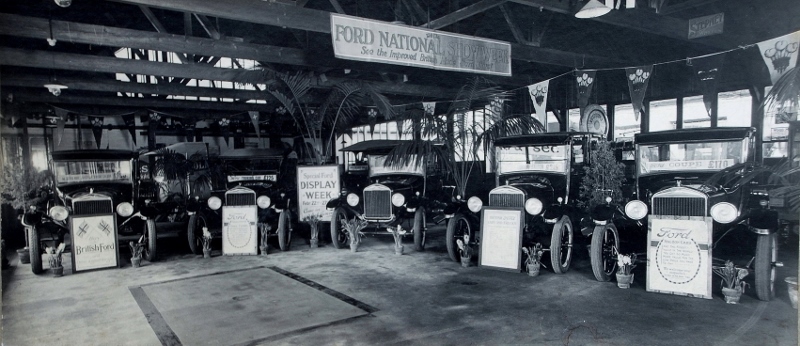
Great-Uncle Percy and Grandad Charles drew up Revised Articles of Partnership in 1925, keeping the trade name as Soans & Dunn, but with no mention of either Dunn or the earlier partner,Jones, in the Articles. However only a couple of years later it was amicably agreed that the partnership be dissolved. By then all three of Percy’s sons were working in the business, as was Grandad’s only one, who was the youngest. It was felt that this might lead to difficulties in the years ahead (if it hadn’t already!) as the next generation increasingly took over from the two founding brothers. Neither Partner particularly wanted to sell the business outright, nor to leave, so after much deliberation they agreed each to offer his half of the business for sale to the other. After some months of counter-bidding, Great-Uncle offered enough and Grandad said “I’ll take the money!”
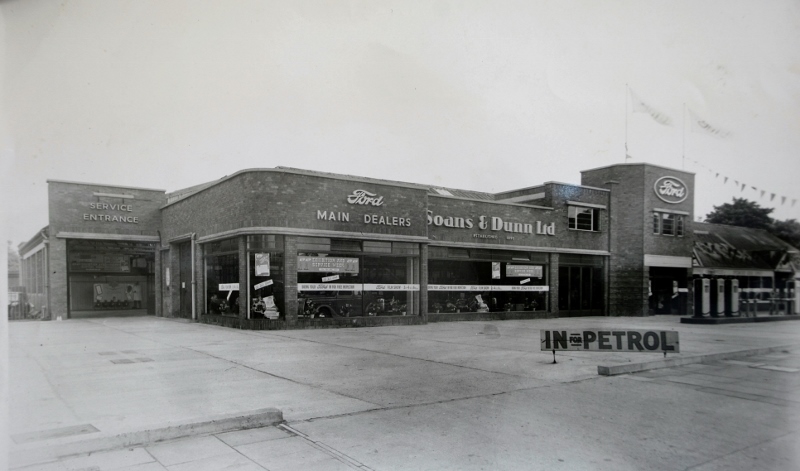
Soans & Dunn continued to prosper, becoming one of the largest Ford dealers in the South East, moving to larger premises post-WW2. However as Percy’s three sons neared retirement in 1963 the business was sold to Bristol Street Motors, at that time a firm of Birmingham-based Ford dealers who were expanding rapidly in the UK under their American owners.
Richard Soans
October 2014
Images from my private collection, edited by Allan Jennings.
Please respect Copyright
Read the Other Chapters:- The Move to Leamington (2);
The Move to Sydenham (3); Life After Ford (4)