
Most references to a Workhouse or Poor-house in Leamington relate to premises in Court Street. However, before trying to establish some details of this place it is probably appropriate to deal more widely with how the community of a small place like Leamington Priors in 1800 cared about and cared for the poor.
Generally, there was little sympathy for those who were able to work but who did not, even if work of which they were capable was not available. Well-off benevolent people sometimes employed more staff and servants than they needed to provide for those who could not find other work; appeals were made to raise funds by voluntary donation and there is record in 1821 of 500 poor people sitting down at the Bowling Green Inn in Church Street to eat a meal provided by the inhabitants (the figure of 500 seems extraordinary when the total population in the census that year was only 2,183). Nationally provision for the poor was governed by Poor Law Acts which began in the sixteenth century; they were designed to deal with what was termed the impotent poor, who were not able, physically or mentally, to hold down a job. In 1601 the churchwarden at Lillington raised a rate for poor relief.
A parliamentary report in 1777 found that there was no workhouse in Leamington but provision for 133 people in Warwick (which was the larger town at the time). Thomas Gilbert managed to have a Relief of the Poor Act passed in 1782 which established poor-houses in a fairly fragmentary way. This was because the system depended on establishing local management and taxation which was not, initially, widely accepted.
Maps dated 1783 and 1818 show a ‘poor house’ in High Street (now Radford Road), to the east of Watery Lane (Camberwell Terrace) near to what became the site of Warneford Hospital. This existed in 1828 when Mr Carter, the auctioneer, was assistant overseer of the poor. There was also a poor-house in Milverton in 1800. It is possible that the present-day Union Road was named for the presence of a Poor Law Union meeting place or workhouse in the street. An alternative example of Voluntary provision for the poor was the founding of the Leamington Spa Charity in 1896 by Benjamin Satchwell to provide salt baths for poor sick invalids.
In April 1831 there was a request in the Leamington Courier for tenders to demolish the Petty Sessions Room and Workhouse in Church Street and to build a new Workhouse. This is the only note suggesting that there was ever a workhouse in Church Street; it was probably referring indirectly to the building in Radford Road.
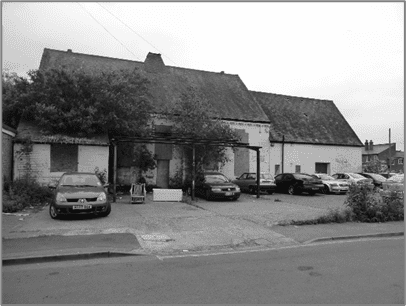
The premises in present-day Radford Road were clearly inadequate because it was agreed to build a three-storey poor-house in Court Street which was also the location of the village pound and the village stocks. In 1832 there was an advertisement for a guardian and matron which had been placed by the churchwardens and overseers of the poor (usually called a vestry). It was paid for by a levy of one shilling. The local court decided that relief in terms of cash should not be given to poor people if there was a well-run poor-house in the parish. The narrow street from Clemens Street to Court Street was probably named Union Walk because it led to premises run by the Poor Law Union. Richard Dunsby was the master of the Workhouse in Court Street in 1835. The Poor Law Act 1832 formalised arrangements nationally and Leamington became part of the Warwick Poor Law Union. The town fire-engine was kept at the workhouse around 1837; it later moved to the Town Hall in High Street.
Another complication was provision for poor people who were sick. There was some provision at Court Street for those not too seriously ill. The foundation of Warneford Hospital relieved the responsibility and cost of caring for sick poor at the workhouse. In 1838 there was an advertisement for a medical man to serve the workhouse and Richard Croydon was Assistant Overseer of Poor who lived at No 4 George Street. In 1836 there was a plan for a new poor-house at Warwick and when this opened in 1839 the workhouse in Court Street closed. It had served its purpose for only nine years. The Rev John Craig of All Saints church expressed interest in buying the old workhouse to build a school and in the event the building was re-used as a school from very soon after closure. However, the school was demolished in 1851 for the building of the railway and a new school was built to the south. But that is another story. The workhouse in Warwick was built in Lakin Road opposite to what is the hospital in 2018.
Various provisions for the poor after 1839 are worth noting. In 1844 there were various job-creation schemes including employing more labourers to maintain roads and employing men to plant trees along one mile of the Kenilworth Road, to avoid sending them to the poor-house. In 1872 a Boys Mission Hall started as a Poor Law Station in Wise Street.
The Milverton Working Society at No 22 Milverton Crescent provided warm clothes for the poor in 1874. As late as 1908 there were what were known as “Children’s Scattered Homes” established under the Poor Law at Nos 9, 11 and 13 Charlotte Street, at ‘Culham’ in Grove Street and ‘Fortescue’ in Willes Road.
This page is one of many which are based on articles in our book entitled A History of Royal Leamington Spa in 100 Buildings which was published in 2018 and is no longer in print.