
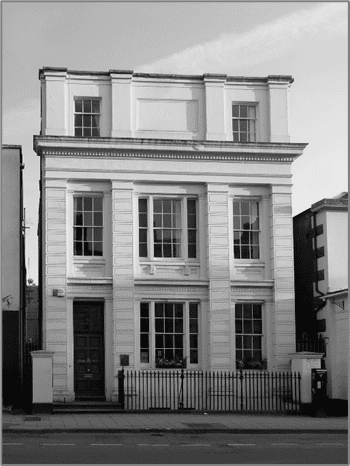
According to company records, No 42 Warwick Street was designed and built by local architect William Thomas as both the office and residence for A S Field Esq, between 1838-1840. With a growing family of three sons and two daughters, Mr Field eventually moved out of the town centre to Blackdown House, Lillington but retained the Warwick Street building for office use, as two sons went on to join him in the family practice. Although now only used for commercial purposes, with resulting later additions and alterations, the four-storey building remains largely as originally built, with much fine woodwork and an elegant façade. It is Grade II Listed.
William Thomas came to Leamington to try his luck as an architect and builder, following the death in 1832 of his business partner, Richard Tutin, and the economic depression, social unrest and cholera outbreak in Birmingham. Leamington Priors was then in the midst of a building boom, and was home to only three architects. The building amply demonstrates what became some of the hallmarks of William Thomas’ work, in the use of a strict, almost grid-like composition, with fine Tuscan pilasters, a simple entablature and dentillated cornice, which enhance the effects of light and shade on the building’s façade. An internal detail of No 42 Warwick Street which clearly shows Thomas’ ability to execute elegant yet substantial designs was his inclusion of Greek-themed fine plaster friezes. Thomas later employed this device to stunning effect on the Commercial Bank of the Midland District in Toronto. The listing document of 1999 notes the full height open-well staircase with tapered rod and central bobbin balusters and wreathed handrail. The first-floor hallway has two decorative plaster plaques of Day and Night after Bertel Thorvaldsen (the originals can be found at Chatsworth House); on the upper level, ‘Mercury bearing Pandora to earth’ is after John Flaxman, sculptor, illustrator and designer, 1755-1826, (original in the Flaxman Collection, University of London). The frieze to the first floor is a copy of the Parthenon Frieze, and the second-floor front room contains a roundel of the Madonna and Child. Several rooms contain moulded cornices, ceiling roses, original fireplaces and shutters to windows. The area railings (also Grade II Listed) have decorative finials with urns to the stanchions.
The commissioning of this house in 1838 from A S Field would undoubtedly have helped William Thomas confirm his reputation in the town, as Mr Field was a widely respected figure not just in Leamington Priors but throughout Warwickshire. He was a solicitor and Clerk to the Kenilworth Justices, a member of the Lillington Local Board and a major figure in the social and political life of the town. He was also a trustee of Jephson Gardens, a subscriber to the Pump Room Gardens, and a member of the Town Commissioners, in addition to his later duties as Clerk of the Peace and Clerk to the County Council. William Thomas’ elegant building provided him with an appropriate family home and base for his expanding business almost within earshot of the Upper Parade.
This page is one of many which are based on articles in our book entitled A History of Royal Leamington Spa in 100 Buildings which was published in 2018 and is no longer in print.