
Originally the only source of drinking water in the spa town of Leamington was filtered water from the River Leam. This water supply was controlled by the Oldham family. However, by the 1870s problems had developed with the quality of the water and attempts were made to secure a new source.
Thanks to the sterling efforts of Alderman Henry Bright and the generosity of landowner William Willes in providing the land, a large borehole was constructed at the corner of Leicester Street and Campion Terrace in the 1870s. This project proved to be successful, giving Leamington clean drinking water. The subsequent waterworks, opened on Tuesday 11th March 1879, were the first publicly owned works in the country.
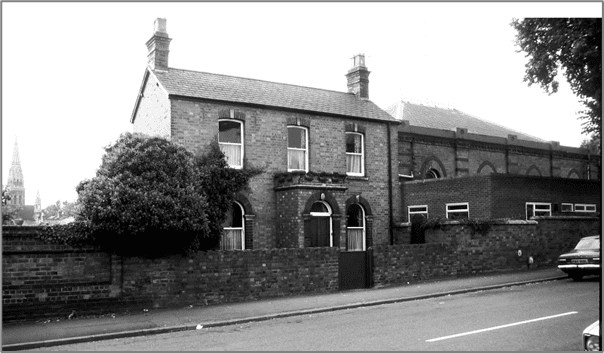
A small detached house at No 2 Campion Terrace, constructed by Leamington Borough Council at the same time as the waterworks (1878-9), was designed to house a resident engineer who would be responsible for the maintenance of the two engines used to pump the water to a reservoir up on the Campion Hills. In order to lift the water from the borehole in the sandstone aquifer two 65 horse-power steam engines were installed inside the waterworks. A newspaper of the day suggests that “400,000 to 500,000 gallons of water would be pumped to the reservoir in the Newbold Hills”. The engines were named ‘Harding’ after the Mayor and ‘Wackrill’, an Alderman of the day. The house, situated to the left of the waterworks, was of a simple design consisting of two storeys. The house had a flat frontage with two ground-floor and three first-floor widows and central front door opening out onto Campion Terrace. The house was 30 feet long and 13 feet 9 inches wide. At the rear there was a 12 feet 2 inch long and 11 feet 6 inch wide section creating a T-shaped design. A front porch, with interesting crenellations, is likely to have been constructed at a later date because a map of 1887 clearly shows the house without a porch.
Inside there was a 3 feet 7 inch wide stair case leading to three first-floor rooms. On the ground floor there were two rooms with a kitchen area situated in the rear T-section. An 1887 map shows some small outbuildings – presumably outside toilet facilities.
The post of engineer to the Waterworks was advertised in July 1880 and attracted a total of 82 applicants from all over the country. The wages for the post were to be £2.10s.0d per week with cottage, coal and gas free. These applications were finally reduced to three – a Mr Buckley from Southport, a Mr Hackett from Birmingham and a Mr David Carey from London. David Carey was successful.
However, this appointment ran into trouble as Mr Carey was dismissed without notice in October 1880. In November 1880, Alderman Wackrill proposed a cheque be paid for a quarter of the salary in lieu of notice to be drawn in favour of Mr Carey. Also, in November 1880, the Leamington Courier reported that the Borough Engineer had obtained the services of John Dean as engine man and J Price as stoker.
The 1881 census shows John Dean, a widower, living in Waterworks Cottage with his three sons and a daughter. John Dean’s occupation was described as an engine driver. The 1891 census shows another change, with an Isaac Buckley now living in the cottage (presumably one of the original applicants for the post) with his wife, three sons and four daughters. Further searches showed that Isaac was living in the cottage in as early as 1882. Given the relative size of the house as detailed above, it would have been quite crowded by having to accommodate nine family members.
The borehole, situated close to the cottage, proved quite a dangerous hazard. The Leamington Courier in May 1876 reported – “Accident at the Bore-hole. Between twelve and one o’clock yesterday morning serious accident occurred to John Martin, a constable in the borough force.
Seeing two men at the bore-hole in Campion Terrace, Martin went to them; and as he was leaving, they advised him to be careful not to fall into the well, which is now 36ft. deep. In the darkness, Martin mistook his way, went inside, instead of outside the scaffold poles which are partly round the bore-hole, and fell to bottom. The two men, who remained on the spot all night for the purpose of pumping out the water, immediately went to his assistance, removed him to the Somerville Arms, whence he was conveyed by cab to the Warneford Hospital, where he was attended by Mr Brown, the house surgeon, and Dr Thompson, police surgeon. Martin’s right arm was fractured in two places, and he sustained severe contusions about the head, face, and body. He is a well-conducted young man and has been connected with the force about nine months. Yesterday he was reported to be doing fairly, under the care of Mr C W Marriott.”
In 1894, the Leamington Courier reported a more serious accident in that a John Thomas King, aged 41, had died after falling down the shaft of the borehole.
That same year, Isaac’s wife, Mary, died, followed in April 1900 by Isaac Buckley himself. Luckily, Isaac’s oldest son, William Henry, had been trained as an engineer and was offered the post at the Waterworks (albeit at a reduced salary) on the death of his father. The family of six could now remain in the cottage, the second oldest son having left for Birmingham to work as an ironmonger’s assistant.
The 1891 census shows William’s older sister, Ellen, as having no job but presumably she acted as housekeeper to the family. However, she did work at home as a self-employed music teacher; Eva was a dressmaker and Lily, a milliner’s apprentice. The youngest child, Isaac, had no employment listed.
In the 1911 census, William was recorded as still at Waterworks Cottage as engineer but living with Margaretta Buckley, his wife and a four-year-old son named Murray Loraine. Margaretta was the daughter of Stephen and Sarah Stratton who were living at 21 Villiers Street. When Margaretta was 20 she moved to Birmingham to live in at Warwick House, a drapery store designed by William Thomas. However, by 1901 she had moved back to Leamington aged 30. She then met William Buckley and they married in May 1906. He was 32 and she was 35. They had their son Murray in 1907.
William’s four sisters and brother were no longer living at the house. One sister, Eva, had married the Leamington artist and photographer, James Edward Duggins – see an article on Leamington History Group website. In 1919 William applied for an increase to his wages, this was granted and he now received £3.15s.0d per week. In October 1938 Mr W H Buckley was described as the superintendent of the Waterworks Pumping Station and due to terminate his employment in April 1939, having reached 65 years of age. This was extended for another year. In February 1940 the Water and Sewage Committee recommended that Buckley be offered a pension of £163 per annum but this to be increased in recognition of his 50 years’ service including his apprenticeship.
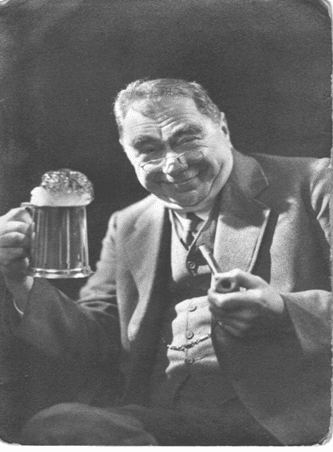
William Buckley finally retired from the Waterworks on 14th April,1940, after 50 years of loyal service. William (pictured) spent almost 60 years at Waterworks Cottage. He died on 27th May 1951 aged 77 years at 60 Highland Road. He left £751 to his wife and son (about £23,000 in 2018). It is almost certain that Buckley Road, Lillington was named after him.
Following William Buckley’s retirement, the Council appointed a Joseph Crowther as engineer. Remarkably, Mr Crowther remained in post until 1966, a total of 26 years.
The steam plant was discontinued in 1956 and the original steam engines dismantled in 1959. Leamington Borough Council handed over responsibility for the Waterworks to the South Warwickshire Water Board in 1963. By 1974 Severn Trent Water Authority had taken over, becoming a privatised company under the Water Act of 1989 and renaming itself Severn Trent Water.
In the late 1960s a new treatment works was built on the Campion Hills to replace the Campion Terrace works. In February 1988 the works at Campion Terrace were decommissioned and finally demolished in 1992 to be replaced by a block of flats called Aqua House.
The engineer’s house or cottage was no longer required to house an engineer and became a base for Severn Trent staff to use whilst on business in Leamington.
In 1999 Severn Trent decided to dispose of the cottage and it was subsequently purchased by a private buyer as a residential home. It currently remains as a home and stands as the sole remaining original building on the site of the Campion Terrace Waterworks.
However, Severn Trent has retained and refurbished the old borehole which still provides water to the people of Leamington to this day.
Michael Pearson, 2018
This page is one of several pages which are based on articles in our book entitled Royal Leamington Spa, A History in 100 Buildings which was published in 2018 and is no longer in print.