
This page is one of several pages which are based on articles in our book entitled Royal Leamington Spa, A History in 100 Buildings which was published in 2018 and is no longer in print.
A considerable part of North East Leamington, including the plot where Victoria House now stands, was originally purchased from the landowner, Edward Willes, by Joseph Vincent Barber. Although better-known as a landscape artist, Joseph Barber became a major speculator in Leamington. Between July 1832 and December 1835 he bought ten acres of land from Willes, covering the current sites of Lansdowne Crescent, Lansdowne Circus and Victoria House as well as an area of land north of them, in the vicinity of Queen Street, Vincent Street, King Street, Campion Terrace and Holly Street.
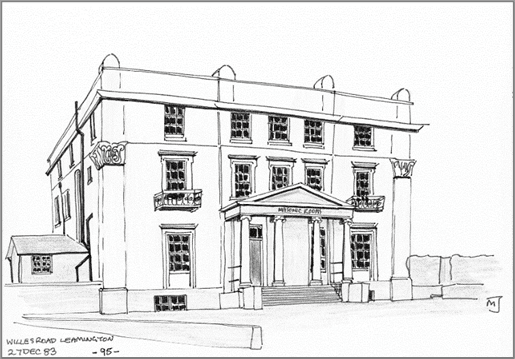
In 1834, William Thomas, architect and speculator, purchased the Victoria House site from Barber and sold it on to a builder, Edward Pinder, on the understanding that Thomas’s plans for a house on the site were carried out. The resulting building, now called Victoria House, was to be one of Thomas’s largest villas in England.
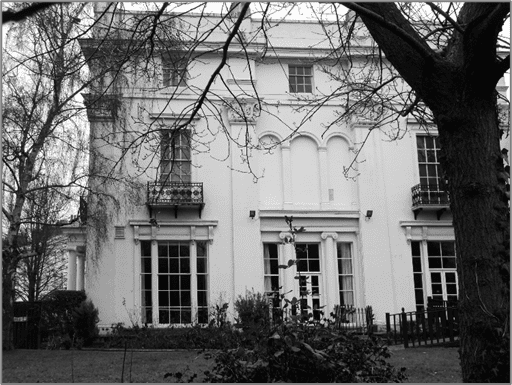
The building was on a corner lot, the north junction of Willes Road and Upper Holly Walk, as these roads are now known. The building had two façades – one facing the Willes Road and one facing Upper Holly Walk. Each façade was to have its own entrance. Thomas decided that the façade facing Upper Holly Walk would be less formal than the front. The placement and variety of the windows worked quite well and opened the house up to its garden surroundings. There was a recessed central bay and an entrance of four Ionic pillars with, originally, a first-floor arched balcony. This balcony, which has since been blocked up, was a surprising and interesting Italianate touch.
The main façade, opening onto Willes Road, was much more formal, with large Corinthian side pilasters and a pedimented main portico on four Ionic columns. Unusually there were six different sizes of windows incorporated in the design, including the basement and entrance. The main entrance was placed asymmetrically and in conjunction with the addition of a central umbrage allows an interesting play of light and shade.
The drawing room, breakfast room, sitting room, library, parlour and spacious entrance hall and associated offices were on the ground floor. The basement contained the kitchen, scullery, housekeeper’s room, servants’ hall, larder, butler’s pantry, ale, wine and coal cellars and some offices. Twenty-seven bedrooms were situated on the first and second floors. This suggests that the villa may have been built as a hotel. It is difficult to imagine that it was meant to be used as a private house.
Unfortunately, the Leamington and Warwick Bank collapsed in 1837 and many local builders and speculators were bankrupted, including William Thomas. Just a year later, in 1838, Joseph Barber died of malaria whilst visiting Rome, leaving his trustees to sell his houses and land at a very difficult time. In 1839 the trustees put Victoria House up for sale although it was not actually purchased until 1841.
Interestingly enough it was then sold as a hotel when Thomas Michael Copps acquired it in August 1841. Thomas Copps’ father, Michael, owned the Copps Royal Hotel in the High Street. At the time, his hotel was one of the finest hotels in Leamington. Unfortunately, Michael Copps went bankrupt in February 1841 and all the hotel’s effects were auctioned off later that year (see separate article).
The same fate was then suffered by his son, Thomas, as the hotel, by then known as the Copps Hotel, failed in February 1842, leaving Victoria House to be either sold or let. After being declared bankrupt, Thomas Copps, left Leamington and eventually died in London on 5th December 1856, aged 48.
In 1842, Victoria House was advertised in the Leamington Courier as a “spacious mansion suitable for the residence of a Nobleman or Gentleman or for a Family Hotel”.
In 1844, a Mrs Startin moved in. She had been running a lodging house in Waterloo Place. Her husband, William, was the architect of Beech Lawn (see article). She wrote to the Leamington Courier to say that “The gradual increase of her connections has induced her to take a larger house and add to her Establishment in order that she may offer to her friends all the comforts of a home”.
However, in 1845 the Leamington Courier reported that the proprietor of Victoria House was leaving Leamington and selling all possessions including the contents of 27 bedrooms. The sale took place over eight days. It was still being advertised for sale or let in 1849. The Leamington Courier reported in September 1849 that a Mr and Mrs Cawthorp (or Gawthorpe) had moved into Victoria House from Lansdowne Circus. Mrs Gawthorpe then set up a Ladies’ Boarding School in Victoria House after presumably buying the premises. The school operated successfully throughout the 1850s, 60s and 70s. Mrs Gawthorpe was described as Head of the family and schoolmistress in the census returns of 1851, 1861 and 1871. The latter recorded 47 people living in the premises including teachers, pupils and servants. However, in July 1885, Mrs Gawthorpe (then aged 70) decided to sell up and move to London with her pupils. The Leamington Courier advertised the sale of all the effects of Victoria House.
Victoria House was recorded in the Leamington Courier still for sale in 1887, but eventually on 2nd March 1889, an article in the Leamington Courier read –
“Now the Guy’s Lodge (Masonic Hall), is about to make another move – this time into a house of its own. Victoria House has been bought and soon the Freemasons of Leamington will be ensconced in Masonic Rooms of their own. This is progress of the right sort.“
Later that year, Victoria House became the permanent home of the Freemasons.
In February 1890, the Leamington Courier carried an advert for the Masonic Rooms, Victoria House, Willes Road, stating that –
“These rooms have been recently enlarged and decorated, and are admirably adapted for Balls, Private Parties, Suppers, Lectures, Classes and Private Entertainments generally. Plates, Linen, Glass and other table requisites on the Premises”
In March 2017, some 127 years later, the Masonic Rooms, Victoria House, Willes Road, was also advertising itself as
“An ideal venue for Seminars, Business Meetings and Conferences. It also lends itself to Christenings, Family Parties, Garden Parties, Funeral Wakes, Remembrance Receptions and Small Weddings”.
So, although many of William Thomas’s villas and buildings have been demolished, his largest Villa, now Grade II Listed, survives to this day thanks to the Masonic Lodge and still provides a valuable service to the people of Leamington.
Michael Pearson, 2018
ACKNOWLEDGEMENTS are presented at the end of this page — CLICK HERE