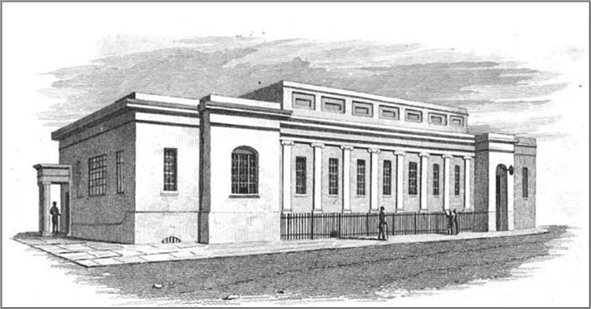
In 1810 a group of people in the town realised that, despite the growing population, there was not a suitable room for meetings, events and entertainment in the town. Prior to that date a room near the old Bowling Green Inn south of the river was used. A Committee was formed, funds were raised, and the site on the south side of Regent Street to the west of the Parade was chosen. This site was previously referred to as a large square.
The new building was designed in Classical style by a local man, C S Smith, and was built with local stone from the quarry field in Warwick Street. Mr Smith also designed the Pump Room which became the Royal Pump Room and Baths in 1814.
The building cost about £10,000 and was opened in 1812 with the first ball being arranged by Mr Williams of the Bedford Hotel, situated just down the Parade. The main entrance was on the Parade with another access in Bedford Street and there were seven windows lining Regent Street, separated by Ionic pilasters. The grand entrance on the east side had four Ionic pilasters. It was known as the Upper Assembly Room before 1822, possibly to emulate the rooms with the same name in Bath. This may well have been prompted by the opening in 1821 of Elliston’s Assembly Room in Bath Street which is best known as the Parthenon (see article).
Over the coming years the Assembly Rooms were run variously by a Master of Ceremonies or a Director and rules about the organisation of events and behaviour of visitors evolved. Initially the annual subscription was £1.11s.6d (£1.57).
The first MC was Major Abiathar Hawkes; he was succeeded by Mr Heaviside until 1818; he was followed by Captain Stephenson and then Captain Francis Stenton in 1822. Henry Twistleton Elliston leased the premises and became director in 1830 as well as running the Lower Assembly (the Parthenon). Mr F Bissell was steward in 1846 and Captain Blackburne was MC in 1858. Abiathar Hawkes was one of the three men who successfully petitioned the Queen for the grant of the town name of “Royal”.
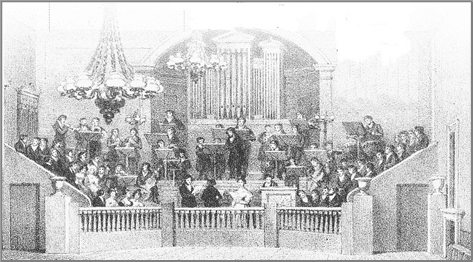
The premises were restored and redecorated in 1825 and new facilities of a reading room, a lounging room and a reference library were incorporated. These rooms were provided with atlases, geological surveys and a wide variety of other reference materials plus daily newspapers from London on the day they were published. The ballroom was bedecked with new decorations including ornamental vases.
Grand balls and concerts were the familiar fare at the Upper Assembly and in 1822 The Season ran from 4th June to 15th November. Other events included lectures on experimental philosophy in 1825. By 1822 the wine and spirit Vaults, run by O Mills, were below the building and by 1839 Mr Hewett’s library was just inside the main entrance. In 1827 William Lloyd Lubbock was running a bookshop at the premises but was declared bankrupt.
In 1878 the Upper Assembly was closed down and sold. The site became retail premises for Plucknett & Steevens and then Gamages. Gamages was run by a relative of the well-known London firm of Gamages and then it became Woodward’s in 1908. Woodward’s prospered for many years and survived until 31st July 2004. Many of the original fittings, such as the elegant curved staircase and plaster friezes, remained within the store until recent refurbishment.
The Upper Assembly Rooms were a shining asset to the town for many years but the venue struggled as fashions and the economic situation fluctuated and also as competition increased (the Parthenon (see article) had opened in 1821 and the public hall in Windsor Street in 1853).
The town was, perhaps, fortunate to have these attractive venues for so many years. They provided ideal resorts for the “Fashionables” who graced the town with their presence in the heady years of the nineteenth century.
This page is one of many which are based on articles in our book entitled A History of Royal Leamington Spa in 100 Buildings which was published in 2018 and is no longer in print.