
This page is one of several pages which are based on articles in our book entitled Royal Leamington Spa, A History in 100 Buildings which was published in 2018 and is no longer in print.
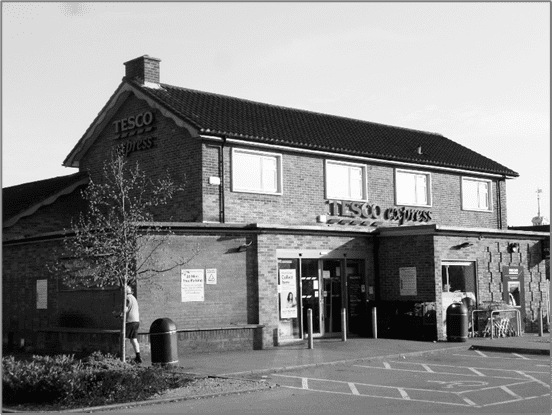
The demise of public houses in the local area has prompted a phase of demolition with replacement by housing; not so with the building under consideration. The link between Tesco and public houses is that the supermarket giant, upon closure of a public house known as The Walnut Tree, subsequently converted it to a local store. The land use prior to that of a public house goes further back into the history of the village of Lillington, when it was the site of Village Farm.
Village Farm can be traced back to the ownership of Matthew Wise, who in his will dated 22nd August 1807, identified one John Radford as his tenant, along with Frances Wright. They occupied some four acres described as “A House, Yard, Barns and Garden, an Orchard and Home Close”. In addition John Radford was a tenant on his own of a much greater area of land. His family continued to farm the land well into the 20th century, although the ownership changed.
A considerable area of land in Lillington had a restrictive Covenant in respect of Licensed Premises. However, there was a plan in 1947 to have a new pub in Cromer Road but, in the end, this was not built. The new pub in Crown Way took over the licence from The Bell in Rugby Road which had been revoked when an off-licence was built.
According to information found in The Pubs of Royal Leamington Spa by Messrs. Jennings, Ellis and Lewin, a provisional licence was granted in 1956 for the erection of a public house on the corner of Crown Way and Cubbington Road. The public house known as The Walnut Tree was officially opened in May 1958. The name, it is suggested, related to a large tree of that variety that once grew in the cottage garden. A development plan covering the Village Farm site from the 1950s shows a variety of fruit trees, but alas no walnut. The restrictive Covenant had already been breached when a licence had been issued to the Lillington Working Men’s Club some years earlier. The perceived legal opinion was that once this had taken place further legal challenge was unlikely to succeed, hence the establishment of the first public house in Lillington. In the 1960s permission was given to extend the premise to create a larger ‘outdoor’.
The public house continued to trade until May 2009, after which date it was acquired by Tesco and, utilising much of the original structure, it opened as an ‘Express’ store some 10 months later. This left Lillington without a public house, the only other, the “Jack and Jill”, Newlands, having closed in 1996 and been replaced by houses.
Peter Coulls, 2018
ACKNOWLEDGEMENTS are presented at the end of this page — CLICK HERE