
Following the First World War local authorities were encouraged by the government to build Council Housing to replace the very poor properties lived in by some of their residents. In Leamington the Borough Council showed some reluctance to comply with this. People were living in sub-standard accommodation in courts of houses where as many as 12 people could be living in a single dwelling as well as inhabiting basements subject to damp. Ironically, many of these small courts were close to Leamington’s premier road, the Parade.
In an effort to force the Council’s hand a local group of concerned citizens formed Leamington Slum Clearance Company, a public utility society, which built two estates in town with funds from subscriptions and loans, which meant 72 new properties were built leading to 67 slums being demolished and closing orders on 11 basements.
It faced many objectors to the scheme and public apathy. It organised a “Slum Clearance Week” in order to raise funds. The houses which were built were at The Holt and the Windmill estate.
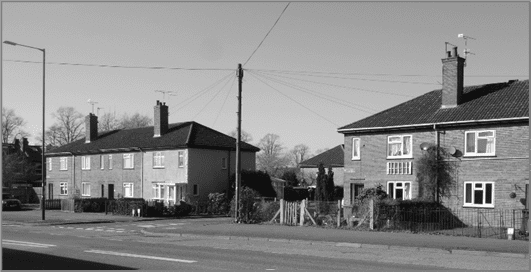
The Holt. The society acquired land in Lillington and started building. On 6th May1927 the Bishop of Coventry, Dr Lisle Carr, laid the foundation stone of the first of the houses built in Lillington in the presence of the Mayor Alderman A Holt after whom the estate was named. Eventually 18 houses were built at a rent of 10 shillings a week (50p) which was less than the council rents which were 11s 6d a week (57.5p). The houses were occupied by new residents when a closing order deeming their house as being unfit for human habitation was issued by the Council and the Medical Officer of Health.
Windmill Estate. The Society’s next major scheme came about when it acquired land at Windmill Farm with the Council lending the Society 90% of the cost of the land. The society built two-bedroom homes and also three-bedroom homes for the larger families who had the greatest difficulty in acquiring accommodation. The houses were in Windmill Road and the two corners of the road with Tachbrook Road.
In 1932 the Windmill Estate was officially opened by Lord Hanworth, Master of the Rolls and formerly MP for Leamington and Warwick. In attendance were the Bishop of Coventry, Dr M C Haigh, and Lord Leigh (Lord Lieutenant of the County). All three guests planted commemorative poplar trees on the estate. 52 houses were built on the 5.5 acres (2.2 hectares) site. All the Society’s properties were managed on the lines devised by Octavia Hill (a social reformer and a founder of the National Trust) by a trained woman housing manager. When the estate was finished weekly cookery classes were arranged on the estate and other events such as special gardening competitions.
An unusual feature on the Windmill Estate is that six houses have memorial plaques set into their front elevations. These plaques were unveiled by the Bishop of Coventry on the day the estate opened. The reason these plaques are there is that the Society introduced a scheme for funding the estate whereby anyone who donated £200 to the funds could have a memorial plaque fixed on a house, as £200 enabled the Society to build a sound dwelling.
No 195 Tachbrook Road. This house is dedicated by Veronica Batchelor, to the memory of her husband Allan Edward Batchelor born at Maindee, Monmouth in the year 1853, died 1916. Allan went to Exeter College Oxford, became a student at Middle Temple on 22nd January 1875, was called to the Bar on 25th June 1879 and became a Barrister. He served in the Yeoman Cavalry and was promoted to Lieutenant in the Duke of Lancaster’s Own on 25th March 1885. He married Veronica Luce Makins, a daughter of Baron Makins on 14th April 1896.
In 1904 he had a house built on the outskirts of Bishops Tachbrook called Greystoke on land acquired from Warwick Castle estate which he later renamed Greys Mallory (the house recently suffered a very bad fire but is being rebuilt). This was an Arts and Crafts house designed by Percy Richard Morley Holder with garden designs by Gertrude Jekyll. Holder also designed the nearby Mallory Court in the same area which is now a hotel.
The Batchelors were quite well-known philanthropists in Bishops Tachbrook and helped set up the 1st Scout Troop at the Village School, provided an alcohol-free Working Men’s Club with a mini rifle range, the site of which is now occupied by a Doctors’ Surgery. At Christmas time Mrs Batchelor and her two daughters took presents such as shawls, scarves and toys for the villagers, which were carried in a Bath Chair. They had the first motor car in the village and employed Mr Ralph Smith, a local man, as chauffeur and his sister as their cook. Allan was also a Vice–President of Leamington Cricket Club from 1907-1909.
When Allan died in 1916, his wife erected an oak door (which has Allan’s name carved into it) and frame in the south porch of St Chad’s Church Bishops Tachbrook in his memory. In 1920 Veronica sold Greys Mallory and moved to Hill Wootton. She died in Leamington in 1951.
No 193 Tachbrook Road is dedicated by Mary L Jenkinson to the memory of her mother, Lady Jenkinson, born at Enniskerry, Ireland in 1830 and died in 1915.
No 197 Tachbrook Road is dedicated by Daisy Rooper to the memory of Percy Lens Rooper, born at Uppingham in the year 1861 and died in 1930.
No 38 Windmill Road is dedicated by Mrs Graham Rees-Mogg to the memory of Edward H Douty.
No 40 Windmill Road was built in memory of two sons killed in the First World War.
No 42 Windmill Road was built in the memory of a beloved brother, Arthur Llewellyn Lloyd, born in 1855, died in 1926.
Under the Housing Act 1930 the Government gave subsidies to local authorities for building housing on the basis of the number of people rehoused following slum clearance. Accordingly the council began schemes of its own. The Society was wound up in 1937 and eventually the properties at The Holt and Windmill Estate passed to Leamington Borough Council.
Footnote on Slums in Leamington
After World War Two, in 1950, the Council embarked on a Slum Clearance programme and a new council house-building push with new estates in Lillington and South Leamington. Areas of the town targeted for clearance included the remaining courts in Brook Street, John Street, Windsor Street, Satchwell Street, Park Street, Kenilworth Street, Windsor Street, the whole of the Althorpe Street estate, the area of Lansdowne Street including Thomas Street and parts of King Street and Duke Street.
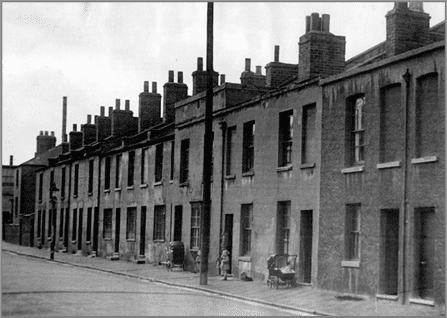
The Althorpe Street area became one of the two new post-war industrial estates. The Kennedy Square Estate was built over the Lansdowne Street area and Brook Street was renamed as New Brook Street where Leamington’s first high-rise block, Westbrook House, was built.
The Shrubland Street area including Scotland Place and parts of Tachbrook Street between Brunswick Street and Tachbrook Road were demolished and new council housing built including Christine Ledger Square.
Further slum clearance was threatened in the Shrubland Street area alongside the school but luckily the Council introduced General Improvement Areas whereby grants would be available for improving the existing properties with new kitchens, bathroom extensions and central heating.
This page is one of many which are based on articles in our book entitled A History of Royal Leamington Spa in 100 Buildings which was published in 2018 and is no longer in print.