
Warneford Hospital was one of the best-loved landmarks in the parish of St Mary’s, Leamington Spa, and was so very familiar to many of us. Perhaps we, or our children, were born in Cay Block, or maybe we had our tonsils out in the Children’s Ward. It is invariably locally called “The Warneford”.
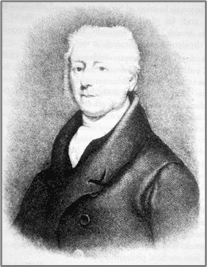
The origins of the Warneford Hospital start in a small hospital founded in Regent Street in 1825, which moved in 1834 to a new and larger building on Radford Road. The hospital owed its name to the Rev. Dr Samuel Wilson Warneford, (1763-1855) a Gloucestershire man, and his sister Philadelphia, who were both lavish benefactors over quite a wide area. They donated £3,000 of the £4,000 needed for the first building.
The foundation stone was laid on Tuesday 10th April 1832 by the Hon Charles Bertie Percy of Guy’s Cliffe House, and two of the planned six wards opened in 1834. The original maternity unit was built in 1884 and named the Herbert Beaumont Cottage Hospital. It had 10 beds and later became the Midwifery School. Even before the hospital opened the name was changed from ‘The Leamington General Hospital and Dispensary’ to ‘The Warneford and General Hospital.’ The children’s ward which opened in 1868 was named after Lord Leigh. The chapel was completed in the same year.
The hospital was entirely dependent on funds from charitable sources and voluntary donations and wards were named after generous benefactors such as Lord Leigh, and Messrs Timms, Mellor, Machen and Ryland. The foundation stone to the Victoria Wing was laid by Lord Leigh on the front of the building facing Radford Road, on 18th March 1891 following a ceremonial procession of 200 people from the Town Hall.
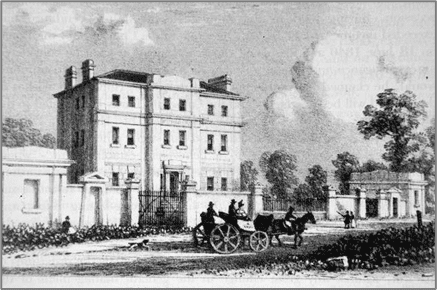
Collection of Allan Jennings
The Warneford took full advantage of new developments and it is interesting to note that the use of X-rays was pioneered at the Warneford. X-rays were discovered by Professor Wilhelm Röntgen in late December 1895 when he recorded the possibility of taking photographs of internal structures of the body. Experiments with X-rays began at the Warneford in early January 1896, but it was not until April 1897 that staff managed to develop an X-ray, despite taking over 100 plates in the first week alone.
The Victoria Wing, opened in commemoration of the Queen’s Diamond Jubilee in January 1900, had two wards named after Queen Victoria and Princess Helena.
Annie Cay, widow of a Birmingham glass manufacturer, was another important benefactor. She launched the appeal for a new maternity unit in 1935 with an initial donation of £1,000 and gave another £1,000 at the unit’s opening on 28th June 1939. The Cay Maternity Unit was named after Mrs Cay who died in April 1941 at the age of 89. By 1958, the unit had doubled in size and by 1980 it comprised 50 beds in the antenatal and postnatal wards, five delivery rooms, and an operating theatre. There was also a special baby nursery with 15 cots where premature and ill babies were nursed. The number of babies born in the unit up to 1979 averaged 1,500 a year, but in 1979 a tremendous birth boom occurred and just under 2,000 babies were born there.
The Warneford remained a voluntary organisation until the creation of the National Health Service in 1948, when the committee of management handed over control to the Ministry of Health. The committee’s expressed desire was that “The Warneford will still remain as it now is, a hospital, personal and easily accessible to all who needs its services”, but under NHS control it survived no more than half a century.
Admissions Booklets for the guidance of patients and relatives were issued by the Warwickshire Area Health Authority. A 1970’s copy advises:
“Please see that your name is put on your clothing; We regret that owing to limited storage space we cannot keep your outdoor clothes at the hospital; In the interests of your comfort not more than two visitors are allowed with you at any one time; children may visit patients at the discretion of the ward sister; earphones are supplied to most beds. Please treat your headset with care, they are difficult and expensive to maintain and patients are asked not to interfere with them”.
Perhaps the best one of all is, ‘While you are in hospital your doctor may prescribe tablets, medicines, or other treatment.’ – That’s all right then!
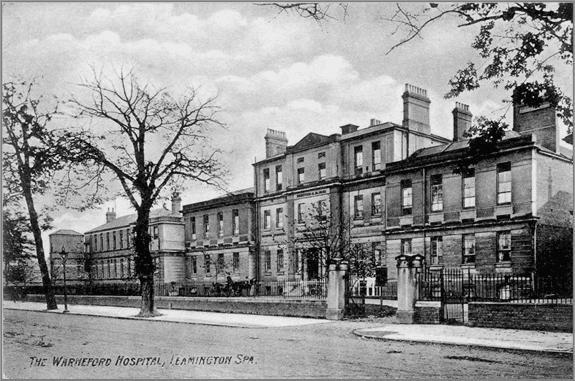
The Warneford Hospital that many of us remember was finally demolished in 1993. Once a fully functioning hospital in its own right, at the time it closed, it only had 93 beds left, mainly for female illnesses and childbirth in the gynaecology and obstetrics department. There was also a day-case unit and outpatient’s department. For close on 160 years we had the Warneford Hospital on our doorstep. How we miss it!
Postscript: ‘The Riddle of the Warneford Hospital’. In the early 1990s, as the Warneford Hospital was about to disappear for ever to make way for a new housing development, an intriguing headline appeared in the Leamington Courier: “Hospital Treasure Mystery”. When the Warneford’s foundation stone was laid in 1832, it was believed that a time capsule containing two medals and gold, silver and copper coins dating back to the reign of William IV was placed beneath the stone.
The building underwent many extensions as Leamington and district developed and required more extensive medical provision, and although the original foundation stone, laid by the Hon Charles Bertie Percy in April 1832, bore a brass plate to that effect, it is thought that it may have been covered over during refurbishments in the 1950s. Avril Middleton, chairman of the Leamington Society, issued an appeal through the press for information about the hoard, before the site was irretrievably changed. So far, nothing has come to light. Perhaps these coins, like the supposed hoard of the Lillington miser William Treen, were simply the stuff of local legend.
For more about health services in the town see the footnote to Dispensary.
This page is one of many which are based on articles in our book entitled A History of Royal Leamington Spa in 100 Buildings which was published in 2018 and is no longer in print.