
In post-war Britain there was a push to build more Council Housing. Leamington Borough Council targeted an area of land outside the Leamington Parish that was part of Whitnash in the area of Warwick Rural District Council but the Council was not happy about this and refused to negotiate with Leamington. In January 1950 Leamington Borough Council issued a Compulsory Purchase Order to acquire 19.5 acres approximately for the estate from Messrs Lines and Moore. A Public Inquiry followed after which the Order was confirmed. In March 1951 following a formal boundary change, the land became part of Leamington Borough.
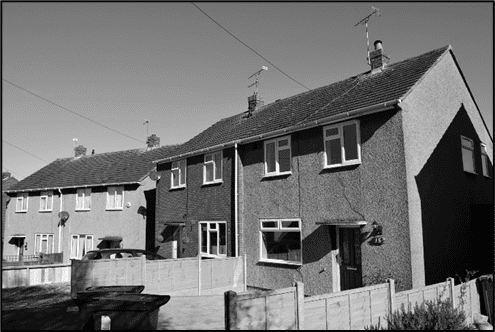
Building work started at Southway in 1951 but there were problems with waterlogged land. Gradually the Council acquired the land from its owners, one of whom was a local builder who did a deal with the Council by agreeing to build the Council Houses planned to be built in Brunswick Street in traditional style, leaving the Council free to build on his remaining land on which Southway is built.
The majority of the houses the Council built on the estate were of a non-traditional construction and were built by George Wimpey, a national chain of builders, using a system known as No Fines construction. George Wimpey and Co. developed this system of housing using no-fines concrete and traditional construction methods. No-fines concrete is made without sand and has unusual properties in that it can be cast within a mesh or standard formwork and exerts less pressure while setting than normal concrete. Its porous nature also provides some insulating properties, although not adequate for today’s requirements. In excess of 300,000 low-rise dwellings from the mid-1940s onwards were built using this system in configurations ranging from bungalows, houses and low-rise blocks of flats of up to five storeys.
The Whitnash Estate comprises mainly 2- or 3-bedroomed terraced and semi-detached houses usually with good sized gardens. There are also some three-storey blocks of flats and a neighbourhood shopping mall of eight properties, again with two floors of flats above them. They also built two sites of sectional concrete lock-up garages to rent to the tenants.
After the introduction of the “Right to Buy” in the Housing Act 1980, many properties were bought by the tenants. The remaining stock was eventually improved by Warwick District Council by building a brick skin around the existing concrete walls together with adding new kitchens, bathrooms and central heating. The estate was also one of the areas adopted for the installation of Solar Panels.
Similar non-traditionally constructed properties were built at Lillington.
This page is one of many which are based on articles in our book entitled A History of Royal Leamington Spa in 100 Buildings which was published in 2018 and is no longer in print.