
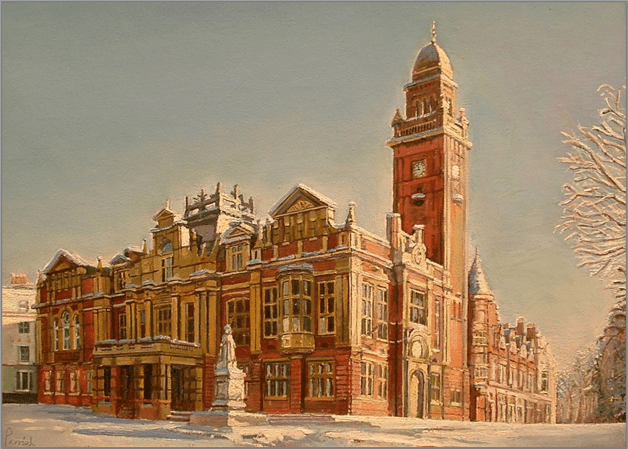
By 1881 the population of the town, now named Royal Leamington Spa, had risen to about 23,000. It was four times the size it had been when the original ‘Old’ Town Hall (see article) was built in 1830 and, consequently, a much larger building was required. Following the closure of the Upper Assembly on the Parade and Regent Street in 1878 there was also a need for another meeting place or hall. The initial idea was to use the Public Hall at No 5 Windsor Street as the new Town Hall. It was also suggested that it could be built in the gardens next to the Pump Rooms.
A special Town Council meeting in December 1880 decided on a new Town Hall and Assembly Room plus a Library, a Museum and a School of Art. The proposal to add these buildings to the Pump Rooms was agreed. There was a strong opinion that Milverton and Lillington Local Boards should also participate. A competition was organised for suitable designs and 46 sets of plans were submitted.
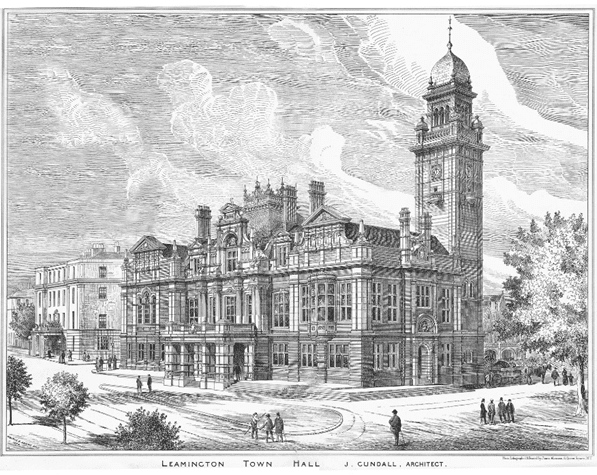
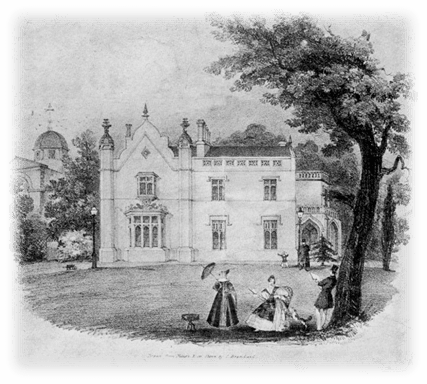
In 1881 it was decided that the new Town Hall should be built on the Parade, the town’s main street. The council initially purchased a strip of land in front of Denby (sometimes Denbigh) Villa which was built by John Williams, owner of the Regent Hotel, in 1828. ‘Denby’ is believed to have been the maiden name of Sarah, the wife of John Williams. Sadly, Sarah died in 1831. John retired to the Villa in 1834 when he sold the Regent Hotel (see article).
Denby Villa and its large garden were next to the south side of the Regent Hotel. The house and the Regent Hotel were both owned by Mr Lyas Bishop but he fell on hard times and sold Denby Villa and its garden to Mr John Fell a local builder and property developer, for £10,000. Fell served as a councillor on the Borough Council and was mayor in 1887-8. He was also involved with the local tramway.
It was initially estimated that the new Town Hall would cost at least £25,000 and the Council resolved to seek a loan from the Public Works Board for £20,000. The Council had other expensive projects under way at this time, including the waterworks in Campion Terrace, the sewage works and the ideas for a museum, library and school of art. The Council had to apply for further loan in 1884. The design was commissioned from a local architect named John Cundall in 1882 and within a couple of months tenders for building work were invited. Mr Fell built the Town Hall at a cost of £14,000. Fell had already built the Theatre Royal, on land in Regent Grove which he owned that adjoined the site.
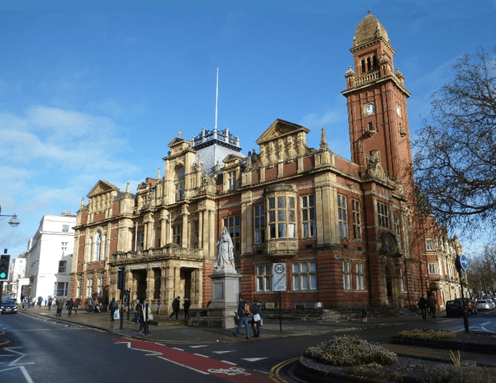
The foundation stone was laid in October 1882. The original drawings for the complex show a Library and Art School to the right of the clock tower but these were never built. That apart, the rather eclectic building is pretty much as envisaged by John Cundall. The building is mainly of red brick and creamy-brown Camden stone. This is said to last longer than Bath stone. Cundall amended the design to add more stone after building began. The mosaic on the front is of Hygeia, the goddess of good health, cleanliness and sanitation. The tower is 130 feet tall. The heating was entrusted to William Jenkins, the well-known local iron-founder, who had premises in Morrell Street. Stained glass was also installed and the Town Hall clock was presented by Alderman Henry Bright.
There was a long-running controversy between the architect and the Council about whether interior wall panelling and carpentry should be in walnut or mahogany. The architect changed it from walnut to mahogany but was forced to change it back again.
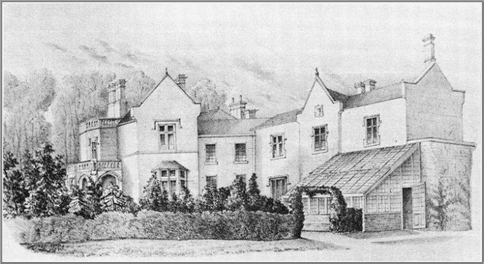
Leamington History Group Archives
The building was officially opened on 18th September 1884 with several celebrations including a large star above the entrance with the town arms in the centre, judicious lighting and decorations throughout the town. Many lamps were lit in the Pump Room Gardens and the Manor House Hotel and there was even the thrilling ascent of a balloon called Juno.
There is a carving of a bird on the top of the façade and one joker suggested that the cormorant had been placed there to show the size of the “Bill”. The name Town Hall was not universally adopted at the start and it was often called the Municipal Building in the first few years.
It was agreed that the old Town Hall in High Street should become the Police Station but it was unclear at the time whether there would be enough space for cells and Magistrates Court as well. The town library moved from Denby Villa (built 1833) to the Town Hall in 1885 and the villa was demolished soon after. The Midland Electric Light Company had installed 300 lights in the building by 1887.
The terrace known as Denby Buildings was built by John Fell in “Scottish baronial style” along Regent Grove in 1885. These buildings were restored around 2015; the adjoining Theatre Royal (see article) was built slightly before the town hall, in 1882.
The new town mobile fire-escape ladder purchased in 1890 was stored at the town hall instead of the previous site in Chandos Street.
A distinctive feature of the forecourt of the building is the statue of Queen Victoria by Albert Toft, erected in 1902. It was unveiled by Lord Leigh. It is well-known that the statue was moved on its plinth by a bomb in 1940. There is a bust of King Edward VII, also by Albert Toft, on the stairs inside the Town Hall.
The Town Hall has been used for many civic events. For example, the Mayor made the Armistice announcement on the Town Hall balcony on 11th November 1918. Bells rang out on this occasion at All Saints and St Mark’s, many flags appeared and soldiers played impromptu music in the Pump Room Gardens. On 19th July 1919 a parade of over 1,000 ex-soldiers, marched from Binswood Avenue to Jephson Gardens, and 800 men were entertained at dinner at the Town Hall.
After World War Two there were march-pasts to recognise many military units including the dissolution of the Home Guard. The Town Hall was the venue for conferring freedom of the Borough on people and in 1947 this honour was awarded to Viscount Montgomery and, appropriately, the roll was presented to him in a metal casket in the shape of a tank. In 1947 there were proposals to reuse the British Restaurant at the rear of the Town Hall and by 1950 it had become offices for the Borough Council. In 1964 a Committee of the Council stated that it was not averse to demolition of Town Hall but this did not go ahead.
The town hall is Listed Grade II. See also the article on the Old Town Hall.
This page is one of many which are based on articles in our book entitled A History of Royal Leamington Spa in 100 Buildings which was published in 2018 and is no longer in print.
View ACKNOWLEDGEMENTS as presented in the book