
This is Mark’s own brief personal and professional story about how he became interested in the history of Leamington Spa and producing films about the town’s full, varied and fascinating past and present.
I first moved to Leamington from Ealing in early 2000, with my wife Kathryn and our two-week-old son Patrick. Having decided that we didn’t want to bring up a family in London we chose Leamington as an attractive, thriving town with cheap house prices (well, compared to London anyway!), good schools and excellent connections to the rest of the country. We traded in our two-up, two-down London terrace for a detached Victorian villa in the South of the town, which gave us plenty of room for a growing family, and the option to run my market research business from home. This was originally the home of Benjamin Bradshaw, a successful 19th century builder, Alderman and member of the original Borough Council in 1875 – facts to which we were, of course, completely oblivious at the time!
As well as studying people, I’ve always had a strong interest in creative technology and story-telling and over the last 20 years my business has become increasingly focused on what is called ethnographic video research, which involves filming interviews and behavioural observations, then editing the resulting footage into compelling insight-driven narratives. From there it wasn’t a great leap into the world of documentary film-making. I started to explore this seriously from 2018 onwards, and signed up for numerous film-making courses at Film Oxford and the Midlands Arts Centre in Edgbaston.
I had become aware of Leamington History Group in 2013, when I was approached by the secretary, Margaret Rushton, to help them build a new website. As we worked together over the years that followed I grew more and more interested in the rich history of the town, and increasingly frustrated that most visitors (and many residents) know so little about this, despite the many excellent website articles, Facebook posts and books published by members of the Group.
In a world where video has become most people’s primary means of absorbing information (and YouTube is second only to Google in terms of the world’s most visited websites) it struck me that there could be an opportunity to use my newly developed documentary film-making skills to help Leamington History Group engage with a much broader, younger and more diverse audience.
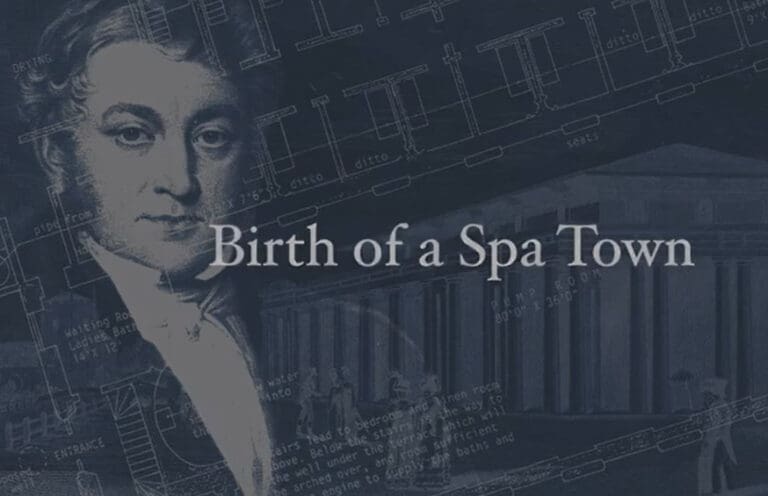
After much debate – and despite misgivings from some committee members – we agreed to test the waters with an initial production, Birth of a Spa Town. This 20-minute film tells the story of Leamington’s transformation from a small village to a thriving spa town in the late 18th and early 19th centuries, how the town became “Royal Leamington Spa”, and the demise of the original baths in Old Town. It was pieced together from a range of sources including interviews with local history experts (including some brave volunteers from the History Group), period images (many of which were kindly provided by the Leamington Spa Art Gallery and Museum), and a series of animations based on artwork created by local artist Mick Jeffs. We recruited narrators from Myton School, and local actor Alan Gill (The Crown) became “Voice of the Courier”, reading excerpts from some marvellously pompous newspaper articles of the time.
The video was published on YouTube on 23rd May 2020 and promoted via the LHG Facebook page and website and a small article on The Courier’s website. A huge amount of effort had gone into producing the final film, and we all waited nervously to see if anyone would watch it. Then, something rather miraculous happened. We were in the midst of the first COVID lockdown and people were relying on social media to stay in touch with their friends and neighbours. Word of mouth about the film began to spread online. Within a week, we amassed over 5,000 views – beyond our wildest dreams. To date over 12,000 people have watched it, and we’ve received many wonderful comments.
Moreover, the success of Birth of a Spa Town proved that there really was an appetite for this kind of content. This helped to unlock much-needed sources of funding for subsequent films, as well as making it much easier to recruit people to participate in them, including representatives from local institutions, politicians and academics. Equally importantly, it has inspired members of Leamington’s diverse communities to come forward and share their personal stories.
To date we have published a further five films:
Leamington’s Victorian Legacy (2020): the story of Leamington’s development during the Victorian Age, revealing how many of Leamington’s most famous landmarks – including Jephson Gardens, the Town Hall, the Mill Bridge and Victoria Park – came into being.
Life After Victoria (2021): the story of the town in the early 20th century – its contribution to the First World War and the Votes for Women movement, improved living conditions and workers’ rights, and the birth of some of Leamington’s most treasured cultural institutions.
Many Cultures, One Town (2023): how Leamington recovered after 1945 to become a thriving industrial and tourist town, and how people came from Poland, Ireland, India, Pakistan, Africa and the Caribbean to make Leamington their home – and the challenges they sometimes faced building a new life here. (This topic is covered in further depth in the book ‘Global Leamington’ published by LHG}.
Leamington Spa: University Town (2024): chronicling the sometimes chequered history of the town’s relationship with nearby Warwick University, how and why Leamington became a destination for large numbers of Warwick students and staff, and the impact of the University on the economic, social and cultural character of the town.
Leamington at War (2025): what life was like in Leamington Spa during World War 2 and how the people of the town contributed to the war effort.
In total, nearly 50,000 people have now viewed one or more of the films, and YouTube estimates that around half of that audience is under the age of 45 – a very different profile to those buying books or attending local history events. We really have succeeded in bringing local history to a new audience… something for us all to be proud of.
Personally, I’m pleased to say that this success has also opened other doors; I have been invited to produce several other historical documentaries, including 100 Years of The Loft Theatre Company (2023) and Lords of the Manor: The Lost History of Caludon Castle (2024). I’ve also launched my own YouTube channel (https://www.youtube.com/@postmastermedia), which features short films about local history, and discussions with local historians.
Documentary film-making has become a large part of my life, and I love it. As well as exercising my creative muscles, it has allowed me to get to know a wide range of fascinating people whose voices might not otherwise be heard. Through these films I hope that their stories become an integral part of the history of this great town.
Mark Ellis, May 2026