
This page is one of several pages which are based on articles in our book entitled Royal Leamington Spa, A History in 100 Buildings which was published in 2018 and is no longer in print.
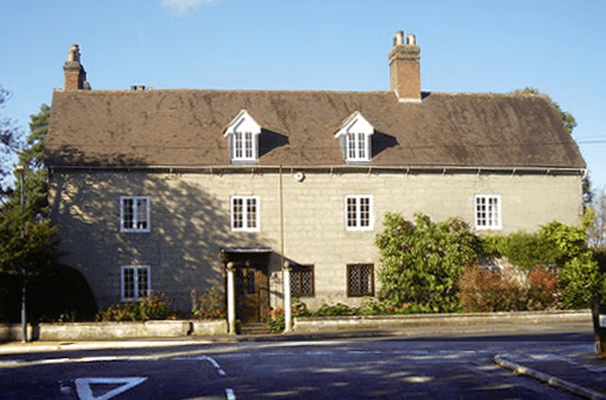
The Manor House lies at the centre of the old Lillington village, a short distance from the parish church of St Mary Magdalene, and the site of three village farms. It is thought to have been built in its present form in about 1700, though internal inspection reveals clues to an earlier building on the same site. Pevsner (2016) comments that it is thought to have been re-built in its present form around 1740 by William Smith the Younger.
Built of limestone ashlar with plain tile roof and brick chimneys, the house, attached railings, gates and piers are included in the Grade II listing. The house is built on an L-shaped plan, with three storeys including an attic with two recent gabled dormer windows. It may once have been a farmhouse: recent work to restore the north east wing and attic storey revealed a large inglenook fireplace after a mid-20th century false wall had been removed. In 1862 what was then known as ‘The Stone House near the Church’ was occupied by Captain James Montgomery of the Prince of Wales 3rd Dragoon Guards. There are further clues in the Leamington Courier online archive: Edward Greaves, a resident in 1866 advertised seed potatoes for sale, and in 1872, John Chamberlin was advertising named varieties of seed wheats. In 1874 it was called the ‘Manor House’ by the occupier Captain E Raleigh King. Another occupant, A Osmond Williams, put up four horses and a pony for auction in Rugby through Messrs Tattersall and Sons, in April 1882. The horses were described as “good fencers over any description of county, have been hunted up to time of sale, have all been driven in double and single harness and numbers 2, 3 and 4 in a tandem.” In July 1926, Mr Maurice Barnard took First and Champion with his cow “Princess Eliza” at Peterborough Show, – all indicators of farming connections.
Once surrounded by farm fields, the Manor House stood in substantial grounds of just over three acres, prior to the development of Lillington Close and Hill Close, and even as late as 1930 its orchard was often the target of local boys, ‘scrumping’ for apples. The then owner, Mrs Barnard, took a 17-year-old from Lime Avenue to court “for stealing a quantity of apples from an orchard at Lillington Manor, the property of Mrs Barnard.” She generously did not press charges, having brought the case to act as a deterrent, but the young man was fined 5 shillings, as costs. (Leamington Courier, 3rd October 1930.)
Mr Maurice Barnard bought the Manor House and its land from Lady Baker of Lincoln in March 1916. The conveyance (later mentioned in the sale documents of 37 Lillington Close) refers to the property as “that messuage or dwelling house with the stables, barn and appurts [sic] … tog[ether] with the cottage and the outbuildings and appurts thereto standing on other parts of the land …” Twenty years later, Mr Barnard sold the whole area, measuring 3 acres, 1 rod, 31 perches, to Mr Lloyd Foster Ward, Architect, of Birmingham, for £5,500, a not inconsiderable sum in those days. At intervals over the following twenty years, Mr Foster Ward sold parcels of land which became Lillington Close and Hill Close and the north side of Church Lane.
No 37 Lillington Close was sold as a plot of land of approximately 500 square yards in November 1951 to Charles Kimpton of Lonsdale Road, and a number of covenants were placed on the plot to ensure conformity with those houses already built. Mr Foster Ward’s covenants included a ban on any kind of licensed premises, a ban on trading/manufacturing, and requirements to build a house “of suitable size and quality to the existing houses”, to protect the freedom of light and air of neighbours and to maintain boundary fences in good order. Possibly a case of ‘shutting the stable door ….’ – Foster Ward’s attempts to ensure the gentrification of the area may have been as a result of events before his time that did little credit to “Lillington Manor House”: in 1882, the press reported on what appeared to be attempted murder, when a resident maid, Rose Holten, was attacked by a disappointed suitor, Herbert Allen, a carpenter from Birmingham. Allen turned up asking to see Rose, was shown into the maids’ sitting room, and when Rose appeared, promptly attacked her, brandishing a revolver. When the housekeeper heard her cries, she rushed to the rescue, and finding Rose grappling with Allen and the pistol, summoned her husband. A passing farmhand was also pressed into service to subdue Allen until a policeman arrived. The gun was discharged in the struggle, but fortunately, no-one was injured. The bullet hit the wall. Allen was committed for trial at the ensuing Assizes. He could not have helped his case when he said that he was only sorry that he was not to be tried for murder! All this came out and was duly reported in full by local and some national newspapers when the case went to court.
The Manor House staff made further headlines in February 1898, although this time, only locally. “Servants at Variance” was the story of the cook, Madam Seymour, and a maid who appeared in court with her head swathed in bandages. As a result of a disagreement between the two, – these were the days when the cook was a senior member of staff and expected absolute obedience from her inferiors, – it was alleged that the maid had been caught by the cook by her hair and punched. The maid fought back and was then hit with a poker. All this was witnessed by a third employee. Madam Seymour claimed that the maid ran on to the poker and so injured herself, but the magistrates thought otherwise and fined her £1, including costs.
In the 1940s Charles K Turner-Hughes took up residence. He was the Chief Test Pilot for the Armstrong Whitworth Aircraft Company, Coventry. In his flying career he accumulated some 6,800 flying hours in 162 different types of aircraft; quite a record. He moved from there in the late 1960s to Freemans Close, Leamington Spa. It should be remembered, however, that the Manor remains an attractive private residence.
Margaret Rushton, 2018
ACKNOWLEDGEMENTS are presented at the end of this page — https://leamingtonhistory.co.uk/articles-from-royal-leamington-spa-a-history-in-100-buildings/