
The concept of constructing hexagonal houses is not a new one, with examples surviving from the 19th century. Indeed in 1941 Sir Frederick Stewart, Minister for Social Welfare in Australia, was advocating “hexagonal houses with a hole in the roof for a chimney” as a solution to that country’s housing problem, as well as providing a bomb-proof shelter.
At a local level, Lewis and Watters Ltd. built under licence from Formula Housing Research Ltd., a group of four steel-framed hexagonal houses. They were to a two-storey modular design from John B Thorne from Thorne & Barton intended for commercial development. Three demonstration units were built in Lock Lane, Warwick in 1964, one of which eventually became an office. The suggestion was that each unit could be built in a day without the use of scaffolding and cranes. The layout was open plan, with kitchen and lounge on the ground floor with two bedrooms on the second floor with built-in fittings. The house was constructed around a central column in which all the services including the ducted warm-air central heating system was housed. Each unit would cost £1,950 plus land costs, targeted at the local authority housing market. Optimistically Lewis and Watters had programmed the construction of some 1000 houses per annum at this guaranteed price. This was not to be.
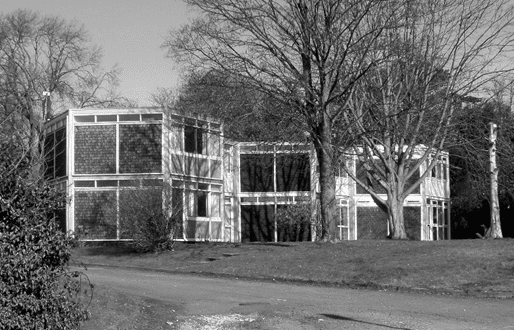
Four linked hexagonal units were constructed in 1967 on Cubbington Road, where it is said Councillors from all over the country were invited to inspect, in the hope that they would be persuaded to purchase. In order to attract local authority funding all new housing had to comply with Parker Morris space standards, set out in 1961 in Homes for Today and Tomorrow”to ensure that public housing met minimum standards relating to the number of occupants and building type, – for example, whether a flat, maisonette, semi-detached, or single or multiple storey dwelling.
The four units were sold privately for £3,500 each. It was rumoured that the owner of the Caleta Palace Hotel, Gibraltar, came over with a view to purchasing units to increase the size of his hotel. The whole project did not take off, prompting others to advocate that this lack of interest brought about the demise of Lewis and Watters. The houses are not listed but fall within the boundary of the Conservation Area. Following a recent planning application, they are likely to be rebuilt in the near future, to bring them up to present-day standards of cladding, sound-proofing and insulation.
(Note – In 2025 the four houses were demolished and a single dwelling was built on the same footprint).
This page is one of many which are based on articles in our book entitled A History of Royal Leamington Spa in 100 Buildings which was published in 2018 and is no longer in print.