
Manor Farm was the largest of the three Lillington village farms, extending over 230 acres to the Cubbington boundary. At the turn of the 19th century, all three farms were owned by local landowner Matthew Wise, whose family had owned the land since it was divided into fields almost a hundred years before at the date of enclosure in 1730. The farmhouse, dating to the early 1700s and possibly earlier, was a large building of brick on a stone foundation, with “Queen Anne” chimneys, red-tiled roof and dormer windows, surrounded by a well-kept garden and closely grouped byres, stables and outhouses, a granary and two enormous barns. In 1805, the Beamish family were granted the tenancy of Manor Farm, and it stayed in their hands for the next three-quarters of a century.
From 1836, for the next forty years, the farm was run almost singlehandedly by the widowed Mrs Mary Beamish, with a housemaid, a dairymaid, a cowman and a handful of labourers to work the land. The farm land was divided into twenty-two fields, where winter beans, wheat, barley, oats, peas, hay, clover and honeysuckle were grown. Mrs Beamish also had chickens, ducks, some milking cows, 147 sheep and lambs, and six horses for farm work. For a number of years prior to her death at the age of 86, Mary Beamish had the help of two of her nieces, Susannah and Mary Radford, whose family were tenants of nearby Village Farm (roughly where the Tesco Express mini-market now stands).
After the death of Mary Beamish, her nieces went to help their brother at Village Farm, and Manor Farm passed into the hands of the Amos family until about 1902, when Norman Hague from Cheshire took over. By this time, the land was part of the Waller Estate, and had grown to 260 acres, producing a wide variety of crops. 56 acres were devoted to wheat, 24 to potatoes (‘King Edward’ and ‘Up-to-date’ varieties), 16 to oats, 14 were set aside for swedes and mangolds, and 33 for clover. The rest was grass, except for an orchard of 3 acres in which 1000 ‘Prince Albert’ apple trees and 3000 ‘Whinham’s Industry’ gooseberry bushes were grown. In 1913 the crop of gooseberries weighed 17 tons.
The land was cultivated on the four-field crop rotation system – roots, corn, seed, corn and so on. Mr Hague also bred both horses and cattle and had a flock of 90 crossbred sheep, and 30 milking cows. The milk was bought by Leamington dairymen for supply in the town.
When Norman Hague gave up the farm in 1916, it was acquired by Edward McGregor, who went on to breed prize-winning cattle. He bought the farm at auction in October 1920, when Sir Wathen H Waller began to dispose of the Lillington portion of the Woodcote Estate.
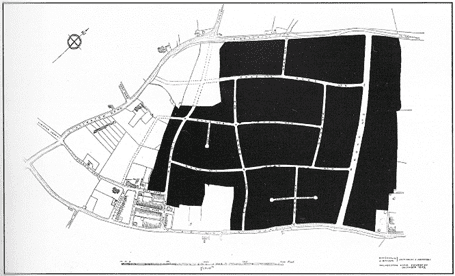
‘Eddie’ McGregor farmed successfully for over a decade, but as his interest was in cattle breeding rather than arable farming, in April 1935 he began to sell off his land for housing development. In February the following year, he made an application for the layout of future streets on his property, followed in April by a further application to build five shops between the Manor Farmhouse and the Working Men’s Club, and a ‘Motor Lorry Garage’ at the Farm. (A decision on the plan was deferred. The Garage site later became Lime Garage.) Mr McGregor also offered the farmhouse for sale or let. With a gap during World War Two, over the next twenty years, ‘Manor Farm Estate’ was eventually developed, and given the McGregor connection, the majority of the roads were given Scottish place names. In accordance with the covenants put in place by the Wise family, the original landowners, no Public House or Roman Catholic Church was allowed to be built there.
The farmhouse is now a family home, and a large barn is a two-storey industrial unit. All the remaining outbuildings are about to be redeveloped for housing, now that the pipistrelle bat colony has moved elsewhere.
This page is one of many which are based on articles in our book entitled A History of Royal Leamington Spa in 100 Buildings which was published in 2018 and is no longer in print.