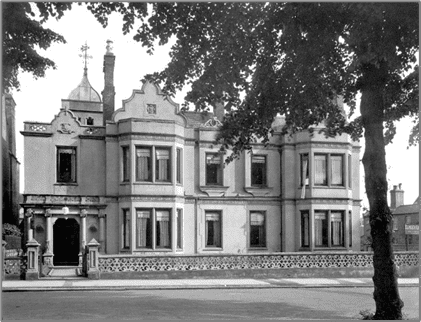
Marlborough Hotel started life in the 1850s as a private Regency house, Elmley Lodge, in Brandon Parade, designed by builder, Benjamin Bradshaw. It was No 4 Brandon Parade and later No 48 Holly Walk.
The house was to provide the future home for distinguished nobility and clergy in the 19th century and then developed as a Boarding Establishment (1919-1923), a Private Hotel (1924-39); a Ministry of Labour Hostel run by the YMCA (1941-46) before becoming the flourishing Marlborough Hotel (1946-1964).
Reverend Robert Townshend Forester moved into Elmley Lodge, from Droitwich, in 1861. He was proactive in the community, serving on the Local Board of Health. He advocated the “spiritual well-being” of all classes “high and low, rich and poor”. Forester was praised for his “magnificent generosity” by purchasing an “excellent ox” to donate Beef for the poor for Christmas. During his time at Elmley, he appealed vehemently against the valuation rate of his house (£200), claiming it was ‘influenced by the decorations and fittings instead of the “rental value”’.

Collection of Stella Bolitho
Following Forester’s death in 1867, Elmley was sold, including its “elegant furniture, objets d’art, splendid tapestries [and] cellar of old wine”. The plan shows the grand design of the house and garden.
Captain Alexander Stephen Creyke then occupied Elmley from 1868-1874. He was proactive in the Leamington Priors Association; and the Warwickshire Horticultural Society, participating in the Jephson Gardens Floral Fetes. When his housemaid, Ann Horn, stole “his gold and carbuncle sleeve links … [worth] half crown and a shilling”, Creyke attempted to withdraw the prosecutions but then requested leniency for her; she was sentenced to two weeks imprisonment.
Lt Colonel Morgan James Saurin of the Pembroke Yeomanry Cavalry, and a Magistrate, moved in (1879-1886) with four children and six servants. The next arrival at Elmley, was Sir Charles Frederick Smythe, Bart, of Acton Burnell, described as “a gentleman renowned for his lavish hospitality” (1887-97). Finally, the last private resident was Mrs Louisa Gilpin-Brown (1900-1916), an active Arts supporter in the town. After the First World War, Elmley experienced the same staffing and financial difficulties as many other large houses. Subsequently, it became a Boarding Establishment (1919-1924), run by Mrs Bunce who obtained a Dance Licence (1921) and held Ballroom, Tango, and Jazz classes with Miss Gertrude Roake. During one Dance, a Cloakroom theft took place: a certain Gerald Matthews “narrowly escaped conviction” but his accomplice was sentenced to 1 month’s hard labour (1924).
Mr & Mrs Geoffrey D Smith then took over the Elmley Lodge Hotel, continuing ‘dancing and deportment’ classes. William (1873-1948) and Flora Ellen Smith (1898-1981) then developed the Elmley Lodge Hotel from 1925-1938, offering tea dances, dinners and community entertainment. The Smiths also owned the Central Hotel, Euston Place.
William, and his two sons, Peter and Reginald, seem to have some bad luck with motoring offences over the years, regularly appearing in court: William hit a cyclist with his car, failing to report the accident and was fined 10s (1938), and a similar offence in Kenilworth Road (1934) when he claimed “Not much damage was done … the whole thing is ridiculous.” In 1941, Reginald crashed his lorry into a bus, in Rugby and was also caught speeding (£1 fine) in Tachbrook Road (1944). Finally, Peter was fined 20s (1949) for not having a Car Registration.
During Black-Outs, Reginald was also fined twice for “unscreened hotel lights” at the Central Hotel. Even Flora was fined 2s in 1940 for not having a dog licence and also for repeated Black-Out transgressions.
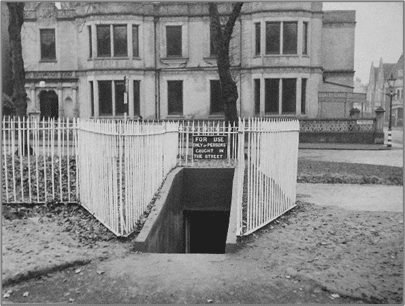
Photo Alan Griffin Collection
During World War Two, Elmley House was requisitioned by the Ministry of Labour as a Hostel for workers, until 23rd August 1946. Having survived the 1940s Brandon Parade bomb damage, Flora returned as sole proprietor (1946-1954), reopening under the new name of the Marlborough as ‘the hotel with a charm of its own.’ To celebrate, there was a Grand Opening Evening Dinner, with the ‘Jackson Cox County Club Orchestra.
The renovated hotel now offered an innovative programme of dinner dances, community entertainment (orchestras) and modern accommodation; this included Wedding Receptions, Afternoon Teas and Sunday Roasts; dinners were also hosted for local groups (Ex-Services Welfare, Warwick School and Rotary). Flora was granted a licence (1947) to provide conference facilities. At the time, it was considered that Leamington had “a shortage of hotels” and expected “large numbers of visitors” in the summer. Active marketing promoted the Marlborough and its famed ‘Restaurant Française,’ including vintage wines.
Although Flora remarried in 1952, she retained the hotel until 1954. After the death of her second husband, Captain James Imrie Herd, Flora subsequently married Major Courtenay-Thompson (1956) and continued to live in Leamington. Marlborough Hotel was then sold to Miss Rosemary Robson of the Grand Hotel, Rugby, who owned the Marlborough until 1964. From 1965 onwards, Banbury Buildings Ltd took over the premises as their headquarters and an office building replaced the elegant hotel.
This page is one of many which are based on articles in our book entitled A History of Royal Leamington Spa in 100 Buildings which was published in 2018 and is no longer in print.