
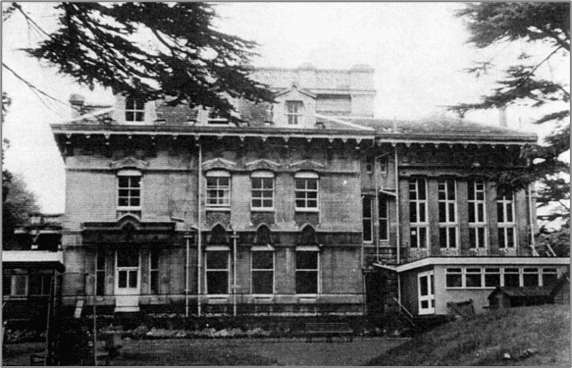
Photo Margaret Rushton
Milverton Lawn is now apartments, but was once a substantial Victorian family home, with a ballroom and fine reception rooms.
The first owner of the house was a Leamington banker, Hubert Lloyd Esq, whose initials are still to be seen engraved in the design of the columns flanking the main entrance. In 1851, Hubert Lloyd and family lived at No 1, Leam Terrace, (1851) then at 43, Upper Parade (1861), – also the address of the Warwick and Leamington Bank Company, where Hubert was Company Secretary, – before moving to Milverton Lawn at 15 Warwick New Road.
The plans were drawn up by George Thomas Robinson, F.R.I.B.A, (a Leamington architect and drawing master who lived at No 14 Milverton Crescent). They probably also show adaptations to the existing building, as although undated, they were approved in 1878, according to documents held at Leamington Library. The plans show rooms of elegant proportions, – a Dining Room 29’ long and 18’ wide, a Drawing Room of similar proportions, both overlooking the garden at the rear. There was also a Library, adjoining a room 18’ x 13’, leading from the entrance hall and designated ”Waiting Room”. The kitchen provided a spacious work area of 20’ x 18’, with a large scullery, pantry and larder and a beer cellar across a small passageway. Close by were the strong closet, the butler’s pantry and the servants’ hall. Across the kitchen court and linked by utility buildings was the stable block, with a large coal store, stabling, harness room and coach house. Above, there was a bedroom, a good-sized living room and an extensive hay loft. Hubert Lloyd, the son of Alfred and Anna Lloyd, was born on 25th October 1820, in Leamington. By 1841, aged 20, he was living at Warwick Road, Tower Hamlets, with his mother Anna, his sister Ellen, also aged 20 so presumably his twin, a 15-year-old brother, Ambrose, and three female servants. Hubert went into banking. He married Jane Brander Potts in London on 26 April 1848 and returned to live in Leamington. Their first child, Jane Anna, was born on July 22nd the following year, but died aged about four weeks on 20th August. This sad event was to be repeated over and over again in the next decade.
The Census taken in March 1851 shows Hubert at No 1 Leam Terrace, with a second daughter, Amy, aged 6 months, his mother-in-law Mary Ann Potts, a cook, a lady’s maid, a housemaid, and a [children’s] nurse. In the town directories of the time he is described as “Gentry”, but on the Census return Hubert’s occupation is given as “Banker’s Clerk”.
Jane Lloyd’s whereabouts are not recorded, but in 1852 she gave birth to a third daughter, Mary Ann, born on 27th January, and baptised two days later on the day of her death, 29th January 1852, at St Mary’s Church, Leamington Priors. The christening document gives Hubert’s occupation as “Banker”. Jane and Hubert then had two more daughters, Alice, born in the autumn of 1856, and Lucy, born in 1859, and two sons, Ambrose, born in December 1853, and Hubert on 18th April 1860. Hubert died aged two weeks on 30th April, followed by Jane, his mother on 6 September.
In April 1861, Hubert, then the Company Clerk of the Warwick & Leamington Bank, Alice, aged foue, and Lucy, aged two, were living with a housekeeper, a cook and two housemaids at No 43 Upper Parade. Ambrose, aged seven, was registered on the Census return for that year as a pupil at a private school at No 2, Binswood Terrace East. Ten years later, Hubert and Ambrose were in residence at Milverton Lawn, together with their three servants, Rhoda Smith, Emily Holmes, and Mary Rees. Hubert aged 50 was described on the Census return as a Landholder and Householder, so presumably he had retired from banking by this time.
Ten years on again, Hubert and Lucy were staying in the Royal Crescent, Ramsgate, whilst Alice was boarding in Kensington. Hubert Lloyd was never to realise the dream of thirty years earlier when he commissioned an elegant home capable of accommodating a large Victorian family and a fleet of servants. He died in May 1881, leaving a son and two daughters, all in their twenties. Unmarried and living on their own means, Alice and Lucy went on to live together as boarders first in Dover then Folkestone. Ambrose became an agricultural pupil of William Tucker, at Bashley Manor Farm, in Milton, Hampshire, but by 1891 he had given up the idea of agriculture and was also a boarder living on his own means in Lowestoft. He died unmarried in 1917 aged 63 in Norfolk. From about 1877 to at least 1891, Milverton Lawn was occupied by Joseph Hinks, JP.
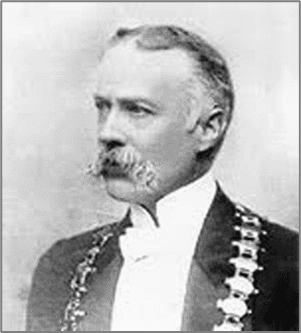
Collection of Margaret Rushton
Originally from Birmingham, Joseph Hinks was a retired oil lamp manufacturer and inventor who later became Mayor of Leamington. Joseph and his wife Frances had 8 children, two born in Acocks Green, Birmingham, three in Sutton Coldfield, and the younger three in Leamington. According to Hinks family research, Florence, the eldest daughter married a doctor and lived in Somerset, where she had her first daughter, then in Devon, where their second daughter was born. One Leamington-born son, Bertram John Hinks, was involved in scandal: he divorced his wife in 1909 when she ran away with their doctor.
Bertram’s younger brother, Ernest, went out to South Africa and was killed in the war there in May 1902. Once their family had left home, Joseph and Frances Hinks moved from Milverton Lawn to Chesford Grange, a handsome house Joseph had built on the outskirts of Kenilworth (now a hotel and conference centre), and then to Castle Lane, Warwick. They eventually moved away from the Midlands, to Orkney Cottage, Taplow, where Frances died on 5th August 1928, and Joseph on 24th April 1931.
William Lord Bollin Hinde and family who were then living at 19, Priory Terrace, Leamington, took over Milverton Lawn from Joseph Hinks, living there until 1907. Born in the spring of 1856 in Birmingham, like his father and grandfather before him, William became a brush manufacturer and general merchant. He was already at work as a brush maker by the age of 15, and by the age of 24, he was married with a daughter, Gladys Gwendoline, and living in Yardley, then one of the outlying districts of Solihull. William is described on the 1891 Census return as a hardware merchant, and apart from finding a later listing in the Post Office Telephone Directory under the number Leamington 680, it is difficult to uncover much information about his working or social life in the Spa. What is traceable is that William sailed backwards and forwards between Liverpool and New York several times in the 1890s. This raises lots of so far unanswerable questions. Why did William visit the USA so often? Were these social visits? Did he have trade connections in the United States? Who knows? At all events, after Gladys had married in 1901 and Dulcie in 1905, the Hindes moved away from the district in 1907.
The next tenants were Mr & Mrs Austin Edwards, formerly of Warwick, who lived at Milverton Lawn with their only daughter Sadie for the next five years. Austin Clay Edwards was born about 1865 in Wrexham, North Wales. His father was a photographer from London, and Austin became a photographer’s assistant, and then a photographic film manufacturer, with premises in Coventry Road, Warwick. Austin was one of Leamington’s first car owners. An archive photograph of 1911 shows him sitting proudly in his car outside the front door. By 1912, Austin Edwards had moved back to Warwick where he continued to develop his film manufacturing business. He is remembered today as the founder of the Austin Edwards Charity, which still supports Warwick residents in further education with grants for musical instruments and other equipment.
The next owner of Milverton Lawn was William Walter Westwood, formerly of The Grange, Southam. He bought the property via a number of mortgages which eventually bankrupted him, and he moved to 91, Holly Walk. The house remained untenanted and vandalised for about six years, until 1920, when Gilbert Sydney Farnfield, M.A, a schoolmaster, set up Milverton Lawn Preparatory School there. The school was so successful that it quickly outgrew the premises, moved to Warwick to become Emscote Lawn, and the house was left empty again.
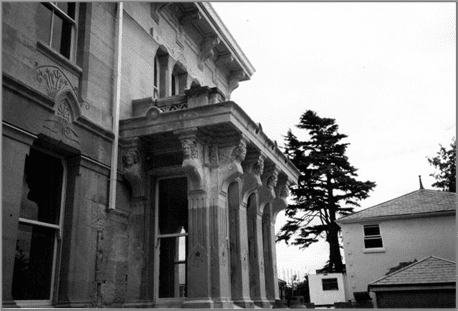
Photo by Derek Billings
In 1924 the house was bought at auction by the Royal National Institute for the Blind and renovated and reopened two years later as The Sunshine Home for Blind Babies (Telephone: Leamington 220). It was later known as the Sunshine House Nursery School. Although Sunshine Homes closed the school in about 1986, when the kind of provision they offered was less needed owing to changes in educational legislation, and the site again became the target of vandals, it was redeveloped in the 1990s as apartments and mews cottages. In 2018, there is still a Sunshine House sign on one of the gateposts. It is Listed Grade II.
This page is one of many which are based on articles in our book entitled A History of Royal Leamington Spa in 100 Buildings which was published in 2018 and is no longer in print.
ACKNOWLEDGEMENTS as presented in the book