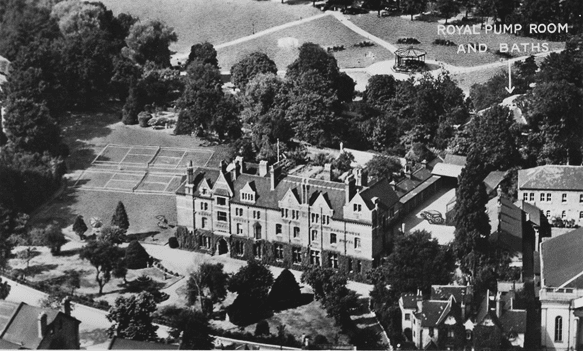
Built as the Wise family home in the Queen Anne style in about 1740 with a handsome Chippendale staircase and two dovecotes at the foot of a three-acre garden, the Manor House subsequently saw many alterations and adaptations.
When Matthew Wise married, he built Shrubland Hall on the outskirts of the town, leaving the Manor House to become an hotel in 1847, managed by Isaac Curtis who previously managed Wise’s Baths. The further particulars published when Curtis had to sell up, included the claim that it was “surrounded by upwards of 3 acres of its own pleasure grounds, laid out with great taste, and bounded by a richly wooded bank on the River Leam.”
The house was approached by carriage drive through an avenue of stately trees and adapted for the Hotel business to contain entrance hall, coffee room, commercial room, smoking room, and two private sitting rooms of good dimensions, nine excellent bedrooms, two kitchens, taproom, waiters’ pantry, brewhouse, extensive cellaring and convenient offices. It also had stabling, a coach house yard, a walled kitchen garden, a large bowling green, a bowling alley and quoits ground.
At some point, the Manor House briefly became a school, the Manor House Academy, under Mr Richard Webb, but soon reverted to Hotel status. Thomas Ratclyffe the Ironfounder was instrumental in the re-granting of the spirits licence in 1871, when he made the case that the growing town needed more licensed premises, for the comfort of visitors.
William Walsh was then the manager. His Cash Book detailing transactions from 1873 to 1878 show quarterly rents of £150 paid to Mrs Wise, and regular payments to local tradesmen which read like the ‘Who’s Who’ of the 1870s spa town. William Walsh traded with Kinmonds, soft drinks, J Edwards, butcher, A Harris, grocer, J Hudson, baker, Perkins & Co, nurserymen, J K Williams, fishmonger, Lewis & Ridley and Flowers & Sons, ales. He dealt with Wackrill’s the drapers, and Blacklock’s, Manders and Kelly & Co for printing. In 1875, the Hotel’s Farm account shows payments of £45.6s.3d for butter and cream, £9.0s.0d for 20 sacks of potatoes and £291.16s.3d for meat. The Servants’ Wages from Christmas 1874 to September 1875 amounted to £114.19s.0d and Walsh’s own salary was £50 per annum. At the close of his tenure in November 1878, he was paid £100, that year’s salary, plus a year which had been omitted. He also received a bonus of £5. The wages bill to the end of November was £148.12s. 4d.
In 1878 Emile Duret took on the lease and seemed set fair. He began by extending the bedroom accommodation. Six years into his tenancy, however, Duret was driven to bankruptcy, even though he had developed the “Family, Commercial and Tavern Business”. Each time additions and improvements were agreed, Mrs Wise raised the annual rent, often by a large amount. Duret’s rent in 1884 had risen to £570 per annum (about £63,840 in 2017). The hotel already had a name for hosting annual dinners for associations such as the Warwickshire Regiment, the Fire Service, the Lawn Rackets Club, The Quoits Club, and there were Band Concerts in the grounds. In an effort to make ends meet, Duret developed a sideline in jewellery and fine art, using his contacts from earlier posts in London and Paris, but in August 1884, he surrendered the business to a Mr Percival, who built the West Wing, and carried out further enlargements in the early 1880s, when a second wing, a large ballroom and a dining room were added. In 1885 Percival sold the goodwill and the lease to a fellow hotelier, a Yorkshireman named Robert Lamplough, and the business remained in the hands of Lamplough and his sons until 1932.
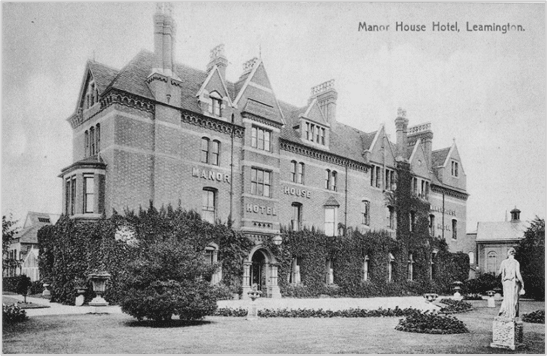
In 1889, Robert Lamplough erected the billiard room and smoke room; and shortly after the turn of the century, garage accommodation was provided. In the 1920s, the hotel had four private sitting rooms, named Warwick, Leigh, Brooke, and Percy. It was claimed that the late Lord Leigh, when staying at the Manor House Hotel preferred to use “Percy”; the late Lord Warwick, “Brooke” and Earl Roberts, V.C, on the other hand, preferred “Warwick” above all others, but this may have been hearsay, or a simple marketing ploy.
During the Great War and throughout the training of the 29th Division in Warwickshire, up to their departure for Gallipoli, the Manor House Hotel became the headquarters of the staff, and General Shaw and General Hunter-Weston resided there subsequently. Several colonial officers, recommended by the War Office, convalesced there.
The hotel’s greatest claim to fame was enacted on its lawns in 1872, when England’s first game of “Lawn Tennis” was played there by Major T H Gem and Mr J B A Pereira (a Spanish wine merchant then living in Avenue Road). They went on to found a “pelota” club in conjunction with Dr F H Haynes and the late Mr A W Tompkins. (Pelota was the name originally given to lawn tennis.) County and “Varsity” lawn tennis matches then quickly followed on the hotel’s five courts. Tennis Tournaments were not the only marketing stratagem employed by Lamplough: as Jubilee Day approached in June 1887, he advertised in the Leamington Courier, offering admission from 11.30 am to 11.00 pm to the Hotel Grounds at 6d per head, to enable people to watch the Jubilee Sports and Amusements taking place in the Pump Room Gardens opposite. The proceeds were to be donated to the Fund for the Dinner for the Poor, and the Cottage Demolition Fund. Lamplough was an astute businessman who made the Manor House Hotel the centre of attention. Two of his sons took on the management after his death in 1903, but although they had grown up in the trade, they did not have their father’s flair. Nor did they own the building (it was still in the hands of the Wise family). Like many other enterprises, they were hit hard by the Great War, and the huge social changes it brought about. In 1932, the Wise family sold the Hotel to a syndicate of local businessmen; a succession of owners subsequently ran it successfully for very many years. The hotel was occupied by the Ministry of Transport in World War Two.
As times changed in the mid-1960s the location of the first tennis courts was lost to a multi-storey development named Manor Court. In 2005 the hotel itself closed to be converted and extended as luxury apartments.
Footnote on the History of Hotels
Once the springs were discovered and developed and the village of Leamington Priors began to flourish as a spa town, wealthy visitors flocked here to socialise and to take the waters. As was the custom, they stayed for ‘the season’, and accommodation had to be found for them, their families and their servants. As appropriately large houses were built as rapidly as materials and transport allowed, suitably appointed Hotels were needed: early visitors’ accommodation in establishments such as Sinker’s Hotel on High Street, The Orange Hotel in Clemens Street, and over the canal bridge in Brunswick Street, The Castle Hotel, was at best basic.
Moncrieff in his Guide in 1818, claimed that
‘every cottage made haste to look like a house and every house offered a lodging, …every summer presented some fresh claim to the favour of the public.’
Amongst the earliest hotels were the Blenheim Hotel (1812) on Clemens Street, the thirteen-bedroom Bowling Green Inn (see article), and The Crown Hotel, built in 1808 as a Vicarage for Rev. Wise. It became an inn in 1815, after many years’ use as a school. Copps’ Hotel (see article) on High Street came next in 1817, and the Bath Hotel, (formerly The New Inn (see article)) in Bath Street, both ideally situated for the Theatre and the Assembly Hall, later known as The Parthenon. There was also The Guernsey Temperance Hotel just off Bath Street, at the end of Regent Place. Another significant factor was proximity to the Turnpike Road (High Street), from where as many as twenty coaches per day left for local towns and cities further afield.
Although as early as the 1820s, stiff competition from Midland spas such as Malvern sprang up, Leamington Priors was flourishing, and landowners such as Matthew Wise, Edward Willes and Bertie Greatheed began to cash in, selling parcels of land north of the river. The first hotel built in ‘the new town’, was The Bedford Hotel at the centre of Union Parade. It opened in 1811, under the direction of Mr & Mrs Williams who later ran the Regent Hotel (see article). The Bedford had 50 bedrooms and numerous spacious public rooms. Its extensive mews and stables were very popular with The Warwickshire Hunt and those who came for the Steeplechase. Eight years later, in 1819, the Williamses expanded their business, taking the newly-built Regent Hotel, thought to be one of the largest hotels in Europe at the time, with 100 bedrooms and one bathroom. Prior to building the hotel, Mr Williams had acquired the nearby King’s Mews and Stables, and these were incorporated into the new development. Arrivals and departures of guests were published weekly by the local press, so it is possible to construct a hierarchy of the fashionable places to stay. Noblemen and their families, people of wealth and social standing, opted for The Regent; sportsmen chose The Bedford; businessmen and tradesmen opted for Copps’ Royal, The Clarendon or The Blenheim.
The Bedford and the Regent were not the only hotels north of the river. The Golden Lion (see article) opened in Regent Street in 1810, and the Angel (see article) at the junction of Regent Street and Regent Grove in 1814. The Warwick Arms was a commercial inn on the same road, which retained its name and image until 1985. It has since undergone a number of refurbishments and changes of name and is now largely a ‘gastropub.’ The purpose-built Clarendon Hotel opened at the top of Upper Union Parade in 1830, closing finally in 1984, but retaining many of its original architectural features, such as the portico. In recent years, it has undergone redevelopment as apartments, and the 19th century addition facing Kenilworth Road became offices for a while, before also becoming apartments. Towards the middle of the 19th century, Leamington’s fortunes slowed, with the nation-wide effects of the Napoleonic Wars, a slump in the building industry and the collapse of the Warwick and Leamington Bank, but speculative building continued in some quarters of the town. Two more hotels appeared on the Parade, – The Imperial, half-way along Lansdowne Terrace from the Clarendon, and The Lansdowne on the corner of Warwick Street.
In the 1890s, there were just short of a hundred small hotels, inns, boarding houses and apartments, attested by the advertisements in local guidebooks and the press. Booking.com lists about a dozen in 2018.
This page is one of many which are based on articles in our book entitled A History of Royal Leamington Spa in 100 Buildings which was published in 2018 and is no longer in print.