
The Gardens. The gardens themselves are, of course, the main reason for visiting them. However, over the years, the gardens have been enhanced by the erection (and occasional replacement or removal) of several buildings. The word “building” has been given a wide meaning in this article.
The Gardens were the private woodland and garden of the Willes family of Newbold Comyn and they extended to 13 acres. One of the first times they were opened to the public was for archery in 1832. The gardens were therefore earlier known as Newbold Archery Ground or Newbold Wood Walk. They opened to the public from 1832 for three hours each morning during the summer and were landscaped as an Arboretum by J G Jackson, (an architect, and Edward Willes’ Land Agent) in 1834.
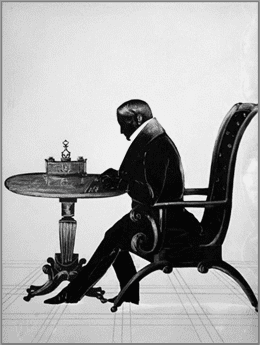
Image Leamington Art Gallery and Museum
J G Jackson lived in Strawberry Cottage to the north of the Parade entrance; this cottage was demolished in 1867. The site was then taken into Jephson Gardens and used for the construction of the Hitchman Memorial Fountain which was unveiled in 1869.
Willes covenanted that the land should never be built on in 1836 and leased it to a local consortium for 2,000 years at £30 per year. Trustees took over the Gardens in 1846 and they were named after Dr Henry Jephson, the leading advocate of the efficacy of the spa water. The formal opening of the Gardens was in 1848. The purchase of the Gardens by the town was finalised in 1854. The Town’s Improvement Act of 1896 led to the purchase by the Corporation of Jephson Gardens as well as Victoria Park and Perkins’ Gardens.
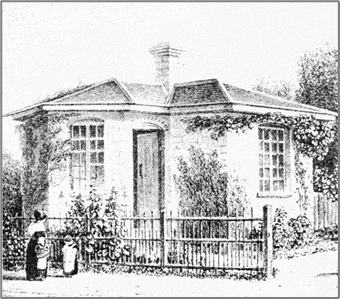
Photo Leamington History Group Archives
Paved paths were laid in 1843 and the lake was excavated by 1846. The design of the Gardens was further improved by John Cullis of Ranelagh Gardens in 1847. In 1890 a maze was made by the river to the east of the centre of the Gardens. A replica of Hampton Court fountain was installed in the lake in 1925. A second fountain was added later. The Gardens were greatly improved under the leadership of Alderman A Holt around 1909.
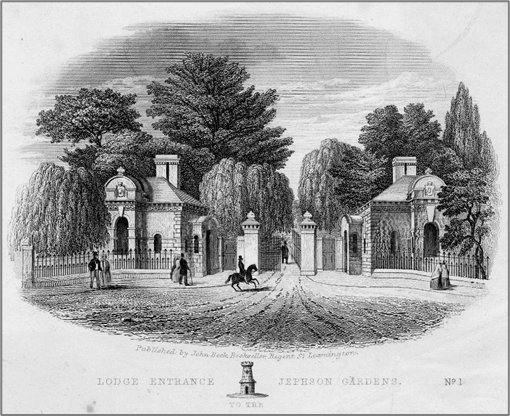
Image Leamington Spa Art Gallery and Museum
An interesting period in the history of the Gardens was from 1951 to 1961 when the “Lights of Leamington” were a popular sight for visitors from miles around. They were prompted by the Festival of Britain 1951.
In 1963 one turnstile remained within the Gardens in the toilet. It was claimed that no law said it had to be removed. The turnstiles at the entrance were removed in 1971 when decimal currency was introduced and they could not readily be converted to the new coinage.
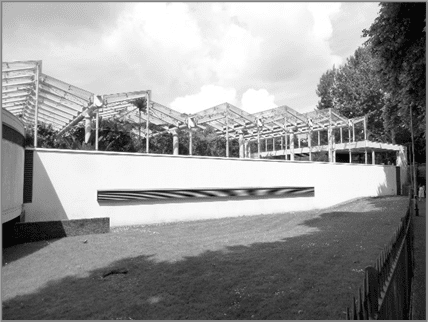
A large area of glasshouses which had been used for growing plants for the Gardens and other Council flower displays in the town was demolished in 1994. The remaining potting sheds were removed in 2000. The area was used to build a restaurant and the Glasshouse which is an attractive space which is home to many tender plants.
New toilets were built in 1994 which, to some extent, mimicked the design of the aviary. A new temperate house and the Pavilion restaurant were built in 2003. A sculpture of a mahout and three elephants, designed by Nicholas Dimbleby, stands near the new Glasshouse restaurant. It arrived there in 2008; it was originally in Whiteheads Court at the Royal Priors, when it was unveiled by the Queen in 1987.
Collection of Alan Griffin
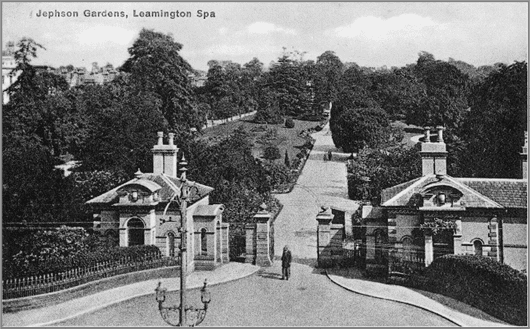
The Lodges. The two lodges at the Parade (western) end were designed by Daniel Squirhill in 1846 after he won a design competition. They are both Grade II Listed. In 1847 the South Lodge was the home of the porter and provided a meeting room. The North Lodge was used as a florists’ shop, run by John Cullis of Ranelagh Gardens, from 1847 until his death in 1849. The North Lodge was used by the Telegraphic Company from 1853 to 1870. South Lodge was extended in 1857. North Lodge was the coal office of Henry Banks from 1881. North Lodge became the office of the parks’ superintendent in 1896. South Lodge was no longer used as accommodation after 1949 and was used as an Information Centre in the 1970s and 1980s. The East Lodge by the Willes Road entrance was designed by J G Jackson between 1845 and 1855. It is also Listed Grade II and, having once been the home of the Park Superintendent, it houses a Community Art Gallery.
Collection of Alan Griffin
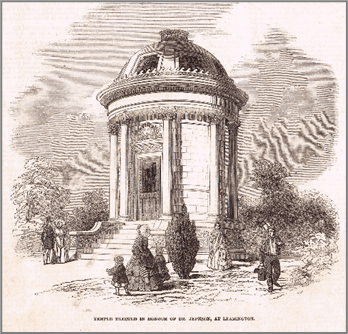
Monuments. The Jephson Temple, with a marble statue made by Peter Hollins, opened in 1849. The temple itself was designed by Daniel Squirhill with Corinthian columns. The Hitchman memorial fountain was unveiled in 1869; it was designed by John Cundall and is described by Pevsner, perhaps unkindly but accurately, as “rather hilarious”. The obelisk for Edward Willes Esquire on the main avenue is dated 1875 and was also designed by John Cundall. Perhaps belatedly, it recognises that Willes gave the site of the Gardens to the town. It is a pale grey granite obelisk on a Derbyshire stone base. A clock tower in memory of Alderman William Davis was designed by F W H Lee and built in 1925; Ald. Davis had been mayor three times. All three monuments are Grade II Listed.
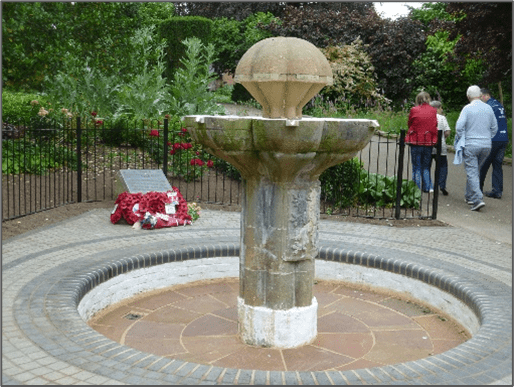
Photo Michael Jeffs
The Czech Memorial Fountain was erected nearby, in commemoration of one of the most daring undercover operations of the World War Two. It was planned at Harrington House (see article) opposite the Gardens and carried out by seven Czech Brigade parachutists who were billeted locally. The operation was code-named Anthropoid. The fountain, designed by local sculptor John French and made from Hornton stone, was sponsored by the Association of Czech Legionnaires. It was unveiled by the Mayor, Miss Renee England, in October 1968. In 2018 the memorial was Listed Grade II.
A floral clock was made and new gates were commissioned for the Parade entrance in 1948. In 1996 a standing stone was erected near the lake in memory of W H Auden, designed by Richard James Kindersley. In 2014, ‘Barbed Poppies’, a metal sculpture was unveiled close to the Aviary. By metal sculptor Tim Tolkien, it pays tribute to all those who played a part in the First World War, including those at home, and features three poppies, – one in bud, one fully open and one seed head. Its symbolism can be interpreted in very many ways. In May 2016, Tim Ward’s interactive memorial to 19th Century Borough Engineer William de Normanville was erected alongside the central path, at the edge of the top lawn.
Collection of Margaret Rushton
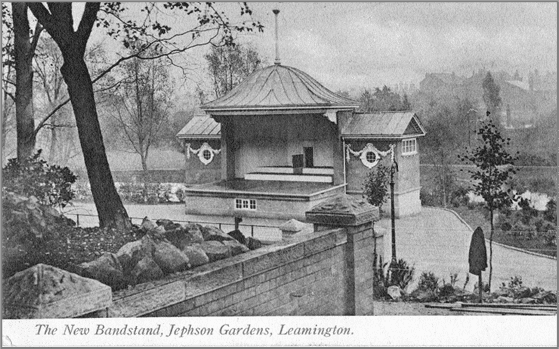
Bandstands and Pavilion. The first Bandstand in the Gardens was built in 1852. A new bandstand was finished in 1893. It was built further from Newbold Terrace because residents of the street objected to the noise of the bands and the crowds so close to their homes. Another Bandstand opened in 1909 along with a glass-roofed auditorium or pavilion near the river. They were paid for by the owner of Harrington House. The Pavilion was refurbished in 1926 and was still being used for Wrestling shows in 1963. In 1966 it was agreed that the Pavilion was unfit for purpose and it became disused. The bandstand and Pavilion were demolished in 1973.
Aviary and Cafés. The Aviary was erected between 1870 and 1880 and is Grade II Listed. A Tearoom was opened in 1899 in the building that had been the aviary and, rather obviously, it was called the Aviary Café. There was a Riverside Tea Garden in 1938. It was agreed to reconstruct the café in 1959. In the 1960s the Tearoom was converted back to an aviary and in 1985 it was agreed to refurbish the aviary and pergola. In yet another volte-face the Aviary reverted to become a café in 2000.
This page is one of many which are based on articles in our book entitled A History of Royal Leamington Spa in 100 Buildings which was published in 2018 and is no longer in print.