
Jane Elizabeth Tolson was born in Yorkshire in 1879 and followed her older brother, John Edwin, into the teaching profession. A qualified teacher, geography specialist, member of the Royal Geographical Society, able linguist and inveterate traveller, Miss Tolson held a series of teaching posts, becoming a head teacher for Staffordshire County Council by 1911. It was whilst she taught at Quarry Bank, Worcestershire, that she met her future husband, Albert Shaw, a Mineral Water manufacturer. They married in the spring of 1924, but sadly, Albert died later that year.
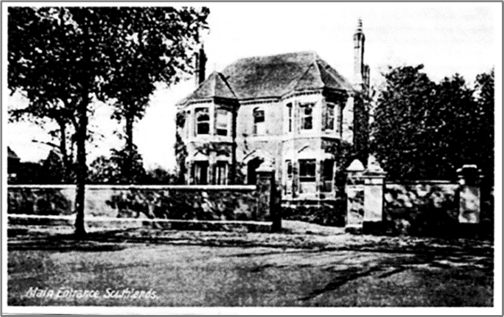
Mrs Tolson-Shaw subsequently came to Leamington where, in 1933, with only 5 pupils registered, she founded Southlands School at 85 Radford Road. She named the school after her old college, and, according to contemporary Nickie Hall in a memoir, as she loved “royal” purple and often wore it, she chose the colour for her pupils’ uniform. The school motto, incorporated into the gothic silver “S” embroidered on the uniform was “Service.” Mrs Tolson-Shaw’s energy, enthusiasm and wide vision soon bore fruit: the school grew, and began to take boarders, whose parents were often serving overseas in the diplomatic and other services. A description of the school in 1937 was ‘The Garden School of Happy Childhood’.
In Mrs Tolson-Shaw’s obituary in the Leamington Courier, Elizabeth Mordecai recorded that during school holidays, when many of the boarders had nowhere else to go, she simply took them home to her house in Weston-under-Wetherley. A multi-talented person in her own right, Mrs Tolson-Shaw was the author of a book on paper-making, an examiner for the Associated Board, a gifted pianist and composer who could be relied on to produce appropriate pieces for any school production. She was ahead of her time in moving away from the strict school prescription of the “three Rs”, believing strongly in nourishing the intellect by enthusiastic support of the individual with access to a wide curriculum. Maps were a prominent feature throughout the school, as part of that curriculum. “Citizenship”, a significant feature in 21st century schools, always featured largely at Southlands, with emphasis on the work of the police, mayor-making and other civic functions and responsibilities.
Mrs Tolson-Shaw owned and ran the school from 1933 until retirement in 1938, when Mr and Mrs W S Grove took over – (Mr Grove ran it as a school from 1939). She published a souvenir booklet, listing the achievements of pupils and staff past and present, and wishing the school well under its new directors. Her future home was to be close by at 54 Leam Terrace, where she planned to welcome friends, pupils and parents to form a happy Southlands Circle focusing on social and educational activities.
In addition to running Southlands, Mrs Tolson-Shaw played a significant role locally in youth work at St Mary’s Church, a short distance away from her school. She founded St Mary’s Junior Church, contributing generously towards the conversion of the south aisle into a chapel for young people, with stained-glass windows showing St Francis of Assisi, and St Cecilia, the patron saint of music. With her backing, St Mary’s Guild of Youth put on musical events and plays, had talks from guest speakers, and held ‘at home’ events at the Pump Rooms. In 1945, she donated a picture, “The Young Reader”, to the Junior Library at Avenue Road (now in the collection of the Leamington Spa Art Gallery and Museum).
When she left Leamington in the mid-70s, Mrs Tolson-Shaw made a gift of Southlands to St Mary’s Church to be used primarily as a youth centre, but she also hoped that with a resident warden the bedrooms might be used for older parishioners.
David Wood remembers that the school continued until at least to 1956 with Mr and Mrs Grove in charge. The Headmaster, Mr Grove (Goofy), was fairly rotund with a balding head. He was assisted by his wife, Mrs Grove. Their daughter Daphne was a pupil at the school. The only other members of staff he recalled were Miss Bastock, who taught French, and Betty, who served lunch.
The school routine was as follows: Assembly each morning when pupils took turns to read the day’s Bible lesson to the entire school. Times tables read on an individual basis regularly with Mr Grove sitting in front of his rather smart roll-top desk. Sports were held regularly at the school sports ground at the rear of the allotments in Radford Road, opposite the lane to Sydenham Farm. Other games took place on the large lawn at the side of the house, or in wet weather, on the covered yard at the rear.
Another vivid memory for David was sitting for lunch at the Headmaster’s table and being taught the correct way to use fish knives and which glass was appropriate for which wine (“none of which we were given!!!”) But he can still bone a fish adequately.
In her 80s, Mrs Tolson-Shaw was still travelling, spending her winters first in Cyprus and later in Bermuda. She died aged 93 in 1972 and is still fondly remembered by a handful of old pupils.
In 1971 the council agreed to acquire the school-building in line with its policy for old houses. Southlands was demolished for redevelopment as town houses and apartments in the 1990s but the name, Southlands, is preserved at the entrance.
This page is one of many which are based on articles in our book entitled A History of Royal Leamington Spa in 100 Buildings which was published in 2018 and is no longer in print.
ACKNOWLEDGEMENTS as presented in the book