
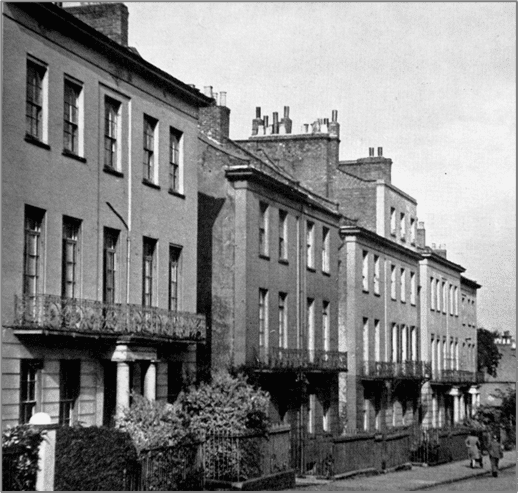
South Parade was the name of a row of eight houses on the north side of Charlotte Street towards the west end of the street. There was some confusion with the name South Parade because Clarendon Avenue was also known as South Parade until 1881. The name South Parade does not appear to have been used for the houses in this article after 1835.
The houses were built in the hope that the south of the town could become as popular with the fashionable residents and visitors as the north. The houses all have three storeys with basements and are Regency design finished in stucco on the front elevation. The name of the architect has not yet been found. They are not identical because some houses are detached with porticos and others are semi-detached. One half of a pair has had a large fourth storey added. They all have iron balconies and they were advertised as “having commanding views of countryside to the south”.
The numbering of the houses has changed a couple of times since they were built between 1818 and 1827. The current Nos 7 to 19 are Listed Grade II. No 21 was another detached house which was similar to No 19 but it was demolished in 1964. It had been named Bute House with the permission of the Marquis of Bute and another house to the rear was called Bute Lodge. In 1834 there was a fire at Bute Lodge when a candle set fire to curtains, but it was dealt with rapidly without the attendance of a fire engine. Bute House was used as a boarding house in 1868 but soon afterwards became used as a ladies’ school. Andrew Son & Co, furnishers and removers, moved to No 23, Bute Lodge, from Bedford Street in 1947. When No 21 was demolished in 1964 it was replaced by a garage called Pitkin’s Motors. When this business closed around 1978, the site was used for a plating business and engineering.
At the west end of South Parade was the entrance to Rusina Villa which was built on a site along Tachbrook Road between Charlotte Street and Ranelagh Terrace in about 1828. This villa had the address of No 3 Charlotte Street for some time. Rusina Villa was demolished around 1912 and houses were built on the site; a couple of houses were built across the entrance in Charlotte Street; one of them is unusual in Leamington with its tall upright windows.
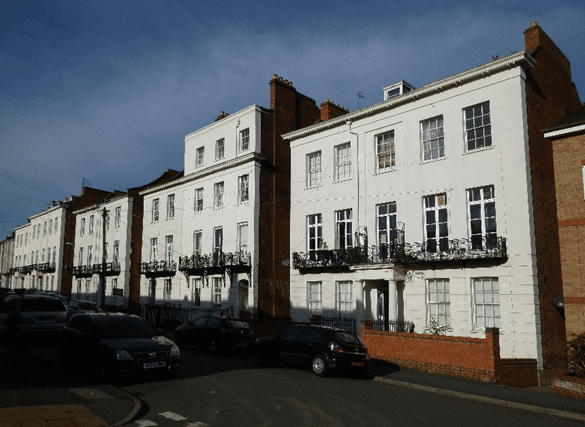
Photo by Michael Jeffs 2017
The land behind Nos 7 to 19 was occupied by a Plant Nursery from soon after the demolition of Rusina Villa in 1912 to 1976. In 1940, when it was owned by Mr Pattenden it was seriously damaged by a bomb. There have been several proposals to redevelop a Mews Cottage at the rear of No 17 but these have been rejected; in 1988 permission was granted to build two blocks of 26 flats each known as Prince Regent Court on the site of Nos 21 to 25.
In recent years a number of the houses in South Parade have been converted to houses in multiple occupation.
To the east of South Parade there is a chapel on the site of the original one built as part of the St Michael and All Angels Home. The Home was established in 1854 by the Church Penitentiary Association. It provided accommodation and training for ‘fallen women’ or ‘immoral girls’. In 1884, the home housed up to 60 girls and women aged from 15 to 25. It was run by the Mission Sisters of the Holy Name of Jesus until 1884, and then by the Community of St John Baptist, an Anglican order. The residents ran a laundry and did needlework to raise money. In 1936 it was recorded that girls came from all over the country. The laundry was closed in 1937 because it was not competitive and the Home moved to Acton House, No 6 Milverton Hill, the following year. The first chapel was built about 1900. This chapel was replaced by one nearer to the street in 1927 which was designed by F G Cundall, the son of the better-known architect John Cundall. When the Home closed in 1938, the chapel was taken over as the Free Gospel Chapel. An engineering works was built on the site with access from Ranelagh Terrace. This in turn has been replaced by flats.
This page is one of many which are based on articles in our book entitled A History of Royal Leamington Spa in 100 Buildings which was published in 2018 and is no longer in print.
ACKNOWLEDGEMENTS as presented in the book