
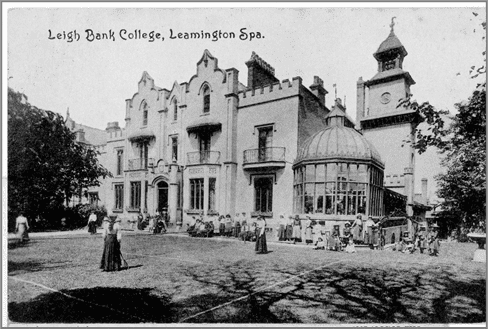
Postcard Leamington History Group Archives
Around 1836, the noted architect, William Thomas, began to develop parts of North East Leamington including Holly Walk, Willes Road and Lansdowne Circus. He designed a series of houses for different income groups: semi-detached properties for the moderately wealthy, detached villas for the wealthy and immense and elaborate villas for the very wealthy.
Two of his very large detached villas, built in 1838, were situated side by side in Holly Walk (now Upper Holly Walk). They were named “Oak House” and “The Furze”. Although The Furze was much larger than Oak House, both had identical frontages. Their architectural style was described by Pevsner as a kind of Indian Gothic. An early photograph of The Furze shows a large conservatory on its eastern side with a large building with a tower to the rear. Only Oak House (Grade II Listed) now remains. It was formerly the Liberal Club and currently (2018) is Oak Sports and Social club.
The Furze was offered for sale or rent over many years. Its name was changed to Grosvenor House in the 1870s. It was described as an 18-bed villa with coach house, stabling for 18 horses and accommodation for a groom. The stables were situated to the rear of the large garden and had two entrances opening onto Holly Street. In 1889, the Villa was used as a school called New College. By 1899 a well-established school called Leigh Bank, previously situated in Lillington Road, Leamington, had taken up residence at Grosvenor House, which now became known as Leigh Bank College. The school was run by the Ivens sisters. One remained unmarried whilst the other married a Mr Adlard. The family suffered a series of tragedies. The Adlards had two daughters. One died aged 16 and several years later her sister, Constance, aged 20, drowned whilst swimming in the sea at St Anne’s near Blackpool. Constance was a gifted violinist with a promising future. Miss Ivens retired in 1910 after 30 years as principal of Leigh Bank. She died at her house in Radford Road in 1932. Her sister, Mrs Adlard, died in 1939 whilst her husband passed away a few years later in 1942, aged 92. They lived at 17 Lansdowne Circus. After 1910 there is no mention of the school in the local press and it is likely that it closed on the retirement of the sisters.
Leigh Bank was put up for sale in 1913, being advertised this time as having 5 reception rooms, 15 bedrooms and dressing rooms, 2 bathrooms, offices, a conservatory, stabling and accommodation with coachman’s cottage.
In 1916, the building was being advertised in the Leamington Courier as Leigh Bank Furniture Depository. It remained as a furniture depository until the end of the 1950s. Mr W H Moore and his wife were resident caretakers for many years. In 1938, the property was inspected by the Council and was declared unsuitable for a dwelling.
Pickfords took over the villa in 1953 and again used it as a furniture depository. However, in July 1958, W A Blackburn applied for planning permission to demolish the villa and replace it with a block of 20 flats. This was granted, the villa was destroyed and a block of flats named Talbot Court opened in March 1959 and remains to this day.
Michael Pearson, 2018
This page is one of many which are based on articles in our book entitled A History of Royal Leamington Spa in 100 Buildings which was published in 2018 and is no longer in print.