
INTRODUCTION
Looking into the start of a town’s gas supply over 200 years ago leads us to think that our energy consumption has increased so dramatically and how the sources of energy supply have changed in a relatively short period of time. In 1820 world energy consumption was estimated at about 6,500 terrawatt-hours; in 2023 it was 169,000 terrawatt-hours. This is a 25-fold increase and is continuing to increase exponentially. In England the increase has been estimated to be 15-fold. The difference from the world being the early industrialisation of England. Of course, the population of England has multiplied by five so that the increase in consumption of energy per head has increased around three times.
I was born in Charlotte Street, Royal Leamington Spa. My home was within sight and sound of the gas works but not to the extent that it was an eyesore or a nuisance. I do not remember any emanation of smells or dirt or disturbing very loud noises but I do recall falling asleep to the sound of something like a pressure release valve gently sounding ‘pop, pop, pop’ for hours on end, possibly 24 hours each and every day.
Another distinct memory is a school visit to the works when I was around 12. The climb up the retort tower was thrilling and quite terrifying when looking back. The sight of red hot coal being reduced to coke and the heat given out was a scene that has stayed with me. I wonder what health and safety regulations were active then?
I regret not taking more of an interest when the works closed in the 1960s but I have recently tried to piece together the story of gas supply in the town. A quite novel feature of the story is that the town was supplied with gas from Warwick as well as Leamington, in almost equal proportions, for a time. Perhaps the competition kept the price down? There is local interest in the surviving buildings at Warwick and claims that it was built before Leamington works; we will see that that is debatable.
Fuels
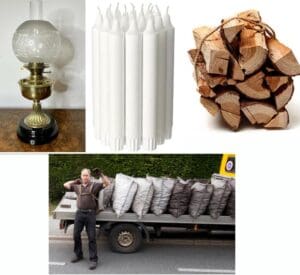
First a look at the wider picture. Energy supplies for heating and lighting before the early years of the 19th century in England were coal, wood and fats and oils of various kinds, occasional referred to as coal and biomass. We can imagine buckets of water over log fires and expensive candles. The discovery of a method to extract and store gas from coal was major breakthrough and was of great benefit for those who could afford it. Of course in industry coal and coke were essential for metal working businesses in the Industrial Revolution.
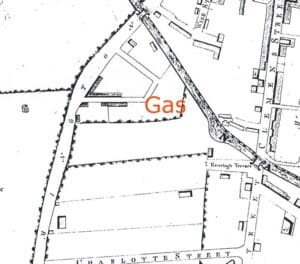
Leamington Gas Works
The date of the first gas works in Leamington is unclear. The oft-repeated story is that Thomas Roberts built a ‘factory to produce gas’ in Ranelagh Terrace in 1819; a picture of the gas works appeared in the Warwick Advertiser in 1819. Roberts was based at a foundry in Warwick. He was a gas enthusiast and generated gas in a retort at his home at Warwick and used it to create a display of gas lights which he invited people to come and view.
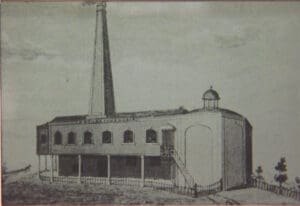
Roberts did develop a gas works in Leamington and an illustration of it in the Warwick Advertiser is dated 1819. After some research I doubt this date. Although from Warwick, Roberts appears not to have been involved in the Warwick gas works which opened in 1822. My guess is that it was something of a a race between Warwick and Leamington to be the first to open, and probably nearly a dead-heat.
Soon after Roberts finished the works in Leamington, the Warwick company laid a gas main to Leamington along Myton Road and Old Warwick Road. However Roberts stirred up opposition and it was removed. A list of ??? People subscribed to provide gas lighting in Clemens Street, High Street and Bath Street in 1822. The gas works was leased by Charles B and James W Robinson; James lived nearby at 15 Charlotte Street.
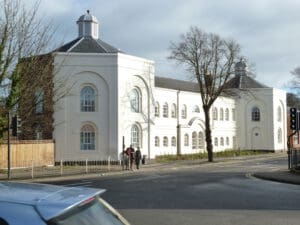
It is important to note that the gas works was built in Warwick in July 1823, and some of the buildings survive to this day in the Saltisford in that town. It is only fair to record that this surviving building in Warwick has an attractive symmetrical façade with an octagonal tower at each end and is Listed Grade 2. By contrast, nothing remains of the gas works in Leamington except the two buildings on Tachbrook Road which were the later offices.
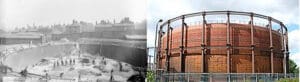
The main raw material required was coal, both to act as the source of gas and also to heat the retorts. Initially this was delivered by canal boats and later by the nearby railway. The central unit in the gas works was the retort where coal was heated to produce gas leading to the coal being reduced to coke. The early retorts were horizontal and made of clay; later they were metal. The gas from the retorts had to be cleaned or purified. Other substances were produced as well as gas and could be troublesome to deal with. A prime example was tar, but this found a ready market. There was also a market for coke and ammonia. The other main feature of the works was a place to store the gas called a gas holder, or in common usage a ‘gasometer’. The first gas holder at Leamington was built with bricks. See a later section about the workings of a gas works.
The gas works company was initially named the Leamington Priors Gas Lighting Company. Shares in the company were issued and there is a note of them being traded in 1822. As indicated by its title, the prime purpose of the business was to provide gas for lighting, and in the early stages this was intended to be street lighting. The evolution of gas lighting in the town will be described later. There was substantial expansion of the works at both Leamington and Warwick during 1826; clearly demand was outstripping supply. An important by-product of the businesses was coke and both works frequently advertised that this was available to the public.
By coincidence, William Murdock, an inventor of gas lighting in 1792, installed gas heating for the baths at the Royal Pump Rooms. A metal plate fell on his leg during installation causing a very painful break. The Warwick and Birmingham canal company provided a special excursion boat to take him home to Birmingham to avoid the jolting of a carriage on the roads.
The company owned much of the large area of land bounded by the canal, Tachbrook Road, Ranelagh Terrace and Clemens Street from the start. It was fortunate that this site was large enough even when the gas production increased enormously in later years. The development of the works included a new larger retort house to a different design in 1843, a towering chimney in 1844 and an addition of a larger third gasholder in 1879. The company extended its land by purchasing another wharf in 1863 and Nutter’s coal wharf in 1875, both alongside the canal. On the west side the company’s land abutted Gas Street and Priory Street off Tachbrook Road.
The Leamington Lighting Company was bought in 1834 by a Mr Barwell and became the Leamington Gas Company. Very soon the company was inviting tenders to build 14 cottages on its land at the western end of Ranelagh Terrace. In 1834 Ranelagh Terrace only extended for 50 yards from Brunswick Street where there was a hedge and five barred gate. The rest of it up to Tachbrook Road was called Rope-walk and was lined with trees. An unfinished villa fronted Tachbrook Road; it was said to be haunted but a squatter called Johnny Boke lived there and it was called “Johnny Bokes’ Castle”. It is not yet known what became of this house but a large house called Rusina Villa was built in the vicinity.
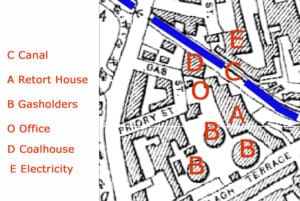
All things did not run smoothly at the works; a near catastrophe occurred in 1861 when a hurricane blew out the supports for one of the gasholders which then fell on a large meter. Fortunately no fire or injury was reported. Following this event extensive improvements were made to the works. Even more major extensions and renovations were made to the works in 1862.
In the early days of the development of the town it is uncertain who was responsible for providing or aurhorising street lighting but it seems clear that lights were provided in Clemens Street, Bath Street and High Street before 1825. After the Leamington Priors Act in 1825, the Town Commissioners had the power to provide lighting. In 1850 the Commissioners were replaced by the Board of Health; they in turn were replaced by the Town or Borough Council in 1875. In the 1890s Lillington and New Milverton became part of Leamington Borough. It is notable that the Act of 1825 had specific references to what the gas company could and could not do.
In 1864 the Gas Company itself introduced a Bill in Parliament intended to become a new Act to extend its powers to dig up streets to lay pipes and similar activities. The Leamington Board of Health opposed this Bill but, nevertheless, it was agreed by Parliament in the following year. In the meantime, the Board of Health made an offer to buy the gas company but after prolonged negotiation this did not happen.
Around 1865 there was widespread criticism of the gas company for poor pressure, noxious emissions from the gas works and clumsy work in laying pipes, including laying them within the required minimum spacing of four feet from water pipes.
In 1868 there was an alarming incident. There were strong rumours that Fenian prisoners from Ireland were planning to blow up Leamington Gas Works. A posse of Police armed with cutlasses stood guard but fortunately there was no attack.
In 1875 the new Borough Council began to discuss purchasing the gas company as many councils had already done so, but took no further action. The same idea was mooted in 1894 and 1897 but again was shelved. It is perhaps difficult to believe that in 1896 the ownership of 627 gas works throughout the country was in the hands of 428 private companies and 199 local authorities.
In 1879 the company was prosecuted for releasing noxious fumes. It was explained that the company had recently invested in new equipment to prevent smells but this had been made ineffective by frost. The court was sympathetic and dismissed the case. A further two new purifiers were installed at the works in 1892 at a cost of £4,500. In 1897, the works consumed 16,000 tons of coal.
In 1906 the manager Thomas Berridge was involved in some rather extraordinary experiments to use a sudden alteration in the pressure of gas to synchronise clocks around the town. Unsurprisingly, nothing came of the idea.
The Chairman of the gas company in 1918 was Thomas William Thursfield, who had been mayor from 1894.
A man was nearly killed in 1910; he was painting at height when a rope broke and he fell 30 feet; luckily he was not badly injured. From the 1920s the works became a focus for complaints and incidents reported in newspapers. There was another accident in 1924 when three men were injured as a firebox blew out; one of them went to hospital.
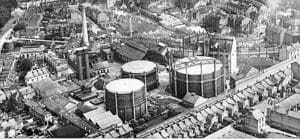
In 1929 the fire brigade was called to a fire in a coke store which took three hours to extinguish. In 1934 a fire in a coal hopper also took three hours to quell. In 1946 a fire in a heap of coal took 10 hours to put out. In the following year a massive explosion in the turbine house set fire to the roof and this received widespread press coverage. In 1962 it took two hours to quench a smouldering heap of iron oxide and later one worker was injured by a small fire. In 1964 there was a somewhat mysterious fire in an underground store of tar water and ammonia when three people were injured.
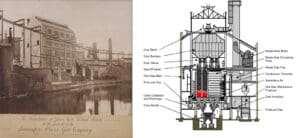
A more efficient Glover-West vertical retort was installed in 1920s or 30s. This design had vertical retorts and was presumably the structure I visited as a schoolboy. There were many visits of school parties of teenage boys to the works from around 1920, so my visit in the 1950s was far from unique.
13 SHOWROOM
There was a Leamington Priors Gas showroom at 64 1/2 Regent Street from about 1925 to 1956 and later on the Parade.
In 1938 a new boiler 18 feet x 9 feet was installed. In the following year much work was required to comply with blackout regulations because there were several areas of the works which must have glowed brightly at night.
14 BOMB
A bomb fell on the Pattenden’s plant nursery between Ranelagh Terrace and Charlotte Street in 1941, quite close to the gas works. There was damage to nine large greenhouses but no injuries. One resident in Ranelagh Terrace charged sixpence for people to see the wreckage from his garden.
In 1948 the West Midlands Gas Board came into existence with the nationalisation of the gas industry. (It became part of the British Gas Corporation in 1972.)
15 OFFICE HOUSES
WMGB took over houses numbered 29 and 31 in Tachbrook Road as administration offices.
There is a well-worn story in the 50s and 60s that coke was transported by lorry from the works to storage under a railway bridge off Waverley Road and if the coke was piled high on the lorry it was knocked into the road. In-the-know neighbours would soon appear with prams and coal scuttles to gather a share of the fallen coke.
16, 17 CLOSURE
The works ceased production at Easter 1964 after 145 years in operation in various incarnations. Two gasholders were retained but 80 people were made redundant. It is said that some of them moved to the electricity station off Emscote Road. Other plants in the county at Nuneaton, Stratford, Rugby and Shipston were also closed. The new Lurgi plant near Coleshill and the works at Coventry were to continue. The Lurgi plant had produced gas from 1963 to mix with other gas in Coventry and Rugby.
18 CLOSURE
In 1968 conversion of appliances for the use of North Sea natural gas was begun by William Press and they had their depot at the site of the gas works.
19 NEW BUILDINGS on the site
A prolonged saga of debate and dispute began about the future of the site. In 1982 there was an application to build 40 houses and there was also a proposal to use it as a site for gipsies and travellers. Nothing happened. In 1993 the site was, unsurprisingly, registered as contaminated land under the Environment Protection Act 1990. A dispute about reclaiming the contaminated land was not resolved by the High Court until 1996 and Thomas Pettifer then applied to build 99 homes. It was necessary to burrow down many feet to extract contaminated material before work could start. The homes were eventually built as Frances Havergal Close.
This article has concentrated on the use of gas for street lighting. Gas was of course bought and used by private companies and people to provide light, heating and cooking appliances.
20 TITLE ELECTRICITY
21, 22 MAP AND PICS
ELECTRICITY
The first public supply of electricity was generated by a water mill in Godalming in Surrey in 1881. This was soon regulated by the Electric Light Act 1882. When electricity became available in the 1880s several towns jumped at the opportunity to use it to light the streets. It is reported that Taunton was the first to trial it in December 1885 but this town was soon followed by Bath, Exeter, Godalming and, indeed, Leamington Spa in 1887. We will discuss electric street lights later.
The First Generator in Wise Street used a steam engine powered by coal to produce electricity, coincidently it almost opposite the gas works across the canal.
The later generating station was in Emscote Road (now a major sub-station near Tesco) and had originally been built to power electric trams in 1905
23 ELECTRICITY SHOWROOM
24 TITLE
STREET LIGHTING
Gas Street Lighting
In parallel with the opening of the gas works in 1819, there was a flurry of subscribers to provide gas lighting in Bath Street, High Street and Clemens Street. It has not been possible to confirm when the first light was lit but if the works was producing gas there was no other apparent use for it. It is also not clear how the gas was paid for at the start. There are reports of a scheme for lighting to the north of the river in 1821 and the Warwick works laid a main over three miles long in 1822 to provide this. 18 lamps were lit on the Parade in October 1823 using Warwick gas.
25 TO 29 PICS OF LIGHTING
In 1826 both Leamington and Warwick companies provided gas for a spectacular Ladies’ Bazaar and in the same year gas lit the opening of the Royal Assembly Room in Bath Street. In the following year the Commissioners paid £193 to the Leamington Gas Company and £236 to the Warwick Company for the gas supplied in six months and in 1833 they paid a total of £986 for gas for a year out of a total budget of £3,979. Gas lighting was roughly 25% of the budget of the Commissioners. In 1830 the Parish Church was lit by 19 gas lights. In 1831 the Bath Hotel was lit by gas to celebrate the Coronation of King William IV. Also in 1831 it was noted that the lights were not lit for four days either side of the full moon. In 1834 there were 223 gas lamps in the town.
Some years later, in 1863, the annual dinner of the Board of Health at the Royal Pump was lit by gaseliers provided by the gas company. Soon afterwards it was decided to cut costs and the size of burners in all street lamps was reduced.
By 1895 there were 35 miles of mains in the town, and 989 public lamps and 3500 consumers. In 1903 the company ignominiously failed to fill a balloon with sufficient gas for men to take off.
A major advance was the introduction of gas mantles in the lamps in place of naked flames around 1900. In 1913 the gas company opened a shop at 39 Bath Street. The gas lighting system was renewed just before World War II.
30 TO 31 DRAWINGS OF LIGHTS
Electric Street Lighting
Gas street lighting was regarded as a wonderful innovation when it was introduced but was actually far from perfect and there was sincere hope for an alternative system in the future. The first electric lights in Leamington Spa were, unsurprisingly, on the Parade in 1888. There were about 180 lamps mounted on the same poles as the gas lights with two junction boxes by the Old Well and at the end of Holly Walk. The grand switch-on by the mayor began with a visit to the generating station in Wise Street. The six engines and dynamos were in a building 91ft x 84ft.
41 Sadly, there was soon disappointment with, and trenchant criticism of, the electric streets lights. The electricity company stated that only 183 of the 1500 lights that they fuelled were street lights and the users of the other 1300 or so lights were satisfied with them. Experiments were conducted over the next two or three years with electric lights along Warwick Street. Criticism of electric lighting on the Parade continued and it was abandoned around 1890. Gas lighting again reigned supreme. It must have been incongruous that trams powered by electricity ran on the Parade and other streets under gas street lights from 1905.
42 The council did not consider electric street lighting again until 1921, having heard of success in other towns. However, a definite rejection was agreed in 1928. It was not until 1945 that electric street lighting was tried out again in Pound Lane and fluorescent lights on new concrete standards were installed on the Parade in 1947. The East Midlands Electricity Board took over supply and the Central Generating Board took over generation in 1947 and EMEB became a private company in 1990. The Electricity showroom was at 14 Parade from 1925 to 1967 approx.
43 However, it was not until 1953 that electric lighting was installed in many other major streets including Northumberland Road, High Street and Radford Road – 65 years after the initial trial in 1888. There was also an experiment with blended mercury lights in Kingsway in that year. Jephson Gardens was still lit by gas in 1953 despite the Lights of Leamington being lit by electricity from 1951 to 1961. There followed a piecemeal installation of electric street lighting until a final comprehensive three year plan was agreed in 1959 and the final electric lights were switched on in 1963.
32, 33 LIGHTS OF LEAMINGTON
Acknowledgements
Terry Gardner, who has lived near the Gas Works for many years and is a bottomless source of historical material on many subjects.
Tom Lewin who work for the Electricity Board for many years.
Michael Jeffs, 29 April 2025, developed from a Talk to the LHG Cafe
DESCRIPTION OF THE OPERATION OF A GAS WORKS
“AT THE LEAMINGTON GAS WORKS” in the style of PAUL PRY. (From Leamington Courier 1903, edited by Michael Jeffs)(Paul Pry was a play by John Poole first performed in 1825; Pry was “an inquisitive and meddlesome fellow” who always left behind an umbrella at every place he visited so that he could return and eavesdrop.)
The works occupy some three or four acres on the bank of the canal. Passing through the great gates of the Gas Works, I was cordially received, and under the genial escort of the most polite of guides, I passed at once into the Retort House,
The retorts were charged every six hours, each retort holding 3 to 3 ½ cwt of coal. These receptacles are like bakers’ ovens, and run back about ten feet. At the end of this ten-feet passage the gas produced ascends up a pipe, whence it finds its way into the hydraulic main. As the doors of the retorts, fastened by strong screws or levers, were thrown open, the glare and glow presented a picture of exceeding brilliancy, a vista of orange red. And near this the men stood, while with long iron rods they raked out the exhausted charge, now turned into coke.
“What coal do you use?” I asked as I was leaving the retort house. “Yorkshire, Derbyshire, and all kinds,” was the sententious answer. “Here, for instance, is a piece of cannel.”
“What is cannel ?” “The best coal for gas making; it is rich, and has many valuable products.”
“It makes the best coke I suppose?” “On the contrary, the coke which it leaves is poor, almost valueless. Bituminous coals make the best coke.”
I have said that the gas distilled in the ovenlike retort passes upward through pipe into the hydraulic main. The hydraulic main is really a gigantic tube reservoir, filled with tar water. The products of distillation pass through the main, with the result that some tar is deposited and some watery liquid condensed. At certain point in the main there is an over-flow pipe down which the products of distillation sink into tar-well. In the well the tar remains. Not so the gas, which escapes through lateral tube (in the overflow pipe) and makes its way into the Condensers. The condensers are wonderful contrivances, and perform very clever work. They have two kinds of condensers at the Leamington Gas Works, one consisting of upright tubes of mammoth dimensions, and the other, more in the shape of what appears to be a gargantuan wine bin of hollow metal work interlaced.
It has to undergo the process of washing, and therefore is led into The Engine House. Now it sucks the gas (by means of its exhausters) from the retorts through the rising pipes into the hydraulic main, thence through the foul main and condensers; after passing the exhausters, it drives it forward through the washer, scrubbers, purifying boxes, and station meter into the gasholders, and the weight of the gasholder drives through the gas through the governors into the mains to supply the town.
The Washer. The work of the washer is to pass the gas fine streams through water, which absorbs ammonia, etc. After the washer comes The Scrubber. The scrubber is an iron chamber filled with deal boards layer upon layer. Down the layers water constantly trickles, so that the gas it ascends subjected to a sort of shower bath.
It has to pass through the Purifier. The greenish white lime which we see carted out of the town, used by our farmers as land fertiliser, has come from the Gas Works’ purifier; sulphate of ammonia is also used as a fertiliser.
The gas has been purified by the scrubbers but has yet to pass through porous lime order to get cleansed from impurities which still clung it in the shape of carbonic acid, sulphuretted hydrogen, and bisulphide of carbon. As the lime becomes foul it is renewed in the purifier. One of the most striking features about gas manufacture, is that there absolutely no waste of any kind. On the contrary, many of the rarer gases, the acids, the “phates,” and the “enes” are the highest value.
The mains of the town are supplied from the Gasholder, the most conspicuous object which the eye beholds as the pedestrian or railway passenger passes by a gas factory.
OTHER
Trips. The Leamington company arranged annual trips to show their appreciation of their workers; the first to be noted was a train ride for 160 people to enjoy Kenilworth in 1863. It is not clear if this became an annual event but a more ambitious trip to Liverpool was provided in 1882 and then another to Liverpool, with an option for Llandudno, was in 1889.
Cooking. The use of gas for cooking was demonstrated in Banbury in 1834.
Portable Gas. Around 1818 portable gas was made available but was not a great success until it began to be used on trains around 1834.