
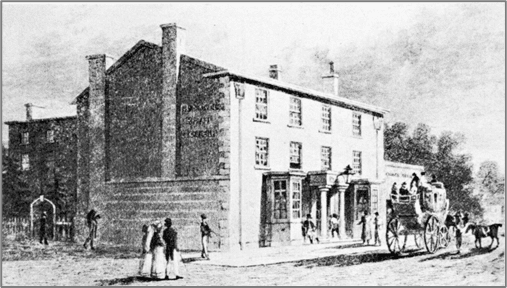
Benjamin Satchwell and William Abbotts were credited with the initial development of Leamington as a spa town. Once a source of spa water was discovered by Satchwell and Abbotts in 1784 on land belonging to Abbotts in Bath Lane (later Bath Street) a bath house was built and Satchwell set about promoting Leamington Priors as an attractive spa town (see also Abbotts’ Baths).
Abbotts realised the importance of providing suitable accommodation for the wealthy people taking the waters. He was already the landlord of the Black Dog, one of two pubs in the small village just south of the River Leam in what is now High Street, but decided to build a new inn near the corner of Spencer Street and Bath Lane (now Bath Street) on land left to him by his uncle. He called the building The New Inn.
Work commenced in 1790 but it was not opened for business until 1793. Abbotts decided to leave the Black Dog in 1793 having passed the business on to Thomas Sinker. Abbots then ran the New Inn until his death in 1805. The Inn remained in the family until 1820 when it was acquired by the town surveyor, John Russell.
As the Inn was next to the original Baths it was renamed the Bath Hotel in 1814 and enlarged with a spacious mews at the rear. In July 1836 a grand dinner was held at the Hotel (at which Major Hawkes presided) to celebrate the opening of the bowling green which was situated to the rear of the Bath Hotel on the corner of Spencer Street and Lower Avenue. About sixty gentlemen attended the dinner.
The bowling green, which hosted a club, provided entertainment and sport in the town for many years, being advertised as one of Leamington’s main attractions.
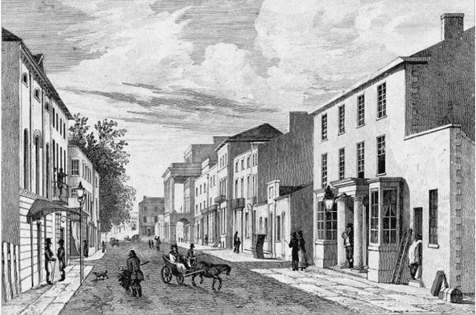
Image Leamington Spa Art Gallery and Museum
The Bath Hotel was put up for auction in 1840. However, it failed to sell and the Russell family carried on the business for a number of years. During this time the Hotel was refurbished including a new frontage. Mr W Gascoyne was employed to carry out the works.
In the coaching days, the Bath Hotel was a noted coach stopping and departure point with as many as twenty coaches departing the mews every morning. However, the arrival of the railways soon put paid to the coaching era. The Leamington Terminus (later Milverton Station) opened in 1844 followed by the Avenue Station in 1851. The hotel closed in the 1850s until the first quarter of 1858 when it was opened with a part of it in Spencer Street, known as the Bath Hotel refreshment rooms.
The hotel continued to develop, opening the Bath Hotel and Vaults Bar accessed from Spencer Street. However, during the early 1920s, a consortium purchased the Hotel including the land and garden to the rear and also the Vaults Bar in Spencer Street. The consortium developed plans to build a cinema upon the site previously used as the bowling green and in March 1925 the Clifton Cinema was opened. In 1926, a Palais de Dance, known as the Bath Assembly Rooms (see article) was built next to the Clifton. Both these buildings still exist, one as a music venue and the other as a keep-fit establishment.
The Bath Hotel bowling green was hence no more. It was sadly missed by the Leamington bowling fraternity as it was not only one of the oldest bowling greens in the country it also had a perfect “lawn and turf.” It was, however, successfully replaced by the Avenue Bowling Club in Avenue Road which opened in May 1924. This club still exists today.
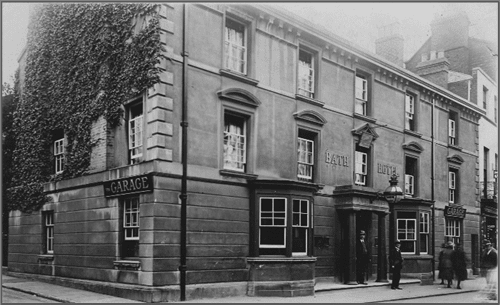
Meanwhile the Bath Hotel continued to develop and by 1930 had three bars, two billiard rooms, fifty-four bedrooms and five bathrooms. During World War Two, the Bath Hotel was requisitioned and closed to the public, opening again in 1946. In 1947 it had the Green Cocktail bar on Bath Street and the Red Cocktail Bar on Spencer Street. However, the premises finally closed in 1951 never to reopen again as a hotel. By 1958 it was in the possession of Lockheed who renamed it Festival House and used it as a hostel for female factory workers. Just a couple of years later it was demolished and replaced by the latest phenomenon – the supermarket. It became Burton’s supermarket in 1960 before turning into Fine Fare. Today the supermarket chain Spar operates on the site of the Bath Hotel with Leamington’s main Post Office to the rear. A brown plaque on the front wall celebrates the previous history of the Bath Hotel.
Note that there is no connection with the present-day New Inn in Leam Terrace (East).
Michael Pearson, 2018
This page is one of many which are based on articles in our book entitled A History of Royal Leamington Spa in 100 Buildings which was published in 2018 and is no longer in print.
ACKNOWLEDGEMENTS as presented in the book