
To the north east of Leamington are Newbold Comyn and the Campion Hills. It was here that the Willes family had their manor house (see article). Slightly to the north was an imposing farm house and stables, (still in use today as the Newbold Comyn Arms) and again just further north and to the east, was a large mansion built on a hilltop overlooking not only the farmhouse and the Willes family home but the River Leam and commanding a panoramic view of Leamington. The land for the house was acquired from Lady Willes and was basically the side of a steep hill.
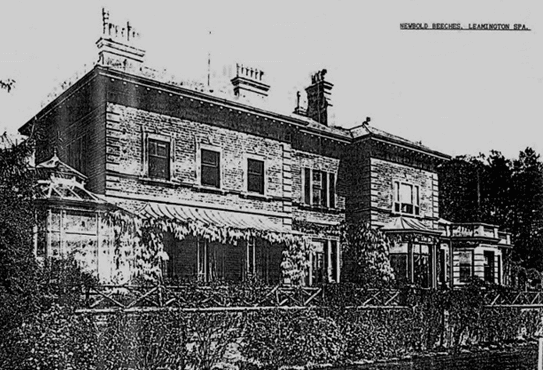
By skilful engineering work, a sufficiently large flat site was created for the construction of the house which was eventually to be named Newbold Beeches. The starting date is not known but a William Alexander Adams is listed as the original owner and he was living at Newbold Beeches in 1863.
W A Adams was the son William Bridges Adams who invented the fish-plate for railway tracks. William Alexander was born in Chile but came to England with his father to work on the building of railway carriages. Later on William Alexander formed the Midland Railway Carriage and Wagon Company. William Alexander’s son, Douglas, was educated at Leamington College and became a well-known artist. Prints of his golf scenes are to be found in most golf clubs throughout the world.
However, by 1867 the house was advertised for sale in The Times of 28 May 1867 and again on 15 May 1871. Mr William Alexander Adams finally left the house in 1873 and settled in Walford Manor, near Shrewsbury. Newbold Beeches then had a succession of owners until 1901, when William Mynors Smythe purchased it. One of the problems with the house must have been the fact that the stables and coach house had been built a good distance from the house, at the end of the drive, almost at the bottom of the hill. This problem was solved to some extent in 1902 by the building of two cottages next to the stables, presumably for the staff involved with the horses and coaches. This site is still occupied today and contains two private houses.
When Mrs Mynors Smythe died in 1927 the house and contents were again put up for sale, in two lots, with the two cottages, stables and coach house split off from the main house, along with all the land below the wall, the tennis court and the hothouses. The main house became the property of Mr Carinish who may have been responsible for the division of the estate. By 1929 the house had become a training school for domestic servants under the authority of the Ministry of Pensions and Labour. It would seem that it was intended as the first of a nationwide series of such schools, designed to help alleviate the unemployment situation. Later, hairdressing was added to the curriculum. For a while, it became a cookery school, attended by young women from far and wide.
After World War Two the house became home to various government agencies, National Insurance being the one remembered by most people, as they required a National Insurance number before they could begin employment. GPO telephone engineers were another group to use the house for their offices.
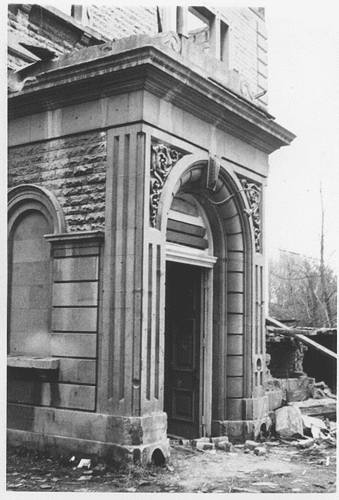
By 1970 most of the occupants had moved out to more suitable accommodation elsewhere in Leamington and the house became a target for vandals, needing several thousand pounds to repair the damage. Warwick District Council bought the house in 1972 from the Secretary of State for the Environment, presumably to go with the Campion Hills which they had bought in 1942. Eventually the whole sorry saga came to an end in 1975 when the Council paid £250 to have the house demolished before vandals did it for free.
Now the site is overgrown with prolific self-seeding vegetation and difficult to interpret as the site of a grand mansion. All that remains are the brick wall that holds up the whole hill, and the brick balustrade that fronted the garden. A single quince bush and Japanese knotweed are the only visible reminders of the garden’s early years. At the top of the hill to the right of the supporting wall a series of woodland walks could still be identified until a few years ago, but these too are now overgrown. It has become an unofficial wildlife garden, home to badgers, foxes and muntjac deer and the occasional band of bored children. Newbold Beeches lasted a little over 100 years as a house, but like Newbold Comyn House just down the road, was finally unable to find a useful position in the modern world and both suffered the same fate at the hands of vandals.
Michael Pearson, 2018
This page is one of many which are based on articles in our book entitled A History of Royal Leamington Spa in 100 Buildings which was published in 2018 and is no longer in print.
ACKNOWLEDGEMENTS as presented in the book