
The Willes family were major landowners in Leamington, mainly in the east of the town. It was Edward Willes (1787-1847) who released much of the family land during the early part of the 19th century, which led to the development of the Leamington we know today, including the renowned Jephson Gardens.
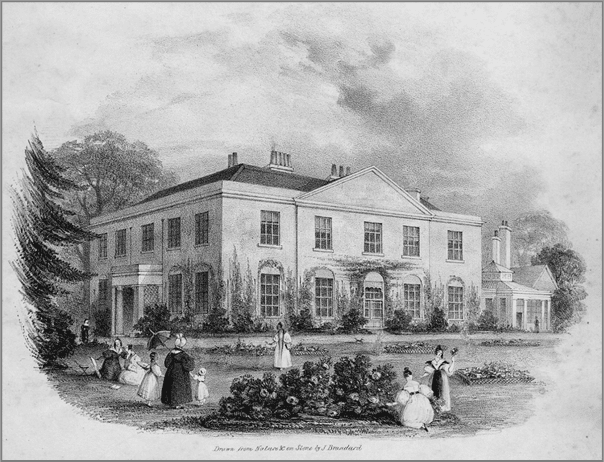
The family lived at Newbold Comyn Hall, their historical family seat, which lay to the east of the town centre of Leamington Spa and north of the river Leam. Newbold Comyn was separate from Leamington Priors and had been in the possession of the Willes family since Richard Willes purchased the estate in 1539. The first house built on the site remained until the eighteenth century when the Rev Edward Willes commissioned a new five-bay, two-storey house with pediment and low-pitched slate roof to replace it. It was, in fact, a relatively modern, small house for such an important family. The Rev. Willes died in 1820 and was succeeded by his son, also called Edward. Edward commissioned Henry Hakewill and a local architect, John Russell, to draw up plans for the addition of a library, verandah and conservatory to Newbold Comyn Hall. A view of the house in 1827 shows these additions with the house set in a landscape of mature trees and shrubberies.
However, any plans for a completely new house were abandoned when Edward decided to take up residence at his Berkshire estate in 1821 and lease the Newbold Comyn house.
One of the earliest tenants was Miss Walker who ran a school called “The Academy” at the house from 1827. Miss Walker was obviously of a generous disposition as a report in the Leamington Courier of 11th Sept 1830 shows –
“I, George Smith, having been detected on a Sunday morning, the 5th instant, STEALING a quantity of pears, the property of Miss Walker of Newbold House and that lady having humanely consented to forgo proceeding against me, I do hereby make this Public Acknowledgement of my offence. Witness to my hand, this 6th day of September 1830, GEORGE SMITH. Witness to the signing Thomas Oldham.”
On 20th May 1839, the possessions of Miss Walker were put up for sale at Newbold House. The contents of the Hall, Dining and Drawing Rooms, Library and 15 bedrooms were sold off including her collection of 1200 books in rich and varied bindings.
The census taken in 1841 shows that the house was then occupied by the Honourable Captain Kenelm Somerville and family. The Somervilles took the house on a long lease before finally leaving in 1879. Captain Somerville, who inherited the title of Lord Somerville in 1842, raised his family of two boys and five girls at the Hall. He died at Newbold Comyn in 1864 and the Somerville Arms in Campion Terrace was named after him.
Following the departure of the Somervilles, the Willes family, namely William Willes, son of Edward, took up residence again. Following William’s death in 1889, the house remained in the Willes family until 1966.
It was William Willes who fought very hard to have a public acknowledgement that it was his father who had given the land, now known as Jephson Gardens, to the people of Leamington. In 1836, Edward Willes had leased the Gardens to trustees at a nominal rent on the understanding that they were never built upon.
Somewhat belatedly, in 1875, an obelisk was erected in the Gardens with a double plaque inscribed with the words –
“Erected in honour of Edward Willes Esquire of Newbold Comyn”
“To whom Leamington is indebted for the site of these gardens”
William Willes was a generous and respected member of Leamington society. However, the only public mention of him found is on the foundation stone of St Paul’s Church, Leicester Street. It was William who had donated the land to enable the church to be built. William also donated land on the corner of Leicester Street and Campion Terrace so that a bore hole could be dug to provide clean water to the town.
The Board of Health map of 1852 shows a formal garden layout to the east of Newbold Comyn House with the grounds narrowing towards the River Leam. Both the 1886 and 1889 OS maps retain this feature together with a formal arrangement on the south side of the house. This latter feature had disappeared by 1900 as a photograph of the south façade, of that date, depicts the house overlooking a lawn tennis court.
By 1939 all traces of layout of formal gardens were lost; this was presumably because of the difficulty of their upkeep.
In 1965 the Fernhill Drive housing estate was commenced on the Newbold Comyn House site. The Willes family sold up in 1966. Although the original intention had been to preserve the old house, vandalism and neglect combined to cause its demolition. Fernhill Drive and the Warwick District Council Leisure Centre now occupy all of the site of the house and grounds.
However, the Newbold Comyn farmhouse and stables still survive and now trade as the Newbold Comyn Arms. Fortunately over 300 acres of the original Willes estate were bought by Leamington Borough Council in 1943 and have been developed as a park, known as Newbold Comyn, much enjoyed by the people of both Leamington Spa and surrounding districts.
Michael Pearson, 2018
This page is one of many which are based on articles in our book entitled A History of Royal Leamington Spa in 100 Buildings which was published in 2018 and is no longer in print.
ACKNOWLEDGEMENTS as presented in the book