
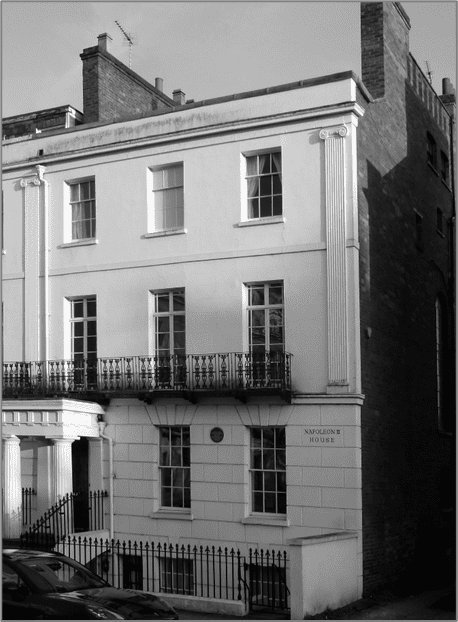
The House. Clarendon Square was laid out about 1828 to the original scheme by P F Robinson, architect, of Brook Street, Mayfair. He was assisted by J G Jackson, the land agent for Willes who was a pupil of Robinson. The gardens in the Square were planted with trees in May 1830. No 6 Clarendon Square is clearly labelled ‘Napoleon III’ and bears a blue plaque recognizing that Prince Louis-Napoléon stayed at the house for several months before he travelled to London and subsequently returned to France.
No 6 is the house on the right of a terrace of four houses on the south side of the square which are now used as houses and flats. Nos 3, 4 and 5 are known as Rofe House. They were built in 1832 or soon after with later alterations, possibly to the designs of William Thomas. They are built of pinkish-red brick in English Garden Wall Bond to sides and rear with painted stucco front façade, Welsh slate roof and cast-iron dressings.
The terrace is 3 storeys high with an additional basement and each house is three windows wide; No 3 projects forward of the other three houses. It should be noted that No 2 was built many years later. The ground floor and basement of No 6 are rusticated and there are Ionic pilasters spanning the first and second floors. The porch has Doric pillars and is at the left side of the house and has seven steps leading to the door. The balcony at first floor level has anthemon-and-heart motif and heart-circle-and-anthemon uprights. The house is Listed Grade II.
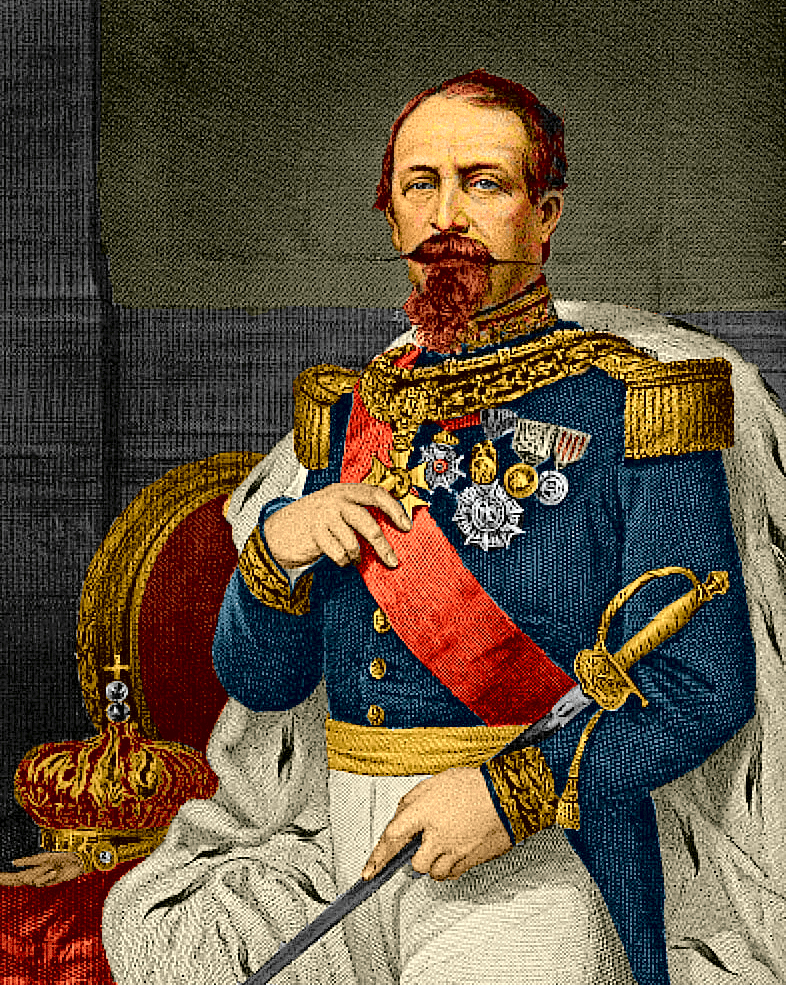
Historical Detail. PrinceLouis, the nephew of Emperor Napoléon Bonaparte, had, like all members of the Bonaparte family, been forced into exile after his uncle’s enforced abdication in 1815. Louis was born on 20 April 1808, the third son of Louis Bonaparte, the younger brother of Napoléon I. Prince Louis had to seek exile from France and arrived in Leamington on 3 November 1838 accompanied by his aide-de-camp Viscount Persigny and a retinue. They had travelled by the newly-opened London to Birmingham Railway to Coventry and arrived at the Regent Hotel in three carriages. After a few days at the Regent a suitably furnished house for the hunting season was found at No 6 Clarendon Square. The Leamington Chronicle reported that “Some of his horses are expected from Switzerland; he has lately made some purchases of others and intends shortly to take the field in the style of an English sportsman”.
The presence in town of such a distinguished person promoted a great flurry of social activities of every sort among the local nobility and gentry. There were receptions and dinner parties and several glittering balls. A ball in aid of the Warneford Hospital was attended by five hundred people including “most of the distinguished and fashionable persons either visiting or resident in Leamington”.
The Prince played billiards at the Upper Assembly Rooms and was declared to be a Patron of the place which was called the Royal Assembly Rooms at the time. He attended divine service at the Roman Catholic Church of St Peter in George Street with his entourage and he hunted with the Warwickshire Hounds.
He spoke good English with a slight German accent, and reportedly made something of a gaffe by proposing a toast at a dinner when he made a reference to “the ladies of the town” when he clearly meant to say“the ladies of Leamington”. Louis was a bachelor and there was much speculation in the local newspapers in late 1838 that he was to marry the Grand Duchess Olga, daughter of Nicholas I of Russia, but such rumours were unfounded. He had a number of well-documented romantic attachments, but not whilst in Leamington.
In March of the following year he left Leamington to live in the mansion of the Earl of Cardigan in Carlton Gardens Terrace in London. He then actively pursued his efforts to restore the Bonapartists to power in France. He sailed with an armed band to Boulogne in August 1840 but this was a failure and Louis again returned to London. Ultimately Louis-Napoléon became the first elected President of France in December 1848, assuming the title of Emperor Napoleon III, but his aims for France were undone by his engagement in a war with Prussia which ended in a disastrous defeat at the Battle of Sedan in September 1870.
Louis-Napoléon returned to England and spent his last few years in exile at Chislehurst in Kent and is buried in the crypt of Saint Michael’s Abbey in Farnborough. His great legacy after his modernising reform of the French banking system, lies in the rebuilding of Paris, replacing the narrow, cobbled medieval alleys of the old city with wide, well-paved, tree-lined avenues lit by gas. Baron Georges Haussmann was charged with ensuring that Napoleon’s grandiose plans for the French capital were carried out, with the result that the whole of the central area of Paris was re-designed, – radical town planning on a scale not seen in France since Roman times.
This page is one of many which are based on articles in our book entitled A History of Royal Leamington Spa in 100 Buildings which was published in 2018 and is no longer in print.
ACKNOWLEDGEMENTS as presented in the book