
1195452
RAF Sergeant James Arthur Atkins died on the 23rd June 1944 when his Vickers Wellington Mark XIV aircraft disappeared above the English channel. James is commemorated on the Runnymede Air Forces Memorial.
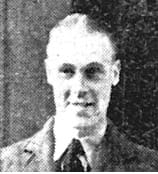
Leamington Spa Courier, Friday, 24 October 1941
James Arthur Atkins was born in Royal Leamington Spa in March 1921 to Frederick James Atkins and Hilda Atkins (née Riman). James was an only child. The 1921 Census shows the family living at 12 Queen Street, with his father working as a taxidermist for the world-famous Leamington firm Peter Spicer & Sons on Victoria Terrace.
James attended Campion Central School. Following his education, he became an apprentice printer at the well-known local firm Messrs. A. Tomes, Ltd. By 1939, the family resided at 43 Clarendon Street.
With the outbreak of World War II, James volunteered for service, enlisting in the Royal Air Force Volunteer Reserve in October 1940 at the age of 19. In late 1941, he married his sweetheart, Dorothy Nina Upton. Dorothy was also a Leamington local, the daughter of a grocer’s assistant at the town’s landmark premier department store, Burgis & Colbourne Ltd on The Parade.
The young couple married on Saturday 18th October 1941 at Lillington Parish Church in a choral ceremony with 75 guests. James wore his RAF uniform, holding the rank of Leading Aircraftman at the time. Due to his rapid deployment, they never established a separate home; Dorothy remained at her parents’ house at 37 Kinross Road, Lillington, “until after the war”.
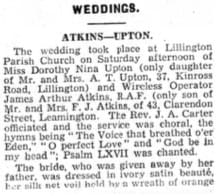
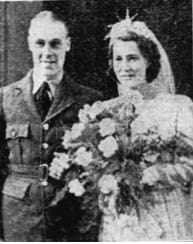
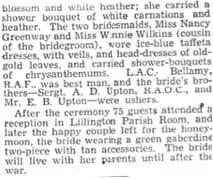
Leamington Spa Courier, Friday, 24 October 1941
Promoted to Sergeant, James qualified for the technically demanding role of Wireless Operator/Air Gunner. He was assigned to No. 612 Squadron of RAF Coastal Command, operating maritime patrol bombers. In June 1944, directly following the D-Day landings, his squadron was heavily engaged in Operation Cork out of RAF Chivenor in Devon, patrolling the English Channel to block German U-boats from attacking the Allied invasion fleet.
On the night of June 22, 1944, James boarded Vickers Wellington Mark XIV (Serial No. HF391, coded “A”) alongside an international six-man crew that included two Australian RAAF officers. They took off at 21:52 PM into the darkness for Anti-Submarine Patrol Sector “Y”. At 03:02am on June 23, 1944, during their third operational mission, a nearby Canadian aircraft intercepted a distress signal from Wellington “A”. Operating the radio keys, Sergeant Atkins transmitted the Morse code brevity signal “WJR”—notifying the base that they were turning back due to severe engine trouble. The aircraft never made it back to Devon and was lost with all hands in the pitch-black waters of the Channel. James was 23 years old.
Having no known grave, Sergeant James Arthur Atkins is officially commemorated on Panel 224 of the Runnymede Memorial in Surrey. Locally, his name was added to the family headstone/memorial at St. Mary Magdalene Churchyard in Lillington and stands engraved on the local war memorial.
His widow, Dorothy, never had children with James. She stayed in the local area for a time before eventually remarrying, moving to Derbyshire, and living to the age of 92, passing away in March 2012.
**********************************
Additional sources of information
- Royal Air Force Commands
- The National Archives; ref AIR 27/2116/12