
In 1818 the only places of worship in Leamington Priors were the parish church of All Saints (see article) and the non-conformist Congregationalist chapel in Clemens Street. A few Methodists did establish a place of worship in a loft in Barnacle’s Yard, Satchwell Street, in 1817, but did not establish a permanent home in Leamington (the Portland Street Chapel) until 1825.
In 1839 Rev. John Craig became the vicar of All Saints and set about trying to make it into the largest Parish Church in England. As the revenue he received was dependent on the size of the parish and the number of residents Rev. Craig was obviously receiving a large income from the parish (see Parish Church).
However, around this time, a clergyman, Dr Marsh, who was vicar of St Thomas’ Birmingham, was ordered prolonged rest owing to ill health. He came to Leamington but was saddened to find so few churches and a great lack of spiritual ministry for the people. He was so concerned that he decided to use some of his own money – and he persuaded some of his friends to donate too – to build a new church, dedicated to St Mary.
The new church was to be built on rural land to the south of Radford Road donated by Mr Edward Willes who was one of the Willes family of Newbold Comyn (see Newbold Comyn Hall).
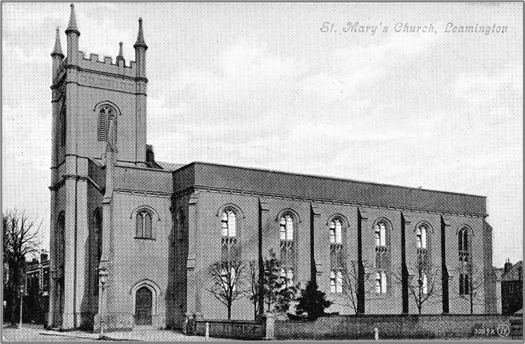
As expected, there was tremendous opposition from Rev. Craig and the churchwardens of All Saints who did all that they could to prevent the church being built. They said that they would fight for every inch of the ground. Rev. Craig wrote a very strong letter to his Bishop querying why a church was to be built “alone in the fields” as he put it, and not on “a site in a more populous part of town”. The content of the letter was printed in the Leamington Courier. It was not clear whether Rev. Craig was more concerned about the siting of St Mary’s or the possible loss of income.
However, the building went ahead. It was designed by Mr J G Jackson (architect to the Willes family) in the ecclesiastical style of the 15th century and was built of brick with a 75 ft tower with battlements and pinnacles. Unfortunately, the pinnacles have now gone. There was space for 1,136 worshippers, 415 of these seats being in the gallery and 400 seats were free. It cost £5,495 to build. This building is Grade II Listed.
Although the church was built and the parish mapped out, it was designated as only a chapel due to the Rev. Craig’s opposition. A compromise was reached and eventually it was designated as a church district. St Mary’s didn’t achieve parish status until 1877 – the year that Rev. Craig died. Its status as a mere chapel is thought to be the reason why there was no churchyard attached to the church.
The foundation stone was laid in October 1838 and was inscribed –
“St Mary’s Church First Stone laid by John Walter Sherer AD 1838 in the second year of Queen Victoria ‘Other foundation can no man lay than that is laid, which is Jesus Christ’. I Cor.III v.11.”
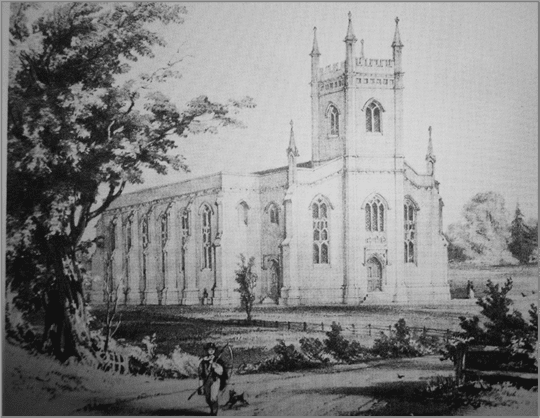
Dr Marsh became the first vicar and preached the first sermon at the opening service on Saturday 27th July 1839. The conse-cration was performed by the Right Reverend Dr Ryder, Bishop of Worcester. The builder was William Green and he was presented with a silver salver on 6th January 1840. There was no vicarage for St Mary’s for many years and Dr Marsh lived in his own house at Lansdowne House (or Villa), now No 79 Upper Holly Walk, which was designed by William Thomas who was the architect of several local buildings including Lansdowne Crescent on Willes Road.
Dr Marsh was a very talented and popular man and attracted people from all over town. They flocked to his services to hear his powerful sermons. In fact, the great number of carriages parked outside the church caused traffic problems. The church had to put up bollards and a chain across the road. Over the next 20 years much building took place in the area – large villas, as in St Mary’s Road near the church, and smaller terraced houses behind the villas, as in Chesham Street and Waterloo Street. The population of the parish increased at such a rate over the next 30 years that it was decided to build another new church, thus subdividing the parish. The vicar at that time was the Reverend Thomas Bromley and he was a prime mover in the building of the new church. It was built in Leicester Street, then a muddy lane, in 1874 and dedicated to St Paul. (See St Paul’s)
After the division, St Mary’s parish consisted of all the land south of the river and St Paul’s parish all the land north of the river. For many years the ‘Mother’ and ‘Daughter’ churches worked hand in hand. When it was built the inside of the church looked very different from how it looks now. In fact, alterations were constantly being made, and are to this day. Hardly anything that can be seen was how it was when it was built.
In 1902 a new organ was dedicated which is still there now – although this is hardly ever used. Apparently, it is only one of two of its type in the whole of Warwickshire.
When the church was modernised in the 1990s the box pews near the entrance to the church were removed. All the seating was like this until new pitch pine pews were installed in 1885. Wealthy people could rent a box pew and have exclusive use of it. The pews have now been replaced by moveable chairs to enable more flexible use of the space.
The old three-decker pulpit was removed in that year too and the new carved one was put in, together with some prayer desks. The eagle lectern was donated by a Mrs Humphries in memory of her late husband.
In 1921 the church was redecorated and the sanctuary was repaved in red and white marble with white marble steps leading up to it. This work was carried out by Charles Pullin, father of Ray, the well-known Leamington stonemason. Apparently, there was originally one bell which cracked and a set of 8 small bells were made from this. They were made to celebrate peace after the Second World War and were installed in 1948. They can be rung by one person.
It is said that St Mary’s was the first church in Leamington to start a school. It cost £1,000, £500 of that being the cost of the land which was purchased from Edward Willes. It was built in a residential area and housed 78 boys, 80 girls and 50 infants. Because of the formation of the new parish of St Paul’s, in 1875 it became St Paul’s School and remained that until a new school was built in Upper Holly Walk. It still bears the name St Paul’s School.
The War Memorial in the car park was erected after the First World War and half of the men mentioned on it were members of St Mary’s Sunday school. The obelisk is one of only three in Leamington – one being near the Town Hall at the start of Regent Grove for Henry Bright and the second is in the Jephson Gardens for Edward Willes. Charles Pullin carved the names of the dead from the First World War and Ray Pullin, his son, did those of World War Two.
Over the years the church has been involved in many activities and ventures and numerous sales to raise money, garden fetes and flower shows were held. In the 1970s as part of its outreach St Mary’s ran a coffee bar in Regent Place called The Fisherman. It closed when St Mary’s took on the Landing Stage as a youth centre. The Landing Stage is within a canalside building which was built as a Maltings.
Anniversaries have been marked – there was a Centenary Thanksgiving Service in 1939, and a 130th Anniversary service in 1969 and in 1989 St Mary’s celebrated its 150th anniversary with many events including a service where the congregation wore Victorian clothes and the Bishop arrived in a horse-drawn carriage. A quantity of plates and mugs were produced and they remain valued possessions.
In conclusion, St Mary’s Church was built in 1839 in Dr Marsh’s words “To secure to the town, as far as human means could, the preaching of the Gospel of Christ in its simplicity and fullness”. It remains, nearly 180 years later with the same aim, but with a much more densely populated parish.
This page is one of many which are based on articles in our book entitled A History of Royal Leamington Spa in 100 Buildings which was published in 2018 and is no longer in print.