
There are reports that the Roman Catholic church was using the Apollo Rooms in Clemens Street and a chapel in Tower Street for services about 1822. However, this article is a tale of two later buildings because the Roman Catholics moved from one church to another.
George Street. In the eighteenth century Roman Catholics worshipped inconspicuously. They were not officially permitted to appoint bishops. Despite strident opposition, including the Gordon Riots, the Roman Catholic Relief Acts from 1778 to 1829 repealed all penal laws which restricted Roman Catholic worship and participation in the public life of the country. In the 1820s there was a movement to build a Roman Catholic Church in Leamington Priors.
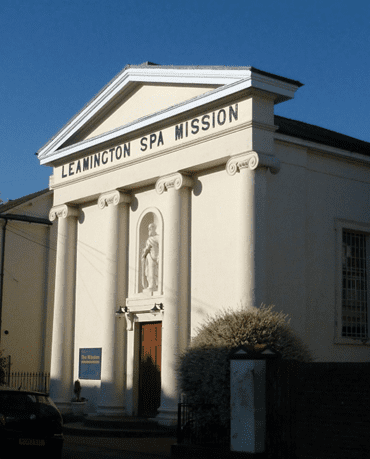
This resulted in the erection of St Peter’s church in George Street. It was opened in 1828 and it is in Classical style with four columns in the facade; it was designed by Edmund Mitchell and John Russell and accommodated 300 people. There is a statue of St Peter mounted on the front wall. There were few, if any, buildings in George Street at the time although it was close to developments in Church Street and Mill Street.
We will see that the new Roman Catholic church was built in 1864. The older building was in use as a Boys’ Mission in 1890 and still bears the words “Leamington Mission” on the front. In 1970 it was proposed that the corporation should purchase the building but this was not agreed. In 1993 it was agreed that the church could be used for religious worship again and the Seventh Day Adventists carried out changes from 1993 to 1999 and they still use the building. These included new stained glass by Dagmar Kraus and a new front door.
This building is Grade II Listed.
Dormer Place. In 1850 the members of the church in George Street began to discuss the need to build larger premises and fund-raising began. They acquired land in Dormer Place in 1862 and the body of the church was completed to the design of Henry Clutton of London in 1864 in what has been termed basilica style. The builder was William Gascoyne and the foundation stone was laid on 29th April 1862. The church is built of red brick with Bath stone used to decorate the exterior. The altar and surroundings are by Mr White of London and the organ was by Bevington’s of London and Signor Aspa, musician and composer of Priory Terrace, assisted with the design. It is remarkable that Rosario Aspa, who died in 1908, was organist at St Peter’s for 40 years. The cost before the campanile was added came to £8,000. The church opened in August 1864. The tower or campanile was not built until 1877; the small spire on the top, which was removed in 1950, was referred to as the “pineapple”; the spire was 220 feet high.
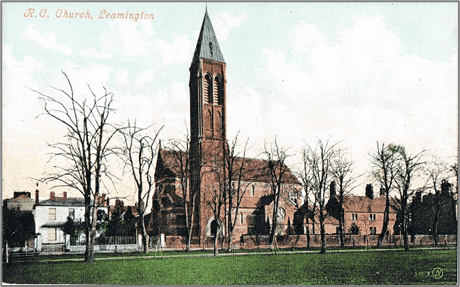
The Presbytery of the Roman Catholic Church of St Peter, also designed by Clutton, was built as the home for the priest in 1866.
Sadly, the main body of the church was burnt to the ground in December 1883; this had been ignited by a candle which had been left burning. St Peter’s girls’ school nearby in Augusta Place was used as a temporary church. The church was restored by G H Cox and reopened very rapidly in November the following year after other churches (including Anglican Churches) in the town raised the funds to pay for the rebuilding work. The Sacred Heart chapel was added in 1894 to the design of AJ Pilkington.
Both the church in Dormer Place and the adjacent Presbytery are Listed Grade II.
This page is one of many which are based on articles in our book entitled A History of Royal Leamington Spa in 100 Buildings which was published in 2018 and is no longer in print.
ACKNOWLEDGEMENTS as presented in the book