
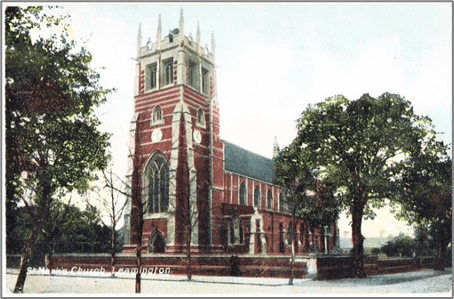
St Mark’s Church is a Church of England establishment which is on the north-east corner where St Mark’s Road leaves Rugby Road. Rugby Road was a turnpike road running from Warwick to Rugby and several cottages and houses were in existence along parts of it for many years before the church was built.
Leamington History Group Archives
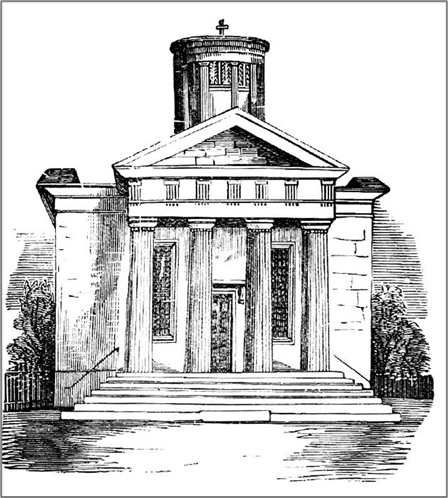
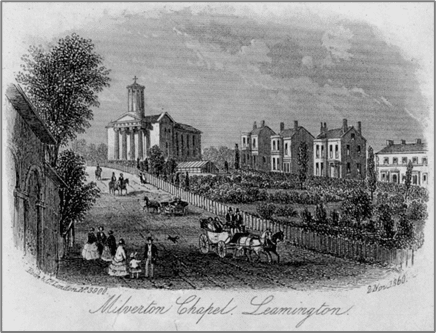
In the early 19th century there were very few houses in Milverton, though during the 1830s houses were built up Milverton Hill, later Church Hill, and along Warwick New Road. The wealthy families living in these new houses didn’t like travelling to their Parish Church of St James, (Old) Milverton, and after much discussion it was agreed to provide a new chapel at the corner of Milverton Terrace and Church Hill (hence the name). The chapel was built in 1836 and had a small round classical-style tower, which housed one bell, so it soon became known to the locals as ‘The Pepper Box Chapel.
By 1871 the chapel was becoming too small for its congregation and it was decided to build a new church. The minister, the Rev. Charles Carus-Wilson, started planning. At the time his sister, Frances, Lady Wheler, lived at Limerick House which stood in Warwick Place next to Bertie Terrace, its grounds extending to Guy’s Cliffe Road. In 1872 Lady Wheler paid for the building of St Saviour’s in Heath Terrace, on a piece of land adjacent to her garden. Although St Saviour’s was never actually consecrated for public worship it was used for children’s services and mission work, largely among the poorest people of the parish and the servants of the families who attended the Chapel. It subsequently became St Mark’s Church Hall. In 1984 it was sold to Emmanuel Church, an independent evangelical church, to help finance the building of the new church hall on part of the Vicarage garden adjacent to St Mark’s.
The new Parish of New Milverton. In 1875 an Act of Parliament created a new civil parish by dividing the original Milverton Parish into two. The parishes were known from then on as New Milverton and Old Milverton. Just before the new parish was created Lady Wheler died, bequeathing a sum of £9,000 towards the cost of erecting a new church. Her estate was divided between her two brothers, the Revs Charles and Edward Carus-Wilson, and they placed the whole of the residue into a fund of £40,000 for building a vicarage and church. This was an extremely large sum in 1875.
This church was built to cater for the newly created parish of New Milverton, whilst Old Milverton continued to use the original church of St James. For some unexplained reason the ‘Pepper Box Chapel’ was deemed to be unsuitable as a parish church. It was demolished and a pair of large houses was subsequently built on that site which were numbered 20 and 22 Milverton Terrace.
St Mark’s was built on the site of an apple orchard on Rugby Road, gifted by Lady Bertie-Percy. The church was duly opened on 19th July 1879, and it continues to serve the parish to this day. The Vicarage was built first, being finished in late 1875. The building was designed in the ‘French Chateau’; style, had 18 bedrooms, and cost rather more than the family had anticipated, resulting in economies being necessary in building the church, and they nearly didn’t have enough funds for the tower. The vicarage is still there in St Mark’s Road but was sold by the Diocese in 1955 and converted into flats, being subsequently renovated in the 1980s. The church was built from about 1876 and was opened in 1879. It was built to the design of George Gilbert Scott junior (1839-1897), the son of the more well-known Sir George Gilbert Scott. Soon after the death of his father in 1878 he withdrew from architectural practice and later suffered from mental instability. His sons Giles and Adrian Gilbert Scott eventually became noted architects. His son, Sir Giles Gilbert Scott, was the architect of Liverpool Cathedral, the Chamber of the House of Commons and the red telephone box.
St Mark’s is considered to be an outstanding example of a Victorian church, and of the three built by George Gilbert Scott it is the only one which remains. The style is basically Gothic revival and the substantial tower has never had a spire or steeple. The structure is brick with a significant amount of stone detail. There were initially seats for a congregation of 1,000.
The Builder. The builder of both the Vicarage and the Church was Mr G F Smith. His work-shops and house were at the top of Beauchamp Hill with its junction with Union Road. The premises are still standing (2018), the house having been converted into flats and the workshops and yard being the site of Henry Tandey Court. The builder’s business continued on that site until the 1930s when it closed and the house became a local Art School.
Mr Smith also built the houses on the site of the ‘Pepper Box Chapel’ after its demolition in 1882. His daughter married George Kennett, the organist who had come from Folkestone Parish Church to be the organist at ‘The Pepper Box’ in 1875 and remained as organist in the parish for 62 years, transferring to St Mark’s when it was built.
The large East window was given in memory of the Rev. Charles Carus-Wilson, who did not live to see ‘his’ church completed, as in 1877 he died in Cannes at the early age of 47, after a short illness.
The organ was presented in 1879 by the Carus-Wilson family. It is a replica of the organ at Ely Cathedral, made to the specification of Dr Chipps who was the organist there, and built by William Hill & Co. It is one of the finest organs in the county. The organist originally sat at a high level looking down into the chancel through two doors in the metal screen. The screen and the metal case were designed by George Gilbert Scott junior. In 1993 it was completely rewired, with a free-standing console, by Hill, Norman & Beard (the Hill being descended from the original builders).
Carus-Wilson’s brother-in-law, the Rev. Henry Maud, succeeded him. He saw the church built and was its incumbent until he handed it over in 1890 to his nephew, the Rev. Frederick Carus-Wilson, Charles’ second son.
Some More People. There is a magnificent alabaster font, with its supporting pillars of Frosterley marble from County Durham. It is older than the church itself and was the gift of Lady Charles Bertie-Percy of Guy’s Cliffe. The massive font cover was made by Farmer and Brindley and is one of several pieces of fine woodcarving in the church. They also carved the pulpit, which cost a mere £63!
Two additions have been made since the consecration. The first is the screen, designed by another famous Victorian architect, George Bodley, and carved by Martin and Co of London. It was not installed until 1904 and moved to its present position in 2010.
Something is known about some of the previous Vicars. In 1898 the Reverend Archibald Parry became Vicar but left in 1900 on his appointment as Bishop of British Guiana. He was Bishop of British Guiana from 1900-1921, and also Archbishop of the West Indies from 1917-1921.
The reredos was installed in 1902 and was carved by the famous Warwick woodcarver Mr Plucknett and represents Jesus, Matthew, Mark, Luke and John. Behind the table and to each side are wooden cupboard doors …except that the left hand one is not a cupboard, but a Priest Hole. Behind is a flight of steps within the walls of the church leading to an outside door for rapid escape. It is interesting to contemplate why George Gilbert Scott incorporated it into his design.
The Chancel has a magnificently painted roof which was originally painted in 1904 to a design by C J Blomfield. It was repainted after World War Two.
Some stained-glass windows were designed by the famous stained glass artist William Kemp. The magnificent brass lectern is in the shape of an eagle which is a traditional shape for a lectern, being the symbol associated with St John who wrote one of the gospels.
The Rev. Bertram Streatfield was Vicar from 1901 to 1920, and it was during this time that many changes were made, including the installation of electric lighting in 1903. He was greatly concerned about the drunken state of many of the working men of the parish and raised enough money to buy a property, on the site of the present Stamford Gardens flats, and in October 1912 the Milverton Coffee House was opened by St Mark’s Church. This provided recreation facilities, beds for homeless men, and of course non-alcoholic drinks. The Coffee House continued in operation until sometime in the 1930s. To one side of the Chancel is a Quiet Area which won a Leamington Society Award in 1997.
Bishop Houghton became Vicar of St Mark’s 1953 and remained until 1959. He had come from being a missionary in China, and is well known for being the author of the hymn, Thou who wast rich beyond all splendour.
Part of the Centenary rebuilding in 1979/80 provided a glazed porch, which keeps the church warm and enables use of the West door again. Other improvements in 1980 were the provision of the kitchen, complete with stained-glass window, the toilets, and the redesigning of the entrance by the South door. In addition, the one large, high-ceilinged Parish Room was cut horizontally, with a new staircase provided and the result was two meeting rooms: the Centenary Lounge on the ground floor and the Upper Room upstairs.
St Mark’s merged with Christ Church in 1951 and Christ Church fell into disuse (see article).
The church is Listed Grade II*, one of only 19 buildings in the town with this grading. The wall and lychgate and vicarage are Listed Grade II.
A church hall was erected at the rear soon after 1984.
The Milverton Lawn Tennis and Croquet Club. This Club was formed in 1902 at St Mark’s Church, playing on the Vicarage Lawns. In 1928 the croquet section moved to the Guy’s Cliffe Avenue ground and became known as the Warwickshire Croquet Club. Tennis continued to be played in the Vicarage gardens until after World War Two, when the two clubs came together again and tennis also moved to Guy’s Cliffe Avenue.
This page is one of many which are based on articles in our book entitled A History of Royal Leamington Spa in 100 Buildings which was published in 2018 and is no longer in print.
ACKNOWLEDGEMENTS as presented in the book