
The Story of the House and a notable resident.
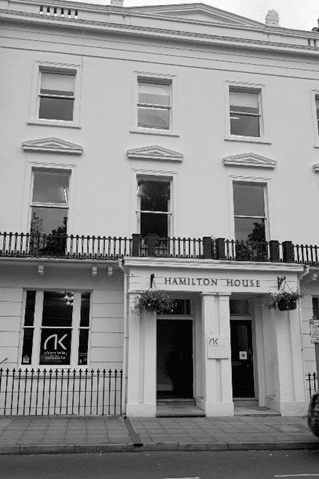
Hamilton Terrace (called Hamilton Crescent until 1848) overlooks the broad avenue of Regent Grove (Holly Walk). The dwellings were built behind a carriage drive in 1833-1834. These are now mainly offices but functioned in early days as boarding houses or furnished lodgings for those visiting the spa town. A Crimean War cannon stood nearly opposite the terrace from 1861 but disappeared during World War Two.
For two years in the 1880s it became the home of an interesting figure, Alice James (1848-92). She came from a moneyed and talented family in Boston (United States), her brothers including the novelist Henry James and William James, the psychologist and philosopher. When aged 38, Alice moved to London to live near Henry, and for some years moved in literary circles there. Her active social life, however, seemed to worsen several long-standing, apparently ‘nervous’, ailments (chronic pain, weakness of the legs and periods of exhaustion). Alice decided to try a more retired existence in the provinces, choosing Leamington as a quiet but pleasant town. She spent the summer of 1886 here, then stayed in the same lodgings from 1887 to 1890. Her vivid letters and personal diaries reflect her experiences and impressions of the life in the town.
She rented first-floor rooms at 11 Hamilton Terrace (now No 20, the offices of a firm of solicitors). Her bedroom was at the rear ‘very pleasant, most comfortable in temperature…I get the sun there’. But soon she grumbled:
‘There are only three bedrooms of any size, and those not much…. There is a complete absence of closets and places for putting away things, most bewildering to us Yankees; people here place their clothes and boots on chairs at the edge of the floor… The English middle classes suffer from jerry-builders… the floors rock and quake, and you hear the voices of your neighbours’. There was no bathroom, the maid and her personal nurse being kept busy carrying items up and down stairs. Her long-term companion, the Bostonian Katharine Loring, also lived here much of the time and provided welcome emotional support. She observed the life of other residents, such as a young couple who arrived in August
1887 for their honeymoon. The day after the wedding, the groom proved to have scarlet fever and in 10 days he was dead. More happily, she described another young couple in the next house ‘bubbling over with life, health and happiness…they now have a baby and we became acquainted on the balcony’.
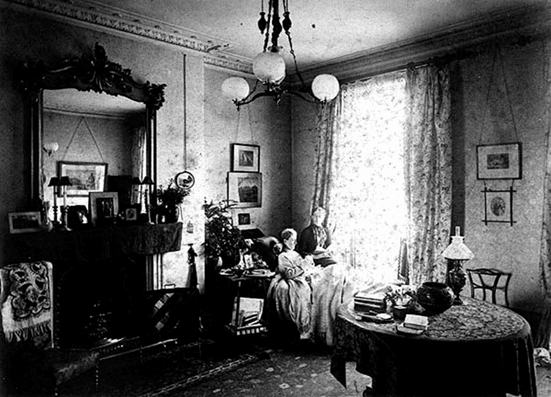
Photo Collection of Dr John Wilmot
Her medical care she received from Dr Robert Eardley-Wilmot, who lived nearby (in Euston Place). He was a staunch Tory and keen foxhunter, Alice enjoying his ‘comical manner’ and appreciating his bemusement at her symptoms (she herself had radical sympathies). When her state of health permitted, she had outings in a bath chair, the attendants pushing her to the town’s parks and sometimes to surrounding countryside. She particularly appreciated Lillington, with its ‘manor house, overgrown farmhouse and delicious local church in its graveyard… like a microcosm of England’. The salty, often hard-drinking, characters that pushed bath chairs for a living amused her. However her writings also record her concern for the hardships of the poor and the malign effects of prevailing rigid class distinctions. She notes the experience of a poor family attending the funeral of an aged relative. After a long wait a clergyman ‘came to read the service, but did not talk to the family, or even look at them!’
By August 1890 she was feeling the isolation of her Leamington life, and her health was clearly deteriorating. She returned (in a private railway carriage) to London, settling in Kensington near Henry. In 1891 she was diagnosed with breast cancer, which caused her death in March 1892. With her reflections on her quiet provincial existence, Alice James can be seen as a victim, or a feminist icon, or as a minor figure in English letters. Her diaries and letters however offer unique glimpses of the life and society of late Victorian England.
This page is one of many which are based on articles in our book entitled A History of Royal Leamington Spa in 100 Buildings which was published in 2018 and is no longer in print.
ACKNOWLEDGEMENTS as presented in the book