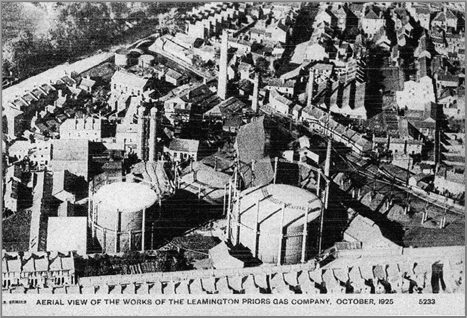
It has been suggested that the earliest evidence of a Gas Works in Leamington was 1819, although other sources imply that it could even be some four years before that. T B Dudley in 1901 claimed that there were works “on the site of the present works, erected by Mr Roberts, of the Warwick Foundry, probably not later than 1820, for a gas standard of his, bearing that date, still remains in George Street, and two of 1822 are in Church Street”. The works were leased to a Mrs Askin, and the sub-manager was Mr Fisher, who lived in a cottage on the premises. He was responsible for the accounts as well as the manufacture of gas. Dudley adds that there was also a ‘tradition’ that Michael Copps had a building at the rear of the Royal Hotel to provide gas lighting, long before Roberts.
However, we know that Matthew Wise sold land originally intended as the site of The Grand Spa, to the newly formed Leamington Priors Gas Light Company in 1822, and a building was constructed near the canal, originally to produce gas to light the streets of the Old Town. The gas for inflating the ‘Coronation’ balloon which ascended from the Bowling Green in 1824, came from the Leamington Gas Works. (Dudley p259)
The first meeting of what was to be known as “The Leamington Priors New Gas and Coke Company” took place in September 1834, to enable them to acquire the rights to supply gas to the whole town. Charles Burt Robinson and James Wickenden Robinson were nominated as the two lessees of the Gas Works on a yearly rental. In 1834 there were two gasholders, capable of holding 50,000 cubic feet of gas.
A new and extended gas works was built in 1838 when an Act of Parliament was passed incorporating the Company under the new title of The Leamington Priors Gas Light and Coke Company. It is understood that at the first general meeting, Dr Jephson was appointed as Treasurer.
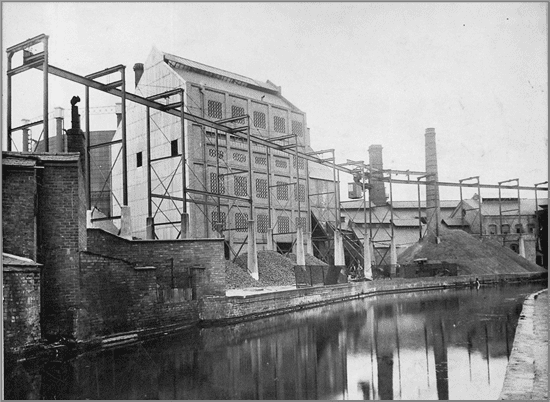
In 1865 the Company was incorporated and emerged with the title of “Leamington Priors Gas Company”. By 1901 there were three gasholders, with room for 1,237,000 cubic feet. An official seal was produced, one of which is understood to be in the Royal Museums collection at Greenwich. The Company continued until it was dissolved on 1st May 1949, to be taken over by the powers vested in the Gas Act 1948 and known as the West Midlands Area Gas Board.
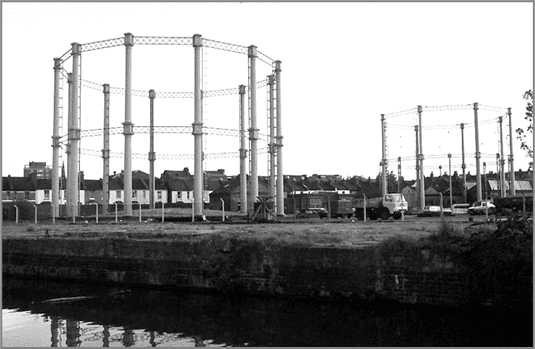
The Company had a coal storage facility in a dedicated railway siding approximately half a mile from the works. There were some 32 continuous vertical retorts operating to produce gas, a by-product being coke (see also Rushmore Estate). Three gasholders were located on the site, a smaller one used for storing water gas, whilst the two remaining had a combined capacity of 1,162,000 cubic feet for town gas. The largest gas holder had painted on the top of the dome in large white letters “LEAMNTN”, an official abbreviation for the town. This was done apparently to assist aircraft pilots in their navigation, hence the extra white “N” indicating North.
The site continued in use until the introduction of North Sea gas, with the eventual demolition of gasholders about 1982. It laid dormant for some years and then the site was developed as flats and terraced and semi-detached affordable homes. The main new street was named Frances Havergal Close (after a local writer) but the name Gas Street also remains to acknowledge the previous use of the site.
This page is one of many which are based on articles in our book entitled A History of Royal Leamington Spa in 100 Buildings which was published in 2018 and is no longer in print.