
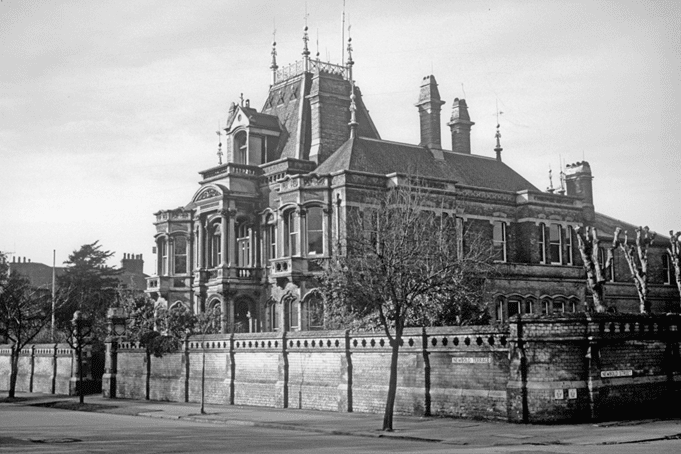
Harrington House was designed by Edward Welby Pugin (1834-1875), son of A W N Pugin, and famous in his own right for designing over 100 Catholic Churches at home and abroad, despite dying young at 41. It was built in 1869 at the north-west corner of Newbold Street and Newbold Terrace on land bought by local builder and entrepreneur William Gascoyne for £1,689.15s from Mrs Emily Willes. It was sold on by Gascoyne on the same day to Thomas Molyneux Seel. Gascoyne built many houses in the town including several upmarket villas in Newbold Terrace, Beauchamp Hall in Beauchamp Avenue and the Salvation Army Citadel which used to stand in Park Street, but perhaps Harrington House was his most flamboyant.
On 21 August 1869, ‘The Builder’ reported that a large mansion and Roman Catholic Chapel was being built by Gascoyne in Newbold Walk for a Major Seale (sic). It was further reported in the ‘Building News’ in November 1872 that it was designed by Pugin père, but by that time; he had been dead for twenty years.
The stone staircase was 10 feet wide with marble columns supporting the roof and was lit by handsome stained glass windows on the half landing. The ground floor rooms included a drawing room 89′ x 18′ and a dining room 28′ x 18′. On the first floor there was the chapel, a billiard room and 13 principal bedrooms, three dressing rooms and a bathroom. The third floor held seven sleeping apartments for servants. There were glass houses and conservatories all around the house with palms and peaches, and beautiful trees in the grounds. Over the entrance were carved the words “Nisi Dominus Aedificaverit” (unless the Lord build) Major Seele never lived there. He took a more modest villa, Comyn House, close by on Newbold Terrace. Marjorie Poole, in More Looking Back, quotes Nikolaus Pevsner’s description of Harrington House as “… a symmetrical but dissolute Gothic-cum-Italian-cum-French building” – an unflattering description of a house designed by a Pugin!
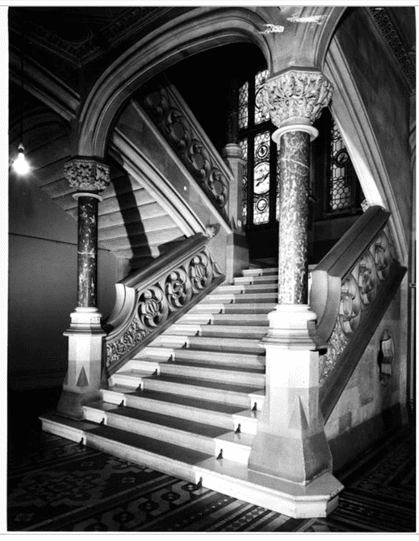
Photo Leamington History Group Archives
The house did have a private chapel but Mr Rowland E L Naylor, a retired banker from Cheshire who owned the house in the early 20th Century worshipped regularly at Christ Church. The choir of Christ Church went carol singing at the house each year, and Mr Naylor gave them £1 when sixpence was normal. Mrs Naylor was delicate and her hearing hypersensitive so he handed over the pound as soon as the choir arrived. It was for his wife’s sake that in about 1909, Mr Naylor had helped to get the bandstand re-sited down by the river, further out of earshot of Harrington House. To Marjorie Poole (quoted above), as a child, Harrington House appeared to be a palace or even a sacred building, with its Latin inscription over the door.
Nora Prosser, also in More Looking Back, wrote that in 1939, the house was requisitioned as the headquarters of Civil Defence, and the head of service and his family had a flat in the building. There was a Civil Defence Club with a canteen and a bar and social evenings were held there, in addition to WVS training, with lectures, map-reading, stirrup-pump practice, fire-lighting and cooking outdoors. From 13th October 1940, Harrington House was also the Czechoslovak Brigade Headquarters and the Czechoslovak cultural liaison office. Many Czech soldiers were billeted in Leamington, opposite the YMCA on the Parade, whilst officers took over many of the houses in Newbold Terrace, Hamilton Terrace and the Upper Parade.
Harrington House had had a number of owners before finally becoming the property of Leamington Borough Council in June 1949. Post-war, the council had use of the greenhouses until at least 1950, when the house was let to tenants, and when the tenants left, it became offices. Local architect Daniel Roth suggested that the house become the town museum in 1962, but this idea was never taken up and the council confirmed a proposal to demolish the building in February 1968, to make way for the Royal Spa Centre.
This page is one of many which are based on articles in our book entitled A History of Royal Leamington Spa in 100 Buildings which was published in 2018 and is no longer in print.