
The project to build a church in Tachbrook Street was inspired by Mrs. Matthew Wise of Shrubland Hall in 1874 whilst she was making alterations to her will. She donated £1,000 for the purpose. A Committee, including Lord Leigh of Stoneleigh and Canon Young, Rector of Whitnash, was formed and a meeting was held in the Crown Hotel on 5th September 1875. In less than two months £2,700 had been collected from more than 200 subscribers. Mrs Sara Hitchman, widow of Dr John Hitchman, gave land adjoining the Arboretum Hydropathic Hospital for the site of the church, along with a donation of £500.
Worshippers initially used St John’s Parochial Hall (also known as ‘The Wise Hall’) which was built by Dr Hitchman. It was used as a place of worship for people connected with his Arboretum Hydropathic Hospital which opened close by in 1862. After the formation of St. John’s Parish in 1875 it was given by Mrs. Hitchman at a nominal rent to the Parish. At that time, it was known as “St John’s Temporary Church” and was used until the nave of the new St John’s Church was ready for use in 1878. In 1883 Mrs. Hitchman gave the hall to the Parish, along with a small strip of land. The land was a gift to the church for a school for children of the poor of the Parish or for the site of a school master’s house. The Rev. William George Wise built a school house which was later used as a Sunday school, for social gatherings, and meetings of all kinds.
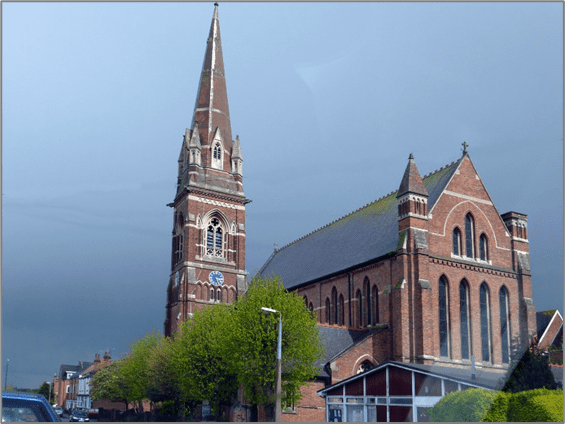
St John the Baptist Church was designed by John Cundall in Early English style in red brick with stone dressings. Cundall also designed many other buildings in town including Leamington Town Hall, St Paul’s Church, the now demolished St Alban’s Church and Warwick School. Many consider St John’s to be Cundall’s best work. It was finally built in Tachbrook Street at a reported cost of £6,000 and is capable of seating 700 people. All the seats were free which indicates that the main congregation didn’t come from the wealthier parts of Leamington.
The church was erected in stages, between 1876 and 1889. The nave was built by Mr. John Fell of Leamington. The first sod was turned on 28th August and the foundation stone was laid on 3rd April 1877 with full Masonic honours by Lord Leigh. The nave and aisles were consecrated on 14th February 1878. There was a great deal to be done before the Church was completed. (A vicarage was built on a site given by Mrs. Hitchman in nearby Vicarage Road (which was later renamed Hitchman Road) and was ready during December 1880.) The building of the chancel began in the summer of 1881, with Thomas Mills of Leamington as contractor. It was consecrated on St John the Baptist’s Day in 1882. Builder G F Smith of Milverton began work on the tower and spire in the summer of 1888, reportedly at a cost of £1,595. The opening service was held on 1st January 1889.
The church clock with three cast iron faces was installed 60 feet up in 1891. Emergency repairs were carried out to the clock in August 2010 as there was significant wear and tear. There are two old bells in the tower. The treble was cast by John Martin of Worcester in 1676 and the tenor by Abel Rudhall of Gloucester in 1745. The bells came from North Piddle church in Worcestershire which was rebuilt in 1876. They were probably originally hung in a temporary belfry until the tower and spire were completed in 1889.
The reredos was installed in 1918 and the rood screen and war memorial in 1921. After the First World War the church hall was considerably improved thanks to the generosity of Mrs. Wise, but the rapid growth of the Parish in the 1920s rendered it totally inadequate. In 1926 work started on altering and adapting the hall to plans by architect Mr. Frederick G Cundall (son of the architect of the church.) The work was carried out by Messrs Standbridge and Parker. This Hall was reopened in May 1927 in memory of Elizabeth Wise, William George Wise and Henry Edward Wise.
The Wise Hall was requisitioned during World War Two by the military on 6th July 1940 and was used for several purposes including a military detention centre and as a billet for Czechoslovak troops. In 1941 a public Air Raid Shelter was installed in the grounds of the church.
Beginning on 28th August 1950 The Wise Hall was used to house the overflow of two classes from Shrubland Street School. Tessa Whitehouse, local historian and a child resident of Tachbrook Street talks very fondly of The Wise Hall. She says,
“The Wise Hall that I knew is not the modern building standing beside the gravel drive. The Wise Hall that I knew was the old hall full of character and built on two levels. Thursday was the night I loved, as it was Brownies night!”
The Parochial Church Council (PCC) decided to demolish Wise Hall and replace it with a new building in December 1966. The Vicar of St John’s, the Rev. Robin Noise said, “No real maintenance has been carried out on it for 25 years”. The PCC had been advised that it would cost £8,000 to £10,000 to give the hall a new lease of life, but that it would only prolong its usefulness for about another ten years. Following the demolition of the Wise Hall a new church hall was erected and opened in 1971 at a cost of £20,000.
Permission for a new parsonage was granted in 1982, the church roof was repaired and reslated in 2001 and the Church Hall was refurbished in 2013.
The Church of St John the Baptist is Listed Grade II*; one of few buildings of this grade in the town.
This page is one of many which are based on articles in our book entitled A History of Royal Leamington Spa in 100 Buildings which was published in 2018 and is no longer in print.
ACKNOWLEDGEMENTS as presented in the book