
Following the end of the First World War David Lloyd George’s Government passed the 1919 Housing Act (the Addison Act, named after the then Minister of Health.) This permittedlocal authorities to build Council Houses and use the General Rate Fund to finance the building of them.
There was some reluctance on the part of some of Leamington’s Borough Councillors to do this but they finally agreed. Leamington’s first estates were in Leicester Street and what is now the Baker Avenue area off Tachbrook Road.
In 1923 the Council put forward proposals for the building of 260 houses on Rushmore Farm, the only problem was that it was not yet in their ownership. The Council made their first offer to the owner, Mrs Willes of Newbold Comyn, in October 1923, but were turned down. Negotiations continued and were finally successful with the whole 50 acres on either side of the Great Western Railway line being acquired for £5,500, including Rushmore Farmhouse and buildings and a small bungalow which stood in what is now Scott Road. After lots of discussions they opted to build a type of house known as a “Leicester” after a visit to Leicester to see their Council Houses.
In 1922 an architect named Arthur Wakerley of Leicester designed semi-detached houses that could be built for £299 each. The design was different to previously built mass housing in that each pair of houses shared a pitched roof and that the entrance door was at the side of the house rather than at the front.
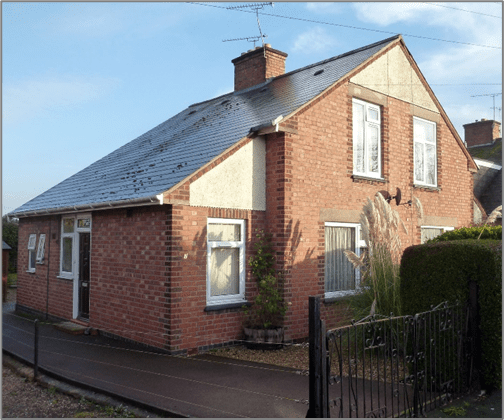
Internally there was a kitchen/scullery with room for a bath covered with a piece of wood, useful for ironing, a living room, a den/bedroom, a WC, coal-store, larder and a hallway with stairs leading to the first floor. On this floor, under the steep ridged roof, were 2 bedrooms with an under-eaves storage space running the length of the house.
The building programme moved forward with tenders being invited to build the first 60 houses in Summer 1925. The successful contractor was Crouch, Butler & Savage, Architects, and Taylor & Bagnall, Quantity Surveyors, and so the development of the Rushmore Estate began. In June 1926 the second phase of building went out to tender for 60 more houses and was won by F G Bursill who bid £29,022.2s.9d.
Mr A Tickle, who was now the tenant of Rushmore Farmhouse, was given permission to rent some barns and outbuildings to Mr Bursill to store building materials, which were brought into the site by canal boat to the wharf at the top of Clapham Terrace.
The rent of the houses was set at 12s 6d a week. In June 1927 a further tender went out to build 56 more houses. It was agreed to name the roads on the estate Scott Road, Offa Road and Waverley Road. In January 1928 a further tender for 62 houses went out, alongside a notice of eviction to two tenants for rent arrears. In July 1928 a Post Box was installed in Scott Road. The Midland “Red” Bus Co. set up the first bus services to the estate, but in 1932, the Leamington & Warwick Electrical Co. bus service took over. This company was sold in 1935 to Midland “Red” with local buses being rebranded as Midland “Red” in 1937 using all three roads on the estate. Unfortunately, two small children subsequently died in accidents, one in Offa Road in 1933 and one in Prospect Road in 1936. As a result of the death of the 4½ year old boy in 1933, the Watch Committee opposed the use of Offa Road by buses, and the L41 bus service ‘Rushmore to Forbes’ route was diverted and became Waverley Road to Prospect Road, then to Alexandra Road, before continuing along Brunswick Street.
One new resident wrote –
“My family moved into Offa Rd in 1925 or 1926, and the roomy houses, council built, had three bedrooms (one downstairs), a large parlour, a kitchen/dining room, bathroom, larder, coal cellar and a super attic-room enough for any family of five, six or more children which were quite common in those days ….”
In the 1950s bathrooms were on the ground floor and a separate WC adjoined the coal-store. In the 1970s more improvements came along including rewiring, and an upstairs bathroom. The former downstairs bathroom made way for an enlarged kitchen.
There was a continuous number of lorries from the Ranelagh Terrace Gas Works delivering coke to land adjacent to the railway sheds. The lorries passed under the Black Bridge and if they were overladen it would scoop off the coke, keenly swept up by nearby residents. Prospect Road Bridge was completed in May 1977 and Waverley Road was made a dead-end at its junction with Prospect Road.
A notable local resident was Nigel Hopkins, a well-known light Opera singer. He lived at No 3 Scott Road and attended Shrubland Street School and Leamington College for Boys.
This page is one of many which are based on articles in our book entitled A History of Royal Leamington Spa in 100 Buildings which was published in 2018 and is no longer in print.
ACKNOWLEDGEMENTS as presented in the book