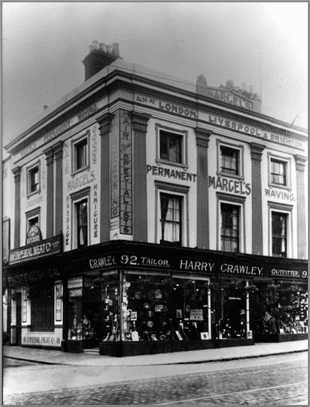
This article relates mainly to the first houses built on the Parade from Regent Street towards Victoria Bridge but also includes the single building on the north-west corner of the crossroads of the Parade and Regent Street. First, a little about the history of this area. The southern end of what is now the Parade from the river bridge to what is now Regent Grove/Holly Walk was part of Lillington Lane from well before 1800. This lane ran from Whitnash down Tachbrook Road, along Bath Lane (Street), across the river to Regent Grove and then along Holly Walk and continued by turning left up Clarendon Street to Lillington Road. It is well-known that the village of Leamington Priors was situated to the south of the River Leam and the few buildings to the north were built by the resident of Newbold Comyn Hall, Edward Willes, which were his farm and, possibly, cottages for workers.
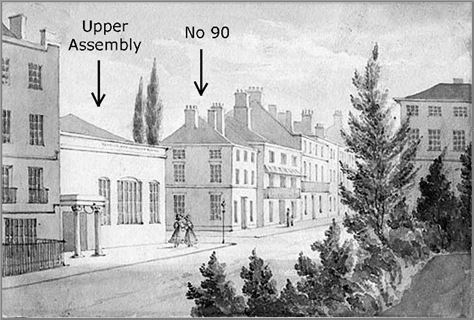
Image Leamington Spa Art Gallery and Museum
The land to the south of Regent Street on the western side of the Parade was part of a 70-acre farm owned by Bertie Greatheed.
The Parade was laid out before 1808, with the first house north of the river built for Mr D Frost who owned the land. (Bedford Street was originally named Frost Streetin Frost’s honour). It is now number 90 and is at the north-west corner of the cross-roads of the Parade and Regent Street. It has been numbered 92 at various times. This part was called Upper Union Parade at this date. The first brick of this first house was laid on 8th October 1808 for Mr Frost by George Stanley, mason. It was re-fronted or rebuilt 20 years later. An early illustration shows the plain frontage to Parade with three bays (windows) but decoration, presumably stucco, was added later to enhance its appearance. The title of the first building in the new town remains a topic for debate: some people support other contenders, such as The Golden Lion in Regent Street.
Turning now to the Parade south of Regent Street. The street from Victoria Bridge to Regent Street was initially named Union Row, presumably because it united old and new parts of the town. The street was later named Union Street, then it became Union Parade about 1829. It was renamed Lower Parade about 1831 and became part of Parade in 1873.
Bertie Greatheed set up a consortium based in Warwick to build on this land. An advertisement was placed in the Northampton Mercury on 4th November 1809 which stated –
“To BUILDERS. PERSONS desirous to contract for BUILDING about TWENTY HOUSES, at LEAMINGTON near Warwick, may apply to Mr. R. SANDERS, Surveyor, Warwick, where Plans may be seen, and every Particular known. Proposals for the Contracts to be delivered to Mr. Sanders, on or before 1st of December next. Not less than four Houses to be included in one Contract, and each Proposal to specify the Time for finishing the Building. Leamington is situated adjoining the Warwick Canal, and from whence there is a direct Water Communication to London, Birmingham, &c.
Warwick, October 10th, 1809.”
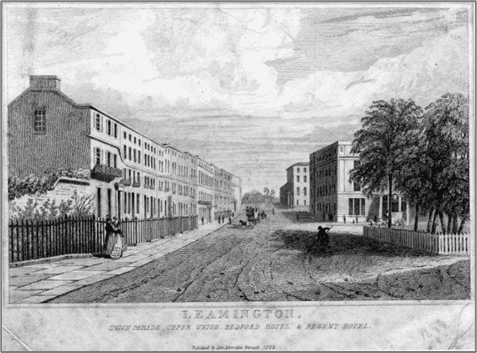
Image Leamington Spa Art Gallery and Museum
Clearly, at least one contract was accepted and 28 houses were built, probably before the end of 1818. It is possible to be fairly clear about which were the first houses. An early drawing indicates that all the houses had two windows on the first floor except the one at the south end which had three windows. The first house with three bays in 2018 is the twenty-eighth which is now No 150 (the south part of what was Barclays Bank until 2016). (A note of caution is that entries for the Listing of Nos 148 and 150 state that they were built about 1835). 18 gas lamps were installed in the street in 1823.
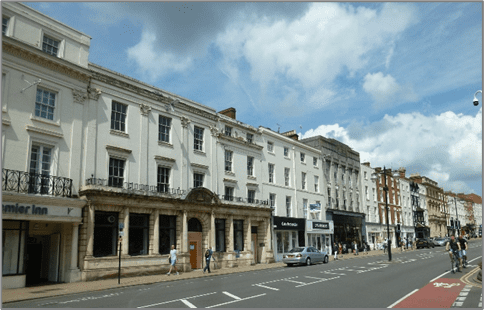
Photo by Michael Jeffs 2018
From this point, the identification of individual houses is not always straightforward. Basically, the numbering began to the south of the land where the Upper Assembly Rooms were built and the numbers ran consecutively from north to south. So far so good. However, the 15th, 16th and 17th houses became the Bedford Hotel and were allocated the single number 15. The numbers then continued from 16 to 26. Houses beyond this were built later. The situation is further confused because when the Bedford Hotel closed around 1856, a bank took over the 15th and 16th houses and they were converted by W Gascoyne. The 17th became No 16 and the previous No 16 became No 16A.
In 1873 it was decided to number the whole of what we now call the Parade from the top (north) end with odd numbers on the east side and even numbers on the west. This sounds straightforward; No 1 became No 98 and so on. However, the bank at No 15, which effectively occupied two houses, was renumbered as just one building, No 126. The row of twenty-eight houses therefore extends from present-day No 98 to No 150.
All the buildings at this date, 1808 to 1810, were only built for residential use; none were shops initially. Some were occupied quite early on by professional people, such as physicians and surgeons. Dr Henry Jephson lived at No 11 (later No 118) in 1826, where there is now a commemorative blue plaque. For some years after 1808, all the shops in the town were still south of the river, primarily in Church Street and London Road (now High Street) with a few in Bath Street. All the buildings at this date, 1808 to 1810, were only built for residential use; none were shops initially. Some were occupied quite early on by professional people, such as physicians and surgeons. Dr Henry Jephson lived at No 11 (later No 118) in 1826, where there is now a commemorative blue plaque. For some years after 1808, all the shops in the town were still south of the river, primarily in Church Street and London Road (now High Street) with a few in Bath Street.
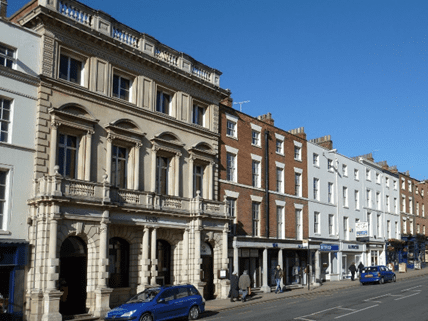
Photo Michael Jeffs
We now ask what became of all these houses. We have seen that three of them became the Bedford Hotel in 1811, run by John Williams and his wife Sarah before they built the Regent Hotel (see article) opposite in 1818.
One source states that the first retail establishment was at No 2 as early as 1811, selling children’s linen. In 1814, E Clarke had a shop at No 16 and Mrs Gill was a dressmaker at No 20. Another source states that Nos 2, 9, 16 and 17 had only become shops as late as 1829. Indeed the Misses Fox were listed in Pigot’s Directory in 1829 as having a milliners and dress shop at No 9. Street numbers were not frequently published at this date. A relative of Charles Darwin writes in her memoirs that in 1832 there were only five shops in the new town and three of them were milliners. It is possible that residents were shocked when shops were opened; this would have echoed reactions today if shops opened in such a street as Lansdowne Crescent.
Development of retail premises increased rapidly and by 1835 the following businesses were in a selection of the buildings –
| 2, Bright, Henry, jeweller | 9, Fox, milliner |
| 3, Nelson, chemist | 11, Boulton & Pritchard, surgeon |
| 4, Dale, dentist | 15, Bedford Hotel, |
| 7, Onion, lace seller | 18, Lawrence, confectioner |
| 8, Laurence, boots and shoes |
By 1846 the following thirteen businesses were in some of the buildings
| 2, Bright, jeweller | 13, Blunn, hats |
| 3, White, chemist | 14, Thomas, draper |
| 4, Ebbage, surgeon | 15, Bedford Hotel |
| 5, Goold, plumber | 16, Hilsdon, wine |
| 9, McCarroll, music | 17, Shepard & Pearce, jeweller |
| 11, Bird, wine | 18, Potter, hats |
| 12, Elston, music |
It will be somewhat tedious to keep track of all the businesses in these buildings because few of them lasted more than ten years.
This extract shows that virtually every house had become home to a business by 1863 –
| 2, Bright, watches | 11, Page, wine |
| 3, Smith SA, chemist | 12, White, watches |
| 4, Wamsley, books | 14, Thomas, tailor |
| 5, Haynes, tailor and outfitter | 15, Leamington Priors & Warwickshire Bank |
| 6, Shepherd, boots | 16, Beckett & Woodhouse, draper |
| 7, Onion, fancy | 16A, Brown, wine |
| 8, Southorn, boots | 17, Willifer, draper |
| 9, Woodruff, milliner | 18, Leath & Woolcott, chemist |
| 10, Woodruff, fancy goods |
In finishing it is interesting to list some of the businesses in 1935, 1967 and 2018.
| Number before 1873 | Number after 1873 | 1935 | 1967 | 2018 |
| 2 | 98 | Freeman Hardy & Willis, shoes | Freeman Hardy Willis shoes | Ryman stationer |
| 3 | 100 | James Walker, jeweller | Walker Smith jewellers | Coop Travel |
| 4 | 102 | Gardner, hats | Englands Smart Shoes | Mountain Warehouse outdoor |
| 5 | 104 | Madame Wright, ladies fashions | Richard Shops costumiers | Trespass outdoor |
| 6 | 106 | District bank | District bank | Nationwide BS |
| 7 | 108 | Sketchley cleaners | Lotus shoes | Laura Ashley |
| Number before 1873 | Number after 1873 | 1935 | 1967 | 2018 |
| 8 | 110 | J Grason clocks | J Grason clocks | Taking Shape |
| 9 | 112 | J T Southorn shoes | J T Southorn shoes | Benjamin Satchwell pub |
| 10 | 114 | Frank Smith costumier | Rogers Knight gents | Benjamin Satchwell pub |
| 11 | 116 | W H Smith stationer | W H Smith stationer | Entertainment Exchange, CDs etc |
| 14 | 118 | Dale Forty music | Mac Fisheries | Planet Bong various |
| 15 | 120 | Herbert Lane watches | Timothy Whites chemist | Betfred bookies |
| 16 | 122 | Amies shoes | Birmingham Post & Mail | Halifax building society |
| 16A | 124 | Rogers Knight tailors | John Plant footwear | Vacant |
| 17 | 124 | Finlay tobacco | Withers tobacconist | |
| 15 | 126 | Midland Bank | Midland Bank | HSBC |
| 16 | 128 | International tea | International tea | Shipleys, bingo |
| 16A | 130 | Haunch of Venison pub | The Lounge pub | |
| 17 | 132 | Regent Garage | Werff ladies | Extra Bargains various |
| 18 | 134 | Cadena café | Cadena café | Furniture and Appliances |
A Mock-Tudor timber-framed façade was added to the Haunch of Venison, No 130, in 1936 (The Lounge in 2018).
A notable event was the need to rebuild the frontages of Nos 106 and 108 about 1988 after they collapsed during refurbishment.
Nos 98 to 104, 112 to 126, 132 to 138, 144 to 148 are all Listed Grade II. Several buildings are omitted from Listing because substantial alterations of the façades have been carried out over the years since they were built.
This page is one of many which are based on articles in our book entitled A History of Royal Leamington Spa in 100 Buildings which was published in 2018 and is no longer in print.
ACKNOWLEDGEMENTS as presented in the book