
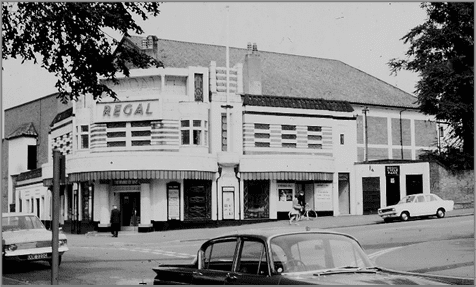
The main cinema in Leamington Spa in 2018 is the Vue which was originally named the Regal and has also been the Apollo. It is on the corner of Portland Place West with Augusta Place. It was opened in September 1931 and is in Art Deco style designed by Horace G Bradley of Birmingham. It is on the site of Quarry Field House which had been known as Augusta Cottage in 1852. The building of the cinema had been commissioned by Mr. and Mrs. S M Devis, then the proprietors of the Bath Cinema (later the Clifton) in Spencer Street.
The first film to be shown was The Middle Watch, a black and white British comedy set on a ship, starring Owen Nares and Dodo Watts. It was a farce where a captain concealed female passengers aboard his ship when they missed the boat back to shore. It was claimed to showcase the British Navy.
The cinema followed a stuttering start for the film industry in the town. The earliest film shows were at the Parthenon in Bath Street around 1900. Some ten years later films were shown for a while at the Winter Hall, and at the Colonnade Theatre de Luxe at the end of Victoria Colonnade. It was used for film and live performances but the owner, Arthur U Morris, ran into financial difficulties in 1935. It then became a roller-skating rink. The building was offered for sale to the council in 1943 but was sold in that year to the Leamington and Warwick Dramatic Club and became the Loft Theatre (see article).
The Scala cinema was the first purpose-built cinema in town at Nos 10 to 14 Bedford Street. It opened in 1910 with the name of The Bijou Theatre and had 527 seats. King George V commemorative mugs were given to customers at the opening. It was renamed The Picture House in 1930 and became The Scala soon afterwards. Local people had a more colourful name for it, implying that patrons were in danger of catching something undesirable, and left with rather more than they went in with. It closed in 1952 and the site became A H Hayes Furnishers (Lee Longlands in 2018). The second purpose-built cinema was the Clifton in Spencer Street which opened in March 1925. It was initially named the Bath Cinema and was built on the site of what had been the bowling green at the rear of the Bath Hotel. It was designed by Horace G Bradley who also designed the Bath Assembly next door to the east. When built there were Wedgwood-style panels on the interior walls. It was renamed when Clifton cinemas group took over in 1938. In the 1950s the premises were updated with a Cinemascope screen. The cinema closed in 1982 and became Lester’s night club but in 2018 it is a fitness centre. It is said that the last film to be shown before closure was Dead and Buried which was a suspense horror film set in a small coastal town.
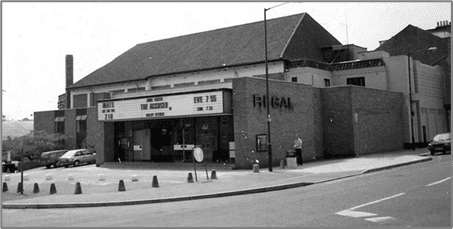
The Regal also had to compete with the Regent Cinema in the old Theatre Royal (see article) in Regent Grove.
The Regal originally had an entrance in Portland Place East as well as Dormer Place. The cinema originally had just one auditorium with 1,305 seats but has undergone alteration so that there are six screens with 898 seats in 2017. Stratford–on-Avon Picture House Co. Ltd., part of the Clifton Cinemas group, ran the cinema from 1936 to 2003 when it was bought by Apollo Leisure. Retail space was included on the side facing Augusta Place and this was known as Regal Buildings; this was the home of Madame Jan Gowns in 1936 and in 1952 it was a location for Radio Rentals.
The exterior has been altered several times, sadly obscuring many of the original conspicuous Art Deco details. The Devises had travelled to Milan in 1930 with their Cinema Organist, Frederick Jukes, to the factory of Angelo Barbieri Organs. After a demonstration of the organ in the Odeon Cinema, Milan, an order was duly placed. The Barbieri organ was installed in 1931 but this was removed in the mid-1950s. It was the only Barbieri organ to be installed in any cinema in this country; thankfully for aficionados a recording of this organ played by Robinson Cleaver survives in the BBC sound archives. Upon removal it went to a private residence in Nuneaton. In 1967 the organ was sold to St Helen’s Church, Sharnford, Leicestershire only to be destroyed in a fire in 1984, although some elements survive in private ownership.
It is of interest that there were proposals for new cinemas in 1936 and 1938. One idea of the Council in 1937 was to build the Ritz on the site of the Crown Hotel. This did not happen. In 1938 a new proposal was mooted for a Kingsway cinema at the corner of that street with Tachbrook Road. It was not built but the idea was revived in 1949 with the addition of a church and vicarage on a site near Edinburgh Crescent; yet again the plan was abandoned.
A major advance was when Cinemascope was installed in August 1955. The cinema was refitted in September 1969 and then had 904 seats.
The cinema itself was submerged in the floods of 1998 and suffered severe damage which took over six weeks to clear up. Ironically, it was screening the film Titanic at the time. The cinema had previously been flooded in 1932, soon after opening.
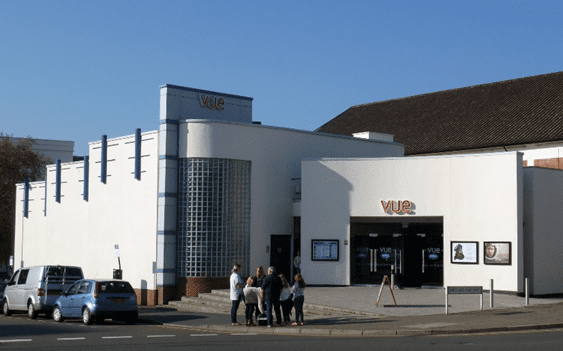
The main entrance from Portland Place was replaced with the one facing Augusta Place in 1969. Additions were made around 1996 and over £500,000 worth of damage had to be repaired after a fire in 2000. There was a further facelift and conversion to two auditoria in 2003.
Well-detailed models of this cinema, made by Peter and Sally Lee of Lillington, were at the cinema museum at Bletchley Park but are currently in storage with the Projected Picture Trust in Milton Keynes. They intend to move them to display at Elstree later in 2018.
This page is one of many which are based on articles in our book entitled A History of Royal Leamington Spa in 100 Buildings which was published in 2018 and is no longer in print.
ACKNOWLEDGEMENTS as presented in the book