
Despite the fact that there were five baths in the town already, one man was desperate to find a spring or well of saline water on his land north of the river. That man was Bertie Greatheed (later Greatheed Bertie Percy) of Guy’s Cliffe House and indeed a well was found on his land just to the north-west of the river bridge in 1811. Greatheed quickly gathered together a consortium of three businessmen from Warwick, John Tomes (a banker), H W Tancred and Mr Parkes, to fund the building of a new Pump Room and Baths.
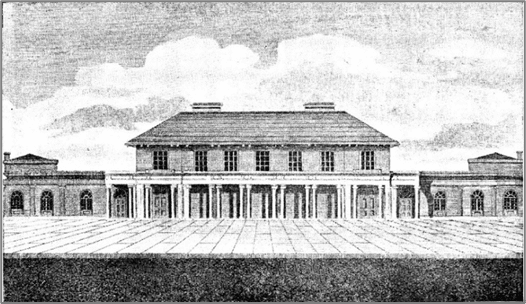
Leamington History Group Archives
The building was a little understated: although it had sandstone Doric pillars at the front, the cottage roof contradicted its Classical appearance. It was designed by C S Smith of Warwick and opened in June 1814. Smith also designed the Upper Assembly Rooms in the town. Initially the Pump Room had 20 baths, 17 hot and three cold, and the water was pumped from the well by a steam engine. It was named ‘Royal’ Baths and Pump Room in the following year. The baths were an instant success, being more modern and well-presented than the competition as well as being nearer to the developing town based on what was to become the Parade. The sign on front now says ‘Royal Pump Room and Baths but they are usually called ‘The Pump Rooms.
As fashions changed and competitors improved their establishments the fortunes of the Royal Baths fluctuated and many alterations were made to enlarge and enhance the premises for over 140 years. The first change was enlargement just two years after opening. There were further significant changes in 1863, 1870, 1885, 1889, 1910, 1927, 1956 and, finally, in 1999.
A fourth part of the Royal Baths and Assembly Rooms was offered for sale in 1824 and this was bought by Bertie Greatheed. He died in 1826 and his son Charles Bertie Percy took over leadership of the consortium. Other baths were keeping up with fashions and by 1838 the Royal Baths needed improvement.
Dr A B Glanville wrote a damning report in 1841 in which he criticised both the style and the ageing ambiance of the venue.
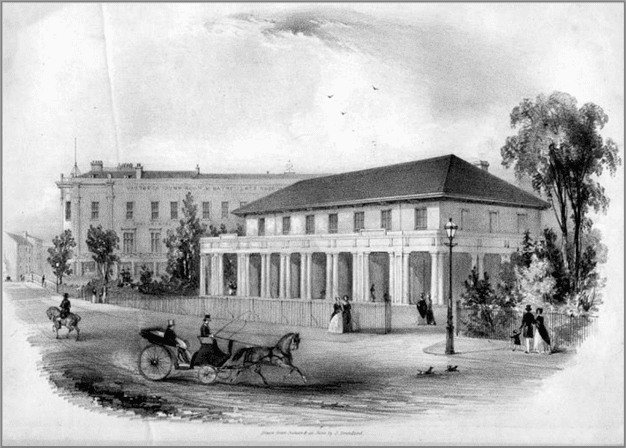
Image Leamington Spa Art Gallery and Museum
There was an increase in business with the arrival of the railway in Milverton in 1844. However, Charles Bertie Percy threatened to close the Pump Rooms in 1860 as they were not profitable. A limited company led by Dr Henry Jephson took over in 1861 and various alterations including a new roof and rearrangement of the columns at the front took place by 1863. The designer of the changes was John Cundall, a Leamington architect. A Turkish Bath or Hammam and other baths were added along with a swimming pool. Ladies and gentlemen were not permitted to use the pool at the same time. The idea of a Winter Garden in the town to extend the ‘season’ was first mooted in 1865 but did not happen until the pool was boarded over each winter after 1890.
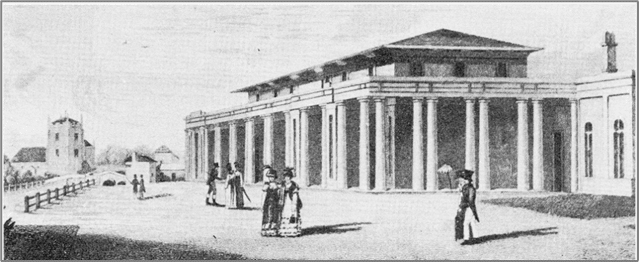
Rooms were sold to the Local Board of Health in 1868 under an Act of Parliament and passed to the new Leamington Corp-oration in 1875. The Board of Health agreed to repair a table and chair damaged when a chandelier fell on them in 1875. The Baths reopened after more works in 1887 which included the addition of a north tower.
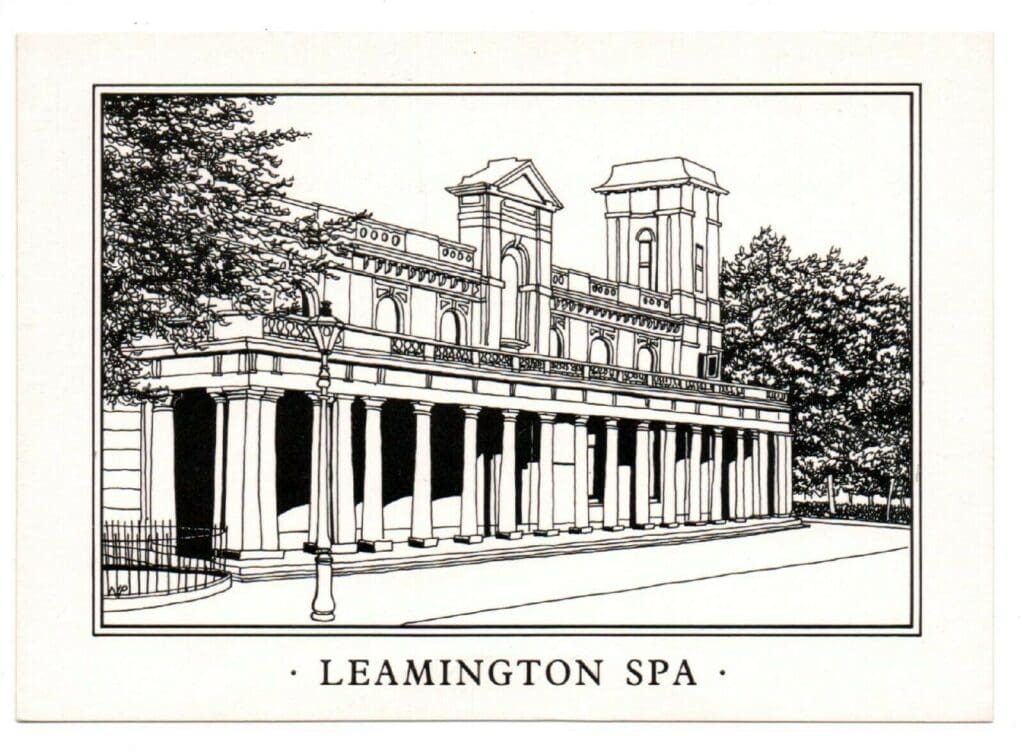
In 1890 a new swimming pool with an iron-framed roof, designed by William de Normanville, was added at the rear. This new pool was for ladies only. When built they were the largest covered baths in the Midlands and in their first year they hosted the National Swimming Championships.
In 1902 it was decided to use the water from Bisset’s well on the other side of the road.
The cinema at the Winter Hall at the Pump Rooms was the first fixed cinema venue in town in 1909. It was revived in 1923 but the last film was shown there in 1925. The venue was used for skating from 1910 and for a while it was given the name Arcadia, a pastoral region of Greece, the mythical home of Pan. Glass-roofed pavilions were added at the south and north ends in 1910 and 1926, respectively. The total frontage of the Pump Rooms was 76 feet in 1926.
Heat and electricity were used for some treatments by about 1914. Soon after 1948 the NHS was paying for most treatments but people paid individually for Turkish baths. By 1958 the Royal Pump Rooms had three Turkish baths with graduated heating reaching up to 200 degrees F, a Laconicum, (dry heat), a Caldarium (hot room) and a Tepidarium (warm room) as well as the swimming pool measuring 100 ft x 40 ft.
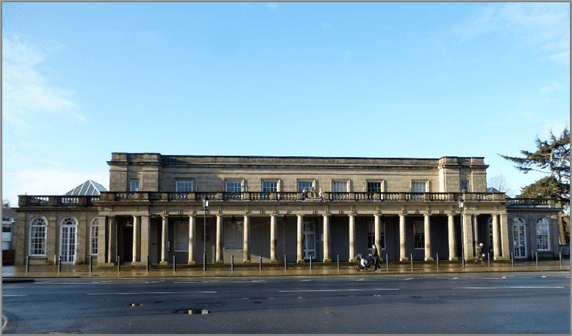
Repairs to the roof and other parts of the building caused huge pressure on the running costs of the building from about 1950. The tower and pediment were removed during restoration from 1950 to 1953. Nonetheless, there were around 40,000 treatments each year for NHS patients in the 1950s. The swimming pool was remodelled in 1956. By 1967 the premises were under further severe financial pressure and for the first time, there was threat of closure. Various options for the future were put forward in the next 30 years or so; these included use for indoor bowls or as a dance centre. Thankfully, the NHS agreed to continue use for a further three years. The baths were taken over by Warwick District Council in 1974 and the Turkish Bath closed in 1975. This was an omen for troubles ahead.
Eventually a plan was agreed around 1995 to convert much of the complex to a library, museum and art gallery and to maintain the main assembly room and south annexe. The north end was remodelled as a café and the entrance to the main attractions. The works were carried out by A C Lloyd and completed by 1999. Inside the new concourse is a sculpture, Spring Celebration, designed by David Jacobson in 1999. Tea dances at the Pump Rooms, popular in the inter-war period, were revived by Peter Martin in 2007 and a plaque for Sir Frank Whittle, inventor of the jet engine, was added in 2010.
The Royal Pump Room was the last place in the Spa town where spa water was used for saline baths but from time to time saline water is still available from taps inside and outside the building. It is Listed Grade II.
This page is one of many which are based on articles in our book entitled A History of Royal Leamington Spa in 100 Buildings which was published in 2018 and is no longer in print.
ACKNOWLEDGEMENTS as presented in the book