
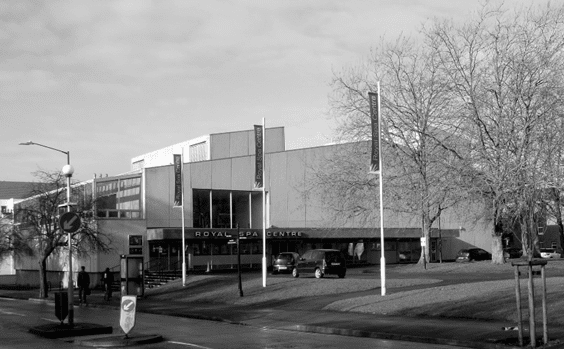
The Royal Spa Centre, designed by Sir Frederick Gibberd and Partners, was officially opened on 15th June 1972, the foundation stone having been laid on 16th November 1970. Sir Frederick was at the time the consultant architect-planner for the Borough of Royal Leamington Spa.
The town had never had a theatre venue provided from the public purse. The first building with “theatre” in the name was opposite to Abbotts Baths in Bath Street and was built in 1813. It was replaced by the Parthenon (see article) further down the street which survived along with the Upper Assembly (see article). The private Loft Theatre (see article) began around 1922 and survives today. Otherwise such venues as the Urquhart Hall, the town halls (see articles), the public hall in Windsor Street, the Jephson Gardens Pavilion and church halls were the main venues filling the role.
The Royal Spa Centre formed part of the group of civic buildings overlooking Jephson Gardens which included a Police Divisional base and County Offices, Jephson House Government offices and the Magistrates’ Court House. These have all since been demolished to make way for the Justice Centre. It was originally intended that Municipal Offices, to replace the existing Town Hall, were to be sited between the Court House and the Centre. It was proposed that the Centre should eventually be linked to Jephson Gardens by a footbridge across Newbold Terrace.
The Centre, built on the site of Harrington House (see article) by Trollope and Colls Ltd at a cost of £356,800, was constructed with a reinforced concrete frame supporting a steel lattice roof. It is clad externally with large precast panels, having a white acid-etched finish similar to those used on the former Magistrates’ Court House. The style is regarded by some as an example of ‘concrete Brutalism’. An attempt to perhaps relieve this has been the provision of coloured external lighting at night.
A large landscaped forecourt overlooking Newbold Street was designed to enable cars and coach passengers to be set down at the canopied main entrance of the building. York stone steps lead up from Newbold Terrace to the main entrance. How times and vision change, for in 2017 the council was proposing to build its new offices on this forecourt area but this was not implemented.
The Centre was essentially designed to contain two halls, one an auditorium for multipurpose use and the other a lecture theatre (which has since become the cinema). Each hall was so positioned that it could be let out separately or in conjunction with the other. The auditorium was designed to seat 550 people on the ground floor for stage performances, to be reduced to 490 when the orchestra area was being used. The upper tiered gallery seats 304 people. The wall finishes in the auditorium provide acoustic adjustment between the differing ideal reverberation times for speech and for music. The lecture theatre (cinema) can accommodate 208 people in stepped seating.
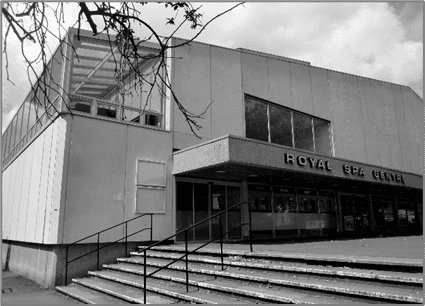
The building is planned on three levels. At ground level, separate entrance halls on either side of a grand staircase open into the linked foyers of the main auditorium and the lecture theatre. To the rear of the main foyer there are now a licensed bar, coffee bar and ticket counter (which was originally to the right of the main entrance).
Leading directly off the main staircase at basement level are the cloakrooms, toilets, stage dressing rooms, plant rooms and storage space.
At first floor level, a large upper foyer off the main staircase opens on one side into the tiered balcony which surrounds three sides of the auditorium. This side of the foyer also serves as an exhibition area for various clubs and societies. The other side originally opened onto an open-air terrace overlooking Jephson Gardens. The terrace has since been enclosed and incorporated within the lounge area of the foyer. At the rear of the foyer is a large bar, whilst the front is fully glazed and overlooks Newbold Street.
The Centre has undergone a number of modifications over its lifetime, the most recent being to the auditorium which included the installation of tiered seating from the ground floor up to the rear balcony level. This eliminated the area of raised seating formerly under the rear balcony. The cinema has also been refurbished with new seating and a digital projection system.
The original brief given to Sir Frederick Gibberd required “a community building designed to fill all foreseeable needs for halls of this nature along with provision for numerous other public and local activities”. The architect was successful in designing a building to meet such open-ended requirements but, it actually became a commercial theatre and cinema. This may explain its apparent shortcomings in the eyes of some. However, as a compromise of the original proposals, the Centre seems to work well.
This page is one of many which are based on articles in our book entitled A History of Royal Leamington Spa in 100 Buildings which was published in 2018 and is no longer in print.
ACKNOWLEDGEMENTS as presented in the book