
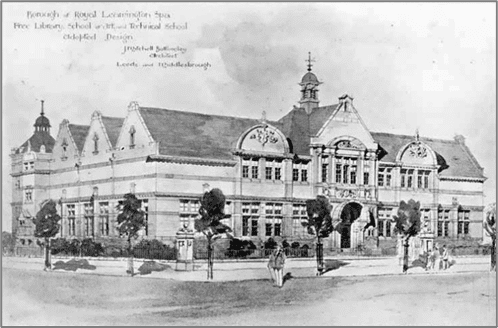
Thanks very largely to the support of Dr Thursfield, Chairman of the Library Committee, a purpose-built, modern Library and Technical School opened on the site of Perkins’ Gardens in Avenue Road, in 1902, and was used until 1999. It was designed by J Mitchell Bottomley of Leeds and built by Richard Bowen of Tavistock Street. The foundation stone was laid by the Mayor, Alderman James Murray Molesworth in November 1900, and the opening ceremony was carried out in December 1902 by Sir Oliver Lodge, distinguished scientist and first Principal of the University of Birmingham. It consisted of two principal storeys with attic and basement set around a rectangular light well with a skylight to the library reading room and was built of red, ‘English bond’ brick with terracotta dressings and a slate roof. The street façade had a central deep segmental porch of terracotta supported on brackets. Within it were double, half-glazed doors with a fanlight and a small window to the porter’s lodge. There was a central timber and copper turret, and to the left, a side entrance and staircase giving access to the school on the floors above. The interior had studio spaces to both floors with cast iron columns and a spinal corridor to both floors with glazed tiles below the dado.
During its early years the Free Library at several sites had survived by gifts of books from local residents. Despite the lack of funding, this library contained 20,000 volumes when it opened, half of them the gift of Alderman Wackrill. He had purchased both the Smith-Ryland and Beaumont collections totalling 1,294 books when Leamington College closed in 1902 and presented them to the library.
For many years the upper floors were home to the Leamington Girls’ College (Grammar School), and later, the Painting and Decorating Department of Mid-Warwickshire College. Later still, it housed the Central Warwickshire Teachers’ Centre. When the Painting and Decorating Department moved to the College main site, and the Teachers’ Centre relocated to Sandy Lane, the building remained empty until Bath Place Community Venture (BPCV) were made homeless by a devastating fire. BPCV then took on the building, and with grants and volunteer support, renovated and leased out the ground-floor rooms as teaching spaces, conference and community advice space, and small start-up business units. For a couple of years, Leamington History Group held monthly Monday meetings there, until the Group outgrew the space available.
Mid-Warwickshire College eventually sold the building for development, in order to fund improvements to the main College site, and by 2015, the building had been converted into a series of luxury apartments by TAG Properties. This project involved the restoration of The Old Library to its former glory and earned TateHindle, the designers, the Architects’ Journal’s Retrofit Award in 2014. The judges said of the work that it represented a “… Sensitive dialogue between new and existing materials. Respectful reuse with renewables incorporated as part of the architectural composition”. The design has blended original Victorian features and character with crisp, modern interior design, incorporating multi-level living spaces with the latest technology, modern appliances and energy efficiency. An open-air communal courtyard has been created in place of the original large glass roofed atrium, allowing considerable daylight into the apartments, as well as a tranquil area for residents to relax on sunny days.
The adjoining Art Gallery at the east end of the Library was designed by A C Bunch F.R.I.B.A, and built in 1928 as an annexe to the Library, for the exhibition of pictures which had been given to the town. The building is plum-coloured, Flemish bond brick with sandstone dressings and a lead roof with skylights. The external walls are blank and divided into panels by Tuscan pilasters with ashlar capitals, entablature and blocking course. The ends of the 3 wings have pedimental gables with stone niches at their centres, that to the south holding a figurative sculpture. The east end has a louvred oculus to the tympanum. The doorway, at west of the south wall, has panelled double doors and applied ashlar Tuscan columns to either side with a segmental pediment. The Art Gallery was also converted by TateHindle when the Library and Art Gallery collections opened at the Royal Pump Room site in 1999. It is Listed Grade II.
The name ‘The Old Library’ was rendered ambiguous in the town in 2017 when the company which took over the ‘Jug and Jester’ in Bath Street renamed it “The Old Library”. This is a legitimate name because it does include the site of the public library from about 1858 (see below).
Footnote on earlier Libraries
As Leamington Priors village developed into the prestigious Royal Leamington Spa, reading rooms and private libraries sprang up throughout the town to cater for the many visitors and local residents who could afford the requisite subscription. There were private libraries and reading rooms in the Assembly Rooms, in Lansdowne Terrace, the Public Hall in Windsor Street, Covent Garden, the Town Hall in High Street (see article), and the Music Hall in Bath Street (also called the Parthenon (see article)), and many other locations. By the middle of the 19th century, lending libraries had become popular nationwide and, as literacy improved, the less wealthy began to demand access to libraries without payment of subscriptions. Parliament approved the first Free Public Libraries Act in 1855, and following the proposal of well-known carriage builder Henry Mulliner, supported by Rev. John Craig, Leamington voted to open its first Free Library in March 1857 in the Town Hall in High Street. In November 1858 the Library moved to new premises at the corner of Church Walk and Bath Street. There were further moves, as the library continued to outgrow the various premises. Eventually a purpose-built Library was built in Avenue Road (see above).
This page is one of many which are based on articles in our book entitled A History of Royal Leamington Spa in 100 Buildings which was published in 2018 and is no longer in print.
ACKNOWLEDGEMENTS as presented in the book