
By 1875 the Leamington Town Council had replaced the Leamington Priors Commissioners who had, in turn, replaced the Local Board of Health.
The Commissioners had a base in Church Street adjoining the poorhouse, which they shared with the local magistrates as a Sessions House. It is likely that the Commissioners were persuaded to leave the Church Street premises by the landlord, the Earl of Aylesford, Lord of the Manor. New poorhouses were built in Radford Road (then known as High Street) and later in Court Street (see article on Workhouse).
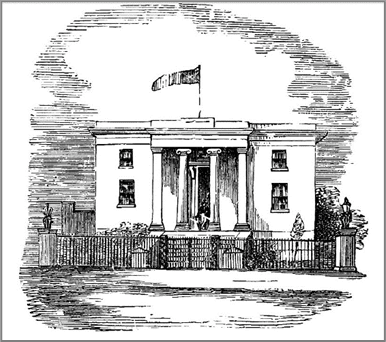
Image Leamington History Group Archives
Around 1830 the population of Leamington Priors was only about 6,000 but the Commissioners agreed to build a new Town Hall in High Street, or London Road or the Turnpike, as it was earlier named. This was on the south-west corner with Althorpe Street. The site, on land owned by the Earl of Aylesford and the Wise family, was close to a pond on the Whitnash Brook as it ran along High Street where there had been three thatched cottages just to the south.
The building was agreed in 1830 and tenders were invited in May 1830. It is Classical Revival style and the architect was John Russell. The foundation stone was laid on 13th July 1830 and the building was opened on 2nd May 1831 at a cost of £1,900. The builder was John Toone; in 1834 he was prosecuted for building party walls which were not thick enough but, fortunately for him, the case was dismissed.
Efforts were made by the Wise family to beautify this rather run-down area by erecting a building opposite the Town Hall and the south-east corner of Althorpe Street in Regency style.
Again the Petty Sessions met at the building for their judicial deliberations and it was often known as the Sessions House until about 1833. There were cells at the Town Hall and there was soon concern that they were at street level, allowing prisoners to converse with members of the public, and use was discontinued. There were stocks in front of the building in 1840. There are also reports of a clock at the Town Hall but no illustration has yet been found.
The surroundings of the Town Hall were seriously affected when the railway was built at the rear around 1850. This was not all bad news because it was possible to store vehicles and other equipment in the railway arches. Under the Free Public Libraries Act a library was established at the Town Hall in 1857 but it was soon moved to Bath Street. A fire escape ladder was kept at the Town Hall from about 1865 to 1890 and the fire engine was kept there in 1880. Other fire-fighting equipment was kept in Chandos Street.
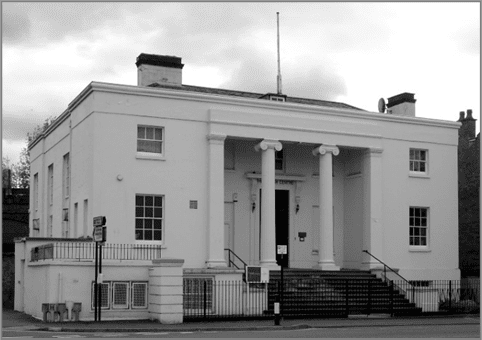
A Public Office and Police Station were based at the Town Hall in 1880 and Petty Sessions were held there every Wednesday. The council had monthly meetings in 1880. The new Town Hall was opened on the Parade in 1884 but other uses were soon found for the old building. The building became the town’s Police Station from the 1880s to 1968 and also as a fire station. Some officials, including weights and measures and shops inspectors, were based at the premises in the 1940s. It became the home of the Polish Centre in about 1972 and a Montessori Nursing School. A Dancing School uses some of the rooms in 2018.
This page is one of many which are based on articles in our book entitled A History of Royal Leamington Spa in 100 Buildings which was published in 2018 and is no longer in print.
ACKNOWLEDGEMENTS as presented in the book