
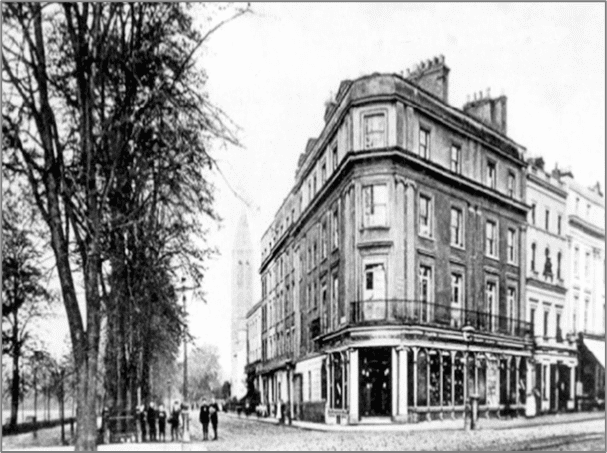
Standing prominently at the corner of Dormer Place and Lower Union Parade, this building marked the gateway to Leamington New Town, providing substantial, quality residential and business accommodation. Its unique position offered versatility for respected up-and-coming Leamington businesses, including ironmongeries, a bazaar, a quality tailor shop, a bank and a pizza restaurant. Now known as 168-170 Parade, the building complex was also, at times, 33-35 Lower Parade and 8-10 Dormer Place.
In 1839, following the popular business trend to relocate north of the Leam, William Flavel, “Sole Manufacturer of the Patent Kitchener” and ironmonger, recognised the potential of show-casing his products at this prime spot (No 35). In the same year, John Wornall, “Modeller, Sculptor and Collector of Curiosities” also displayed his works, until bankruptcy hit. Up to 1848, William Flavel’s son, Sidney, continued to trade at No 35 as a “Manufacturer and Repairer of Iron, Copper, Zinc and Tin Goods”, whilst his sister, Helen, and Aunt, Elizabeth Sparke, remained there until around 1851, taking in lodgers at 9 Dormer Place. The building was quickly snapped up by Thomas Willcox (about 1850), another high-flying ironmonger who advertised “Baths, Baths, Baths, including shower, hip [and] sponging baths”, whilst living at 8 Dormer Place. Willcox left for Birmingham in 1853, becoming a lucrative Gas Fittings Manufacturer and leaving over £66,000 in his Will, in 1899. Longstanding neighbours, Owen White, moved into 33 Lower Parade, from Bath Street, at around the same time as Flavel, trading as White & Son Auctioneers & Appraisers: John White (1776-1861) and son, Owen (1808-1857). Owen was instrumental, as Honorary Secretary, in seeking the best plans to convert lands for Jephson Gardens into an “Ornamental Garden, or Pleasure Ground”, in 1846.
After Owen White’s early death, the firm changed name to John White & Co (1857-61). With no further sons to continue the family business, John’s unmarried daughters, Elizabeth and Hannah White, stepped up to the mark, as Auctioneers and Estate Agents, living again at the premises, with their Aunt, Mary Greenhill. The sisters ran “Sunday afternoon Bible Class for young ladies”, in their drawing-room over the offices [of] the firm on the Lower Parade” and were “interested in music and singing at the Clarendon Chapel.”
White & Locke was established, from 1861 until Hannah’s own death in 1875, followed by Locke, Gilbert & Co (1875-1892) at No 166.
In 1878, on instruction from Hannah’s Trustees, the whole block (35 and 33 Parade and 9 Dormer Place) was sold, described as having an “imposing frontage over-looking the Public Gardens and Linden Avenue…[and] views over the ornamental Jephson and Pump Room Gardens.” The firm remained at No 166 until 1965, eventually evolving into Locke & England in the 20th Century.
Local Watchmaker and Jeweller, William Ricketts, had set up business at No 35. In 1863, he was selling, “beautifully designed and executed Royal Marriage Medals” for one shilling,to commemorate the marriage of Edward, Prince of Wales with Princess Alexandra of Denmark.
From 1867, his enterprise developed into a highly successful ‘London Bazaar’ (1867-1873), previously called Frift & Norris, at No 35, also expanding into No 33. He lived at the premises at No 10 Dormer Place, with his wife, Louisa and two children.
William was the son of Joseph Ricketts, Lodging House Keeper, from No 18 Lansdowne Crescent; a guest staying there, in 1861, Edward Braddyll (magistrate, solicitor and landowner) now lodged with William, in 1871 at Dormer Place.
Active marketing ensured that the bazaar thrived, with regular 20% off sales advertised. During “Christmas time in Leamington’”(1868) it offered an array of toys and “the most trifling goods of the most elegant and costly description”. Every department in Mr Rickett’s business was well filled – jewellery, watches, clocks, cabinet goods, leather. Sadly, on several occasions, Ricketts had to deal with thefts at his shop, including Edward Insall for stealing “jet brooches.” Thomas Southorn then took over the business (1873-79) when “bright eyes peered often and long into the London Bazaar, ravished with the sight of dolls and drums.” He disposed of the business to James McGhie, in 1879, who continued until 1881 – introducing fancy new stock, including Christmas greeting cards, and his wife, Edith, also set up a Registry for securing services of servants, for ladies. This, however, was not a happy time for the McGhies, with the loss of their only infant son, Robert, and a local arbitration case: Southorn v McGhie, in 1880. The dispute focused on the actual value of the stock and sale price, when the business was sold. Subsequently, McGhie was forced to sell all his stock and furnishings, closing the business, in early 1881.
Charles Evans Lockyer next managed the London Bazaar (1881-1884) living at No 170 – and he was also a hairdresser at No 2 Denby Buildings, just across the road. However, both No 170 Parade and No 25 Dormer Place were sold in 1885 and in 1887, he “forg[ed] and utter[ed] a customer’s cheque” with Greenways Bank, for £55, leading to 5 years of penal servitude.
National Tailoring Company (1887-1919). For over 20 years, William Hardinge Matthews rented the building, establishing the National Tailoring Company, from 1887, an upmarket clothier business.
Expanding into Nos 170 and 168 Lower Parade and No 25 Dormer Place, he advertised heavily for specialist, quality clothier tradespeople.
Matthews also engaged his sons as assistants in the family business. The firm supported the community, contributing £1. 1s to Her Majesty’s Jubilee Dinner and Tea Fund (1887) and £2.2s.0d for the Leamington Town Improvement Association (1888).
In 1890, “a ruffianly militiaman – broke windows [in] Dormer Place at his shop”. Although the paired buildings were sold to Mr Bailey, for £4,250, in 1897,Matthews continued to rent for £230 p.a.; whilst Nos 23/21 Dormer Place was sold to Mr Gammage for £640. The Company closed in 1919, after the war and all fittings were sold.
The National Provincial and Union Bank of England Leamington Branch. The National Provincial and Union Bank of England Leamington Branch moved in, under the management of Charles Frederick Medhurst on 6 Jan 1921, and later Henry B Davies.
Alongside this, parts of the building continued as residential and businesses:
Dr Starkey (1928) – chiropractor; elocution (1933-39); and ‘The Home Artistic’ (1934-1938). In 1968, the National Provincial and Union Bank merged with the National Westminster Bank and remained in the building. Currently, the buildings are home to Pizza Express.
This pair of buildings is Listed Grade II.
This page is one of many which are based on articles in our book entitled A History of Royal Leamington Spa in 100 Buildings which was published in 2018 and is no longer in print.
ACKNOWLEDGEMENTS as presented in the book