
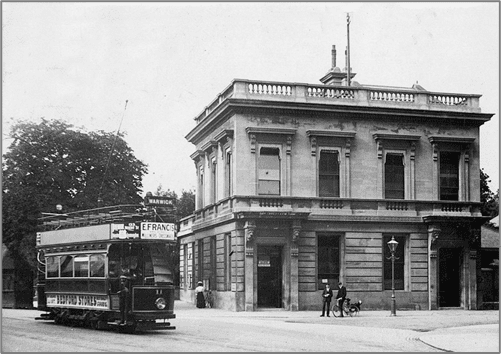
With a single storey extension at the rear. Collection of Alan Griffin
The first Post Office in Leamington is thought to have been the cottage home of the village cobbler and postmaster, later the discoverer of the first commercial spring, Benjamin Satchwell. By 1829, with the Spa town developing very rapidly and the demand for postal services with it, an independent local post office was set up under postmaster George Bevington at 29 Bath Street, within the chemist’s shop of Messrs Beasley and Jones. Postal charges were still exorbitant for all but the very wealthy but, ten years on, business had increased to such an extent that the staff of twelve struggled to cope: bigger premises became essential. The Post Office moved to 41/43 Bath Street, and then in 1846, a new Post Office with a porticoed entrance supported by six columns, was opened almost opposite the Parthenon. This had letter boxes to either side of the door, and a clock in the window, showing standard Post Office time. By 1870 Leamington postal business again required bigger premises, and a new building opened with a staff of twenty at the corner of Priory Terrace. No 1 Priory Terrace, Grade II Listed only in 2014, was built in an Italianate style in 1870 to designs by James Williams, a prolific contemporary Post Office architect. Edward Cropper added an extension at the rear towards the river in 1911.
The 1870 Post Office is a good quality and well-detailed rectangular late-19th century public building, limestone clad with a slate-covered roof. It is four bays wide, the ground floor rusticated with plain bands. The front elevation has two sash windows flanked by door surrounds with hoods on lion’s head brackets. The left-hand door surround includes a stone plaque under the hood reading ‘POST OFFICE’. The first floor sash windows have architraves with console-bracketed cornices and blind balustrade aprons. The main entablature consists of a dentilled cornice and balustrade parapet with a hipped slate roof. The original two-storey building housed the town post office on the ground floor, offices on the first floor and a single-storey sorting office topped by a glass roof lantern to the rear.
The Listing citation confirms that “James Williams’ Post Office forms part of an important group of listed buildings including the Church of All Saints (Grade II*), and its Italianate style complements well the surrounding character of this Regency spa town.”
By the middle of the 1890s, there were 170 staff dealing with 170,000 letters and 5,500 parcels per week. Once introduced, telegrams, money orders and postal orders played an increasingly significant role in the business. Post Office Regulations governing postal deliveries, and office opening times were published in the local press, – a far cry from services available in 2018, even with the Internet. There were three postal deliveries per day, including weekends, and the chief Post Office remained open until 9 pm on weekdays. On Sundays, the office closed at 10 am, allowing all to attend church services. Once Pillar Boxes were introduced at six selected sites in the town, there were five collections per day and an evening collection on Sundays. “Receiving Houses” were set up at South Parade (now Clarendon Avenue) and Upper Parade, and private boxes were available on payment of one guinea per year. By the turn of the century, in addition to postal delivery men and those operating counter services, messenger and telegraph boys were employed in great numbers. In keeping with other local businesses, there were annual staff dinners and outings (as far away as Oxford in 1900).
During the Great War, as men were called up, women began to be employed delivering telegrams as well as general deliveries. (They did two journeys per day in all weathers, on foot.) In World War Two, GPO staff had their own division of the Home Guard. A further floor was added during World War Two, to extend the telephone exchange accommodation which had taken up the first floor since about 1911. Although there have been many internal alterations, as would be expected for a commercial building, a number of original features survive including the main ornate cast-iron staircase, chimney breasts and some decorative ceiling plaster work.
To the east, there are also the 1970s sorting office and vehicle depot block, which are not included in the Listing.
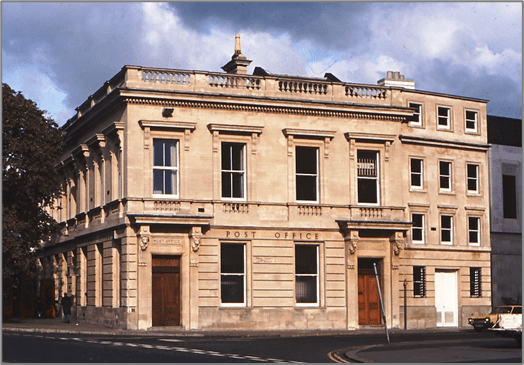
Sadly, as part of a major Post Office rationalisation and improvement programme, the business at 1 Priory Terrace closed on 14 December 2013 and was transferred to the nearby supermarket in Bath Street. As the building lay desolately awaiting either demolition or conversion, strenuous efforts have been made to protect it as part of the grouping including the Parish Church and Victoria Terrace. The upper floors continue to be used as offices. In the Autumn of 2017 the ground floor became home to a contemporary art gallery but in 2018 it is advertised for short let.
This page is one of many which are based on articles in our book entitled A History of Royal Leamington Spa in 100 Buildings which was published in 2018 and is no longer in print.
ACKNOWLEDGEMENTS as presented in the book