This railway station is the sole survivor of the four railway stations that served the town at some time. Two earlier stations not on this site were constructed: one off Rugby Road for the London and Birmingham Railway Company in 1844 (see article) and the other off Avenue Road was opened in 1854 for the London & North Western Railway, who by then had absorbed the London and Birmingham Railway Company. The Rugby Road station was replaced by one on Warwick New Road.
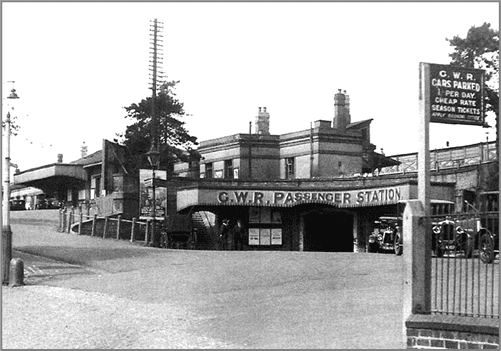
The railway line from Paddington was authorised for the Birmingham and Oxford Junction Railway in 1846 and the company became part of the Great Western Railway in 1847. The line was mixed gauge (broad and standard) from Banbury and opened in 1852. It was engineered by Isambard Kingdom Brunel and completed the route from Birmingham to London (Paddington).
When the Great Western Railway reached Leamington in 1854 the company built a station on the site of what was then known as Eastnor Terrace, having demolished a row of at least 13 imposing, mostly unfinished, houses. Early maps and timetables of the town actually identify the station as Eastnor Terrace Station.
There were two GWR locomotive sheds in the town. One was to the west of the station in Old Warwick Road and the other was opposite the Eagle recreation ground; the latter was the last to close in 1965.
Design, construction and completion of this line were not easy. The LNWR, GWR and local people were very reluctant to cooperate. The grand opening ceremony was delayed because, incredibly, the train bringing guests from London collided with a goods train on the way.
For many years there were frequent trains from Leamington to Paddington in London and Snow Hill in Birmingham.
It is thought that the station remained virtually unaltered until 1935, when in September the Great Western announced their intention to reconstruct the station. In October 1936, E C Jordan & Son of Newport, South Wales carried out the construction of a subway linking it to the station of Avenue Road also called “Leamington Spa” by the London, Midland and Scottish Railway. In 1937 Holliday and Greenwood Ltd. of Buckingham Palace Road, London with their works in Battersea, were awarded the contract to construct the new station buildings and platforms. From 1913 it was known as “Leamington Spa Station” whilst its rivals had already had various name changes all being permutations reflecting the proximity of Warwick, Leamington and Milverton. Work was completed on the station by 1939, to a design in Art Deco style by P E Culverhouse of the GWR Chief Civil Engineer’s Office. By 1946 additional work to extend and alter the platforms was found to be necessary, particularly the removal of a loading dock siding at the east end of the ‘down’ platform. This facility had enabled ‘hunters’, brought down for the season, to be off-loaded and walked down to street level by a spiral ramp which still exists. This was also used by visiting circuses in the 1950s and 1960s.
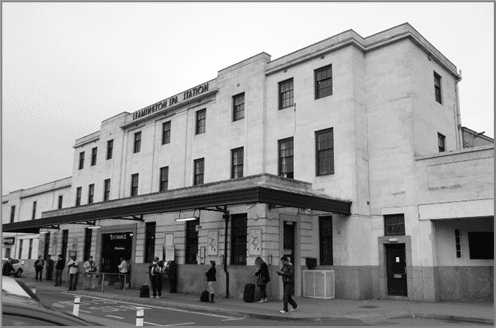
Under the control of British Railways (Western Region) the station was designated Leamington Spa (General). It was not until 2003, when a number of alterations from the original design had taken place that Listed Grade II status was awarded to this building reflecting some of the Art Deco features of the buffet, waiting rooms and Booking Hall. The frontage is of Portland stone and polished granite. Whilst outwardly little has changed except for the lettering on the frontage, the layout at ground level of the Booking Hall has changed. The history in the formal listing makes reference to a whole range of architectural features including ‘GWR’ scrolled platform benches. Management of Chiltern Railways has been very supportive of a group of volunteers called the Friends of Leamington Station who encourage restoration of features of the station and maintain the extensive gardens. The gardens were awarded the title of Best British Garden in 2009.
Footnote on the Leamington and Warwick Tramway
The story of travel in Leamington with steel wheels on steel rails would not be complete without a brief story of the trams.
Horse-drawn Trams.The idea for a tramway was born when an Act of Parliament authorized the Leamington & Warwick Tramways & Omnibus Company to construct it in 1879. The system was engineered by a local man, John Fell, and opened for business on 21st November 1881. It went for just three miles from Station Approach off Avenue Road by way of Spencer Street, the Parade, Warwick Street and Emscote Road to the other terminus on High Street, Warwick, between the Warwick Arms Hotel and Lord Leycester Hospital.Two leading entrepreneurs in the tram company were well-known Leamington Aldermen and the first trams were therefore nicknamed “Wackrill & Bright’s Rattlesnakes”. The route was mainly single track of standard gauge (4 ft 8½ in) with a number of passing places, including Victoria Terrace, Milverton Station and St John’s in Warwick.
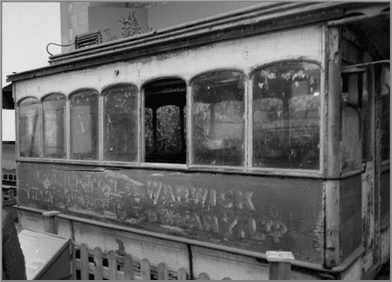
The tramcars were double-decked and were normally hauled by two horses. Over time there were six or seven tramcars from three different manufacturers and they operated with about 13 minutes’ headway. The depot and stables were in Coten End, Warwick, opposite the end of Cherry Street, very near the site of the small Sainsbury’s shop in 2018.
Electrification of the Trams. Brush Electric Traction bought the system in 1900 and it was converted to power from overhead cables. Track was relaid as double-track with a narrower gauge of 3 ft 6 in and a power generating station was built on the Warwick side of the canal bridge on Emscote Road located on what is now Tesco supermarket. Later this power station was to become a much larger plant which fed into the national grid.
There was much sadness locally at the passing of the horse-drawn trams and a special “In Memoriam” postcard was printed. Horse Tram No 1 is now in the National Tramway Museum at Crich in Derbyshire in unrestored condition and Tram No 8 is in use at Beamish Museum in County Durham.
The electric service started on 12th July 1905 and up to 12 Brush trams were available, six of which were second-hand and came from Taunton. A new depot was built on the land adjacent to the power generating station. In 1912 the tramway company also provided electricity from its generators for lighting. The company was purchased from Brush by Balfour Beatty and Company who rapidly expanded the lighting part of the company into the Midland Light and Power Company. The office of the company was at No 14 Parade in 1920.
Competition from more flexible omnibus services led to the end of the tram era with the last tram running on 16th August 1930. Many of the stands for the overhead cables were converted for use as lamp-posts, most notably seen in many postcards of the Parade.
This page is one of many which are based on articles in our book entitled A History of Royal Leamington Spa in 100 Buildings which was published in 2018 and is no longer in print.
ACKNOWLEDGEMENTS as presented in the book